

ACCA Financial Accounting (FA) is where bookkeeping becomes financial reporting. You learn how transactions enter the accounting system, how errors and year-end adjustments are processed, and how the resulting figures become financial statements for a single entity or a group.
The subject is cumulative. If double entry is weak, reconciliations become guesswork; if adjustments are weak, financial statements will be wrong; if statement relationships are unclear, consolidation and ratio interpretation become much harder. Passing FA therefore depends on building the accounting chain in the right order and practising it until the logic is automatic.
This is the FA exam-pass study guide. It explains what to learn and how to approach double entry, adjustments, objective questions and the two Section B areas. For the separate resource-by-resource workflow, see How to Study for ACCA FA Using OpenTuition.
Reviewed 15 July 2026 for the ACCA FA syllabus applicable from September 2026 to June 2027.
1. Understand what FA is really examining
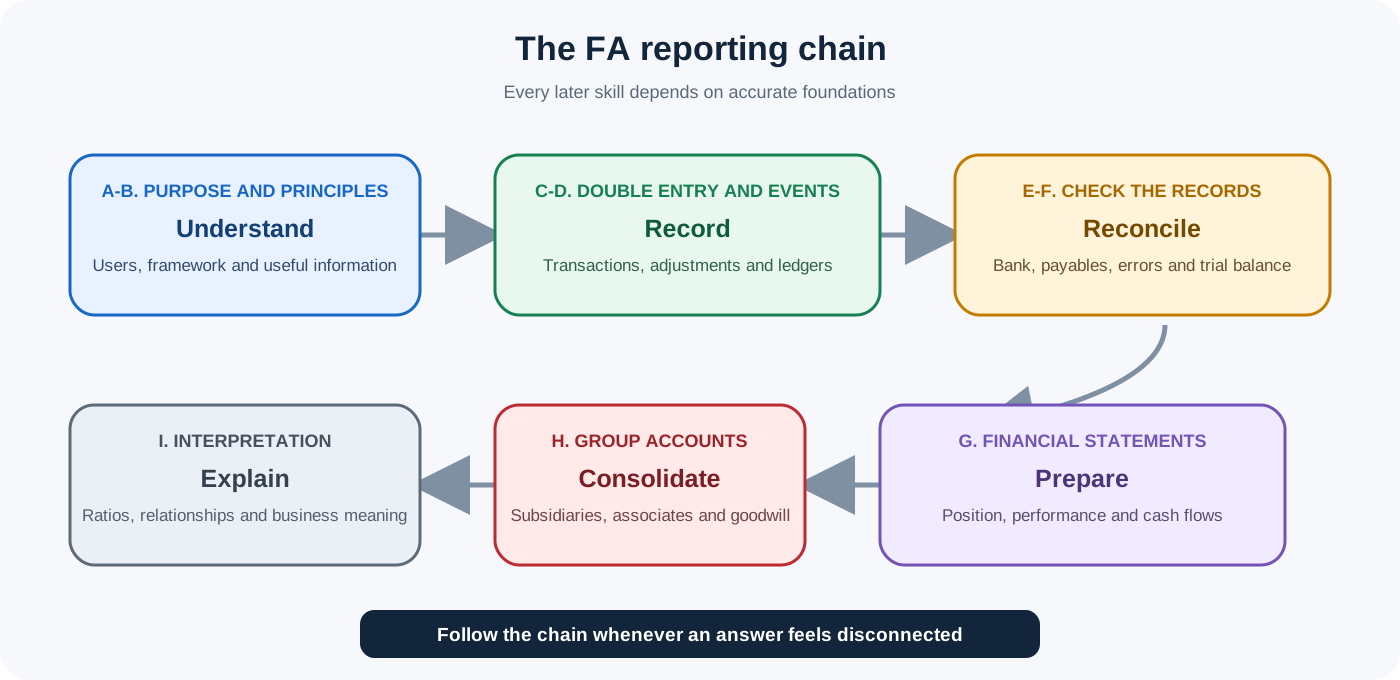
FA examines a connected reporting process. Principles determine what should be recorded; double entry records it; reconciliations and adjustments correct it; the trial balance organises it; and financial statements communicate the result.
A-B. Reporting context and principles
Know the users and purposes of financial statements, the regulatory framework, the elements of financial statements, accounting concepts and the qualitative characteristics of useful information. These ideas explain why a transaction receives a particular treatment.
C-F. The accounting engine
Master business documents, accounting systems, journals, ledger accounts, double entry, transaction recording, reconciliations, the trial balance, error correction and suspense accounts. This is the foundation beneath every later topic.
G. Single-entity financial statements
Prepare statements of financial position, profit or loss and other comprehensive income, cash flows and relevant disclosure notes. Apply year-end adjustments, events after the reporting period and incomplete-record techniques.
H. Basic consolidated financial statements
Understand control, subsidiaries, non-controlling interests and associates. Prepare basic consolidated statements, goodwill and the main intra-group adjustments.
I. Interpretation
Calculate profitability, liquidity, efficiency and financial-position ratios, connect the ratios to each other and explain what they mean for the relevant user.
FA pass rule: do not memorise an isolated answer. Follow it from the underlying fact, through the double entry, to its effect on profit, assets, liabilities, equity and cash.
2. Know the exam structure
FA is a two-hour on-demand computer-based exam. All questions are compulsory and the pass mark is 50%.
| Section | Structure | Marks | Study implication |
|---|---|---|---|
| A | 35 objective-test questions worth 2 marks each | 70 | The whole syllabus is examinable, so broad technical coverage matters. |
| B | 2 multi-task questions worth 15 marks each | 30 | The MTQs test accounts preparation and consolidation, sometimes with interpretation. |
The average is 1.2 minutes per mark. A sensible control is about 80 to 85 minutes for Section A and 35 to 40 minutes for Section B. Do not sacrifice several accessible questions to rescue one difficult two-mark item.
3. Make double entry your accounting language
Do not learn debits and credits as arbitrary lists. Begin with the accounting equation and the type of each account:
- assets and expenses normally increase with a debit;
- liabilities, equity and income normally increase with a credit; and
- decreases use the opposite side.
Drawings and dividends reduce equity, not operating profit. Classify both accounts, then post equal debits and credits in the correct direction.
Practise translating in both directions: from a narrative to a journal entry, and from a ledger entry back to the business event. This prevents mechanical rules from collapsing when the wording changes.
4. Master the major adjustment families
| Family | Question to ask |
|---|---|
| Accruals and prepayments | What income and expense belongs to this reporting period, regardless of cash or invoice timing? |
| Inventory and cost of sales | What closing inventory exists, what cost belongs to goods sold and is inventory limited to the lower of cost and net realisable value? |
| Non-current assets | Is expenditure capital or revenue; what depreciation, amortisation, revaluation or disposal entry is required? |
| Receivables | Which debt is irrecoverable and what closing allowance is required? |
| Provisions and events | Is there a provision, contingent item, adjusting event or non-adjusting event, and is recognition or disclosure required? |
| Company finance | How do shares, dividends, interest and tax affect the ledgers and statements? |
Always calculate the correct closing position first, then compare it with what is already recorded. The difference is the adjustment. This is safer than trying to remember whether every adjustment should be added or subtracted.
5. Use OpenTuition as an active study system
- Read the matching chapter in the free FA notes.
- Watch the corresponding FA lecture and complete each ledger or statement before the tutor.
- Close the solution and reproduce the entry, reconciliation or statement from a blank page.
- Attempt the related FA practice questions without support.
- Record the exact reason for each error and reattempt a new question later.
Add a current revision kit for intensive exam-standard practice. Reading entries and watching statements being prepared may feel fluent, but the exam tests whether you can perform the process yourself.
6. Treat reconciliations as investigations
For a bank reconciliation, update the bank general ledger for the entity's omissions and errors first. Outstanding timing items and bank errors explain the difference with the bank statement; they do not automatically change the entity's ledger. The corrected ledger balance is the figure used in the financial statements.
For a payables reconciliation, compare the payables ledger with supplier statements and identify missing invoices, credit notes, timing differences and posting errors. Ask which record is wrong before making an entry.
A balanced trial balance does not prove the records are error-free. Complete omissions, errors of principle and equal errors on both sides may leave it balanced. A suspense account temporarily holds an unexplained difference; clear it only through the correct journal entries.
7. Use one method for every year-end adjustment
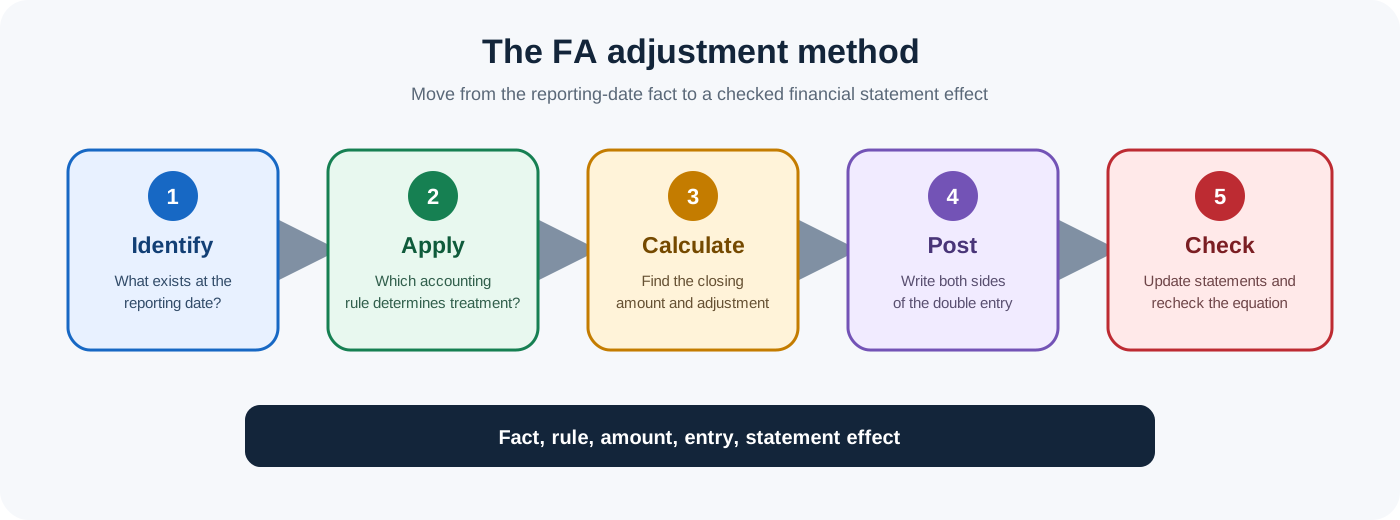
After posting the entry, name every financial statement line affected and the direction of the change. Then check that the accounting equation still balances. This final step often reveals a missing second entry or a figure placed in the wrong statement.
The CBE marks the response entered, so clear rough workings are for your control rather than for method marks. Keep calculations labelled and enter the requested amount, sign and format only after completing the adjustment.
8. Prepare for Section A breadth
Section A may use multiple choice, multiple response, number entry or multiple-response matching. Mix narrative and numerical questions from the start. Technical knowledge and bookkeeping mechanics must work together.
The latest examiner's report highlights useful habits:
- separate items that change the entity's bank ledger from items used only in the bank reconciliation;
- understand relationships between ratios instead of treating each formula independently;
- do not assume a true-or-false set must contain a mixture of answers;
- distinguish performance for a period from financial position at a date; and
- manage time across the paper and attempt every question.
9. Prepare the accounts-preparation MTQ
The accounts-preparation task may involve a sole trader or limited company and may require a full statement or selected extracts. Practise standard layouts and precise titles: a statement of financial position is prepared as at a date, while a statement of profit or loss is prepared for the year ended.
Be ready to:
- adjust a trial balance using journal entries;
- calculate depreciation, inventory, accruals, allowances, provisions and tax;
- place balances under the correct statement heading;
- prepare a statement of cash flows or extracts; and
- derive missing figures using ledgers, cash summaries, the accounting equation or profit percentages.
For cash flows, understand direction rather than memorising signs. An increase in inventory or receivables normally absorbs operating cash, while an increase in payables normally releases it. Separate non-cash disposal profits from the actual investing cash receipt.
10. Prepare the consolidation MTQ
Build consolidation from a fixed sequence: establish the group relationship and acquisition date, calculate net assets, calculate goodwill and non-controlling interests, calculate group retained earnings, process intra-group adjustments and then prepare the required statement or extract.
- Add a subsidiary's assets and liabilities line by line in full; do not use proportional consolidation.
- Eliminate the parent's investment in the subsidiary and exclude the subsidiary's share capital and share premium.
- Include the group's share of the subsidiary's post-acquisition results, not its pre-acquisition retained earnings.
- Eliminate intra-group balances, trading and unrealised profit.
- Time-apportion the subsidiary's results if control began partway through the year.
For an associate, understand significant influence and the basic principle of the equity method rather than consolidating assets and liabilities line by line.
11. Turn examiner feedback into final-revision priorities
- Cover the full syllabus. Section A makes selective study unsafe.
- Use the actual CBE formats. Practise number entry, drop-down lists and matching as well as conventional questions.
- Know statement presentation. Correct figures still need the correct statement, heading and reporting date.
- Practise journal adjustments. Accounts preparation depends on applying double entry to trial-balance figures.
- Learn cash-flow mechanics. Working capital, tax, dividends and disposals require linked calculations.
- Learn consolidation as a sequence. Goodwill, group reserves, NCI and intra-group adjustments should not be improvised.
12. An eight-week FA study plan
| Week | Main focus | Required output |
|---|---|---|
| 1 | Purpose, principles, documents and double entry | Post mixed journals and explain their statement effects. |
| 2 | Sales, purchases, cash, sales tax and inventory | Complete ledgers, cost-of-sales and inventory questions. |
| 3 | Non-current assets and intangibles | Practise capitalisation, depreciation, revaluation, disposal and amortisation. |
| 4 | Accruals, receivables, provisions and company finance | Complete mixed year-end adjustment sets. |
| 5 | Reconciliations, errors and trial balance | Prepare bank and payables reconciliations and clear suspense accounts. |
| 6 | Single-entity statements and cash flows | Prepare timed statements and extracts from adjusted trial balances. |
| 7 | Consolidation and interpretation | Complete goodwill, group statement and ratio questions. |
| 8 | Section B practice and full mocks | Complete timed exams, analyse errors and reattempt weak families. |
13. Become exam-ready
Use the OpenTuition FA revision mock and ACCA's current specimen and practice materials under the two-hour limit. Classify each error as principle, account type, double entry, calculation, adjustment, statement placement, consolidation step, interpretation or time pressure.
You are ready when you can post unfamiliar transactions, process mixed adjustments, prepare both Section B families and achieve a safe pass in timed mocks without relying on notes or memorised answer patterns.
14. FA resources to use
- OpenTuition ACCA FA home
- Free FA notes
- Free FA lectures
- FA practice questions
- FA revision lectures
- FA revision mock exam
- FA flashcards
- Ask the FA Tutor forum
- OpenTuition AI Tutor for FA
- ACCA FA/FFA syllabus and study guide: September 2026 to June 2027
- Latest ACCA FA/FFA examiner's report: September 2024 to August 2025
- ACCA FA/FFA essentials on one page
The FA pass formula: understand the fact, apply the rule, post both entries, update the statements and check that the whole accounting story still makes sense.