
ACCA Corporate and Business Law (LW) is not a test of whether you can write like a lawyer. It tests whether a future accountant can recognise the relevant legal rule, distinguish closely related concepts and apply the rule to a short business scenario.
One pass guide works for both LW-ENG and LW-GLO because the exam structure, question technique and company-law core are shared. The front of each syllabus is different, however, so you must choose your variant first and use the correct notes, lectures, questions and mock throughout.
This is the LW exam-pass study guide for ENG and GLO. For the separate resource-by-resource workflows, see How to Study for LW-ENG Using OpenTuition or How to Study for LW-GLO Using OpenTuition.
Reviewed 15 July 2026 for the ACCA LW-ENG and LW-GLO syllabuses applicable from September 2026 to June 2027.
1. Choose your LW variant before you begin
Both variants lead to the same kind of computer-based exam, but the early syllabus areas are not interchangeable.
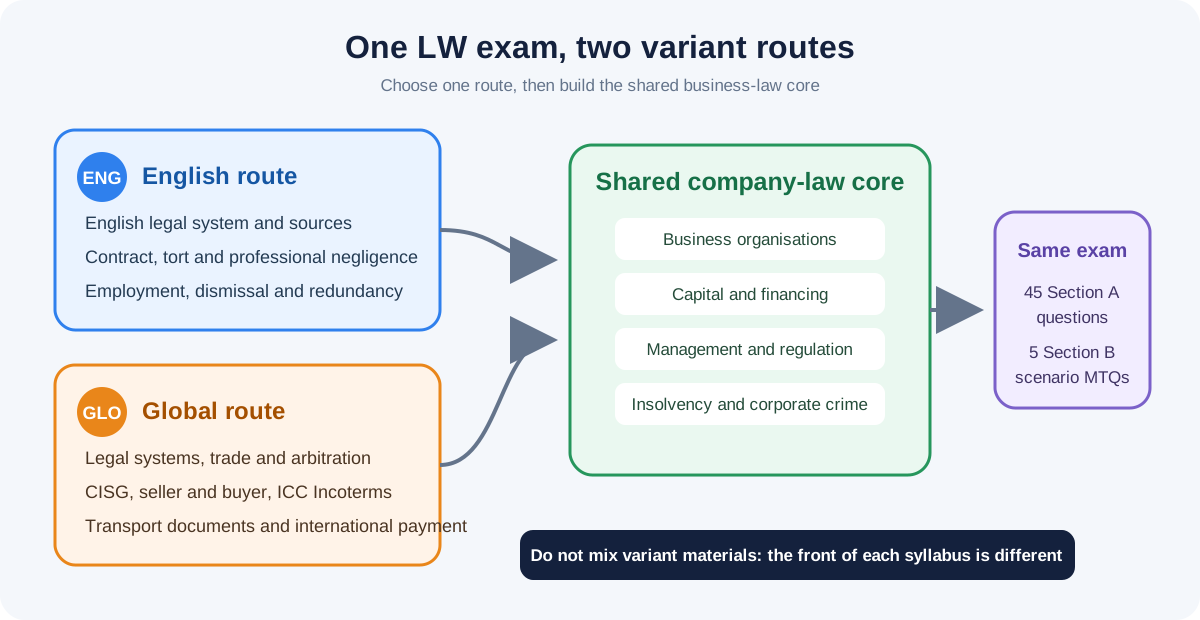
| Variant | Distinctive early syllabus | Who should use it |
|---|---|---|
| LW-ENG | English legal system, contract, tort and employment law | Students registered for the English variant |
| LW-GLO | International legal systems, arbitration, international sales, transport and payment | Students registered for the Global variant |
Do not revise both routes. Confirm the variant in your ACCA booking, then label your notes and question log ENG or GLO. Mixing contract rules, terminology or international instruments can turn sound knowledge into the wrong answer.
2. Know the exam structure
LW-ENG and LW-GLO are two-hour computer-based exams. All questions are compulsory and the pass mark is 50%.
| Section | Structure | Marks | What it tests |
|---|---|---|---|
| A | 25 objective-test questions worth 2 marks and 20 worth 1 mark | 70 | Accurate knowledge across the whole syllabus |
| B | 5 scenario-based multi-task questions worth 6 marks each | 30 | Analysis and application of law to facts |
The average is 1.2 minutes per mark. Use about 80 to 85 minutes for Section A and 35 to 40 minutes for Section B, retaining a few minutes for flagged questions. If one item becomes a battle, eliminate what you can, choose an answer and move on.
3. Build law as rules, not as pages of prose
For every topic, reduce your learning to a usable structure:
- Trigger: what fact makes this legal issue relevant?
- Rule: what definition, test, duty, procedure or prohibition applies?
- Conditions: what elements must all be satisfied?
- Exception: when does the normal rule not apply?
- Consequence: what right, remedy, liability or procedure follows?
A legal term is not learned until you can distinguish it from its nearest rival. Pair offer with invitation to treat, employee with self-employed, member with director, fixed charge with floating charge, administration with liquidation and fraudulent trading with wrongful trading. GLO students should build the same contrasts for the international rules in their variant.
LW pass rule: learn the precise legal distinction, then practise recognising the decisive word or fact that activates it.
4. Master the shared company-law core
The final five capabilities are common to ENG and GLO. They form one connected story about creating, financing, operating and, if necessary, ending a business organisation.
- Business organisations: agency, partnerships, corporate personality, limited liability, incorporation, promoters and company constitutions.
- Capital and financing: classes and issues of shares, loan capital, charges, capital maintenance and lawful distributions.
- Management and regulation: types of director, appointment and removal, directors' powers and duties, company officers, meetings and resolutions.
- Insolvency: administration, voluntary and compulsory liquidation, grounds, procedures and the order of payment.
- Fraudulent and criminal behaviour: insider dealing, market abuse, money laundering, bribery, corporate failure offences, fraudulent trading and wrongful trading.
Study these as a lifecycle. Ask who has authority, whose interest is protected, which procedure is available and what changes when the company becomes insolvent.
5. Follow the LW-ENG route accurately
ENG students begin with the English legal system and sources of law, including the court structure, legislation, delegated legislation, precedent, statutory interpretation and relevant human-rights principles. Current examinable law matters, so use materials for your sitting rather than an old law summary.
Then master the law of obligations:
- formation and content of contracts, including offer, acceptance, consideration, intention, terms and privity;
- discharge, breach, common-law and equitable remedies;
- tort, passing off, negligence, causation, remoteness and professional duty of care; and
- employment status, the employment contract, dismissal, redundancy and remedies.
Cases help anchor a principle, but a case name without the rule is useless. Learn what legal test the authority demonstrates and which fact in a scenario makes that test relevant.
6. Follow the LW-GLO route accurately
GLO students begin with legal systems, the relationship between state institutions, international legal regulation, international organisations and arbitration. Learn the purpose and scope of each instrument or institution rather than treating every international name as interchangeable.
Your variant-specific sequence then covers:
- the UN Convention on Contracts for the International Sale of Goods, including formation, seller and buyer obligations, breach, damages and other remedies;
- ICC Incoterms and the allocation of cost, responsibility and risk;
- international commercial arbitration and the UNCITRAL Model Law;
- bills of lading and international transportation; and
- bank transfers, bills of exchange, promissory notes, letters of credit and related payment rules.
Create comparison tables for similar parties, documents and stages. The latest GLO examiner's report shows that near-identical wording can expose weak knowledge of who must act, whom they must pay and when the obligation arises.
7. Use OpenTuition as an active study system
- Choose the ENG or GLO view on the OpenTuition LW home.
- Read one chapter of the correct variant notes and turn each heading into a question.
- Watch the matching lecture, pausing before the tutor states the rule or conclusion.
- Close the material and reconstruct the rule, conditions, exception and consequence.
- Attempt the matching practice questions without notes and record why every rejected option is wrong.
Use flashcards for definitions and short distinctions, not as a substitute for scenario practice. Add a current revision kit for intensive exam-standard questions and use the OpenTuition forum when a distinction still feels uncertain.
8. Prepare for Section A breadth
With 45 questions, selective study is unsafe. The latest examiner reports warn that ignoring difficult topics is extremely risky, especially because the same topic may appear in Section B.
For each objective question:
- identify the legal area before looking for a familiar phrase;
- circle qualifiers such as not, two, every, only, before, after and unless;
- treat each statement separately in a multiple-response question;
- eliminate options by applying the complete rule, not by choosing what sounds fair; and
- check numbers, time limits, voting thresholds, parties and procedural stages precisely.
Two-mark questions tend to be more complex than one-mark questions. Practise both under time pressure and do not expect every correct answer to look immediately obvious.
9. Apply the FACT method in Section B
Section B scenarios are short, but they test analysis and application. You are not writing an essay; the CBE marks the response selected or entered. The legal reasoning still has to happen before you click.
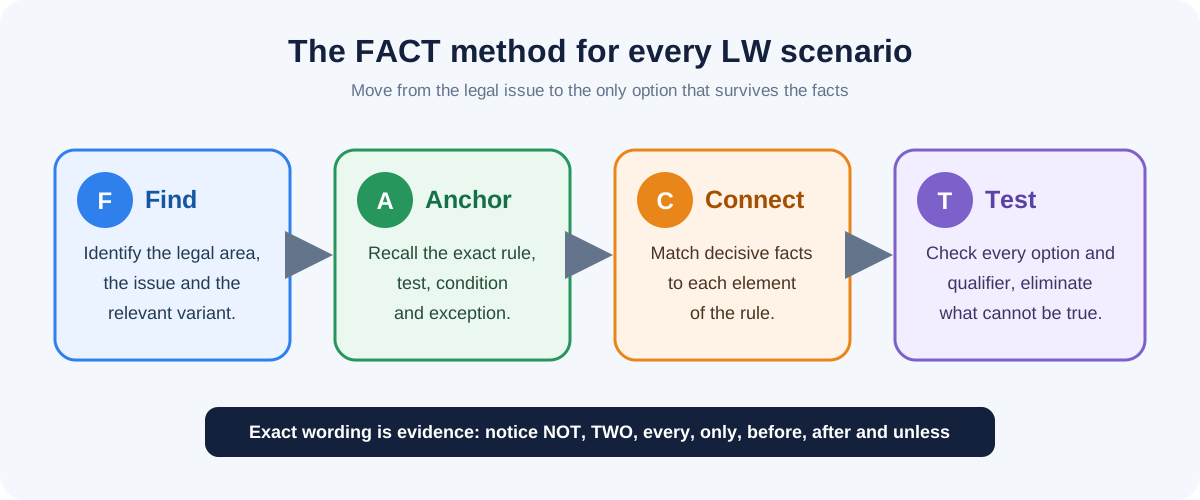
Suppose members vote to end a company that cannot pay its debts. The word voluntarily is relevant, but insolvency is decisive when distinguishing the available liquidation procedures. FACT prevents one attractive word from overpowering the complete legal rule.
Read the scenario once for the story, read each task, then return to the exact facts needed for that task. Different tasks may test different people or events in the same scenario.
10. Turn examiner feedback into revision priorities
- Read every word closely. The latest ENG and GLO reports repeatedly identify language as central to reaching the correct answer.
- Do not avoid difficult chapters. Familiar topics cannot compensate for gaps across a broad Section A.
- Learn legal detail. Similar roles, procedures and conditions cannot always be reconstructed from common sense.
- Practise application. Candidates generally perform better on Section A than the analysis/application work in Section B.
- Use the correct variant. Shared company-law questions do not make the ENG and GLO opening sections interchangeable.
11. Use a six-week LW study plan
| Week | Main focus | Required output |
|---|---|---|
| 1 | ENG legal system, or GLO legal systems and arbitration | Create rule-and-contrast sheets for every chapter. |
| 2 | ENG obligations and employment, or GLO sales, transport and payment | Complete mixed variant-specific objective questions. |
| 3 | Agency, partnerships, incorporation and constitutions | Apply corporate personality and authority rules to scenarios. |
| 4 | Shares, loan capital, directors, officers and meetings | Complete timed question sets on rights, duties and procedures. |
| 5 | Insolvency and corporate criminal behaviour | Build procedure comparisons and complete Section B sets. |
| 6 | Whole-syllabus revision and mocks | Complete at least two timed exams and reattempt every weak area. |
12. Make your question log legal, not emotional
After each set, classify every error as missing rule, confused terminology, missed exception, inaccurate detail, wrong variant, misread qualifier, failed application or time pressure. Write the corrected rule in one sentence and add the fact that would change the answer.
Reattempt a different question on the same distinction several days later. Recognition of the old answer is not proof that the rule is now usable.
13. Become exam-ready
Use the correct LW-ENG revision mock or LW-GLO revision mock, plus ACCA's current specimen and practice tests, under the full two-hour limit. Attempt every question.
You are ready when your marks are stable across the whole syllabus, you can explain why plausible distractors are wrong and your Section B decisions are based on the exact rule and decisive facts rather than instinct. The LW pass formula: correct variant, exact rule, decisive words, applied facts and tested options.
14. LW resources to use
- OpenTuition ACCA LW home and variant selector
- LW-ENG: notes, lectures, practice questions and flashcards
- LW-GLO: notes, lectures, practice questions and flashcards
- Ask the ACCA LW Tutor or use the AI Tutor for LW
- ACCA LW-ENG syllabus: September 2026 to June 2027
- ACCA LW-GLO syllabus: September 2026 to June 2027
- Latest ACCA LW-ENG examiner's report and LW-GLO examiner's report
- ACCA LW essentials on one page