

ACCA Business and Technology (BT) introduces how organisations work, how people and systems contribute to performance, and why professional accountants must act ethically. It is broad rather than technically deep.
That breadth is the main challenge. Students often assume that business, teamwork and communication questions can be answered using common sense. The exam uses precise definitions, models and distinctions. To pass reliably, you need basic knowledge across every syllabus area and enough question practice to apply it accurately.
This is the BT exam study guide. It explains what to learn and how to turn broad knowledge into marks. For the separate resource-by-resource workflow, see How to Study for ACCA BT Using OpenTuition.
Reviewed 15 July 2026 for the ACCA BT syllabus applicable from September 2026 to June 2027.
1. Understand what BT is really examining
BT asks whether you understand a business as a complete system. An organisation operates in an external environment, chooses a structure, uses people and technology, controls financial information and remains accountable to stakeholders. Professional ethics should influence every part of that system.
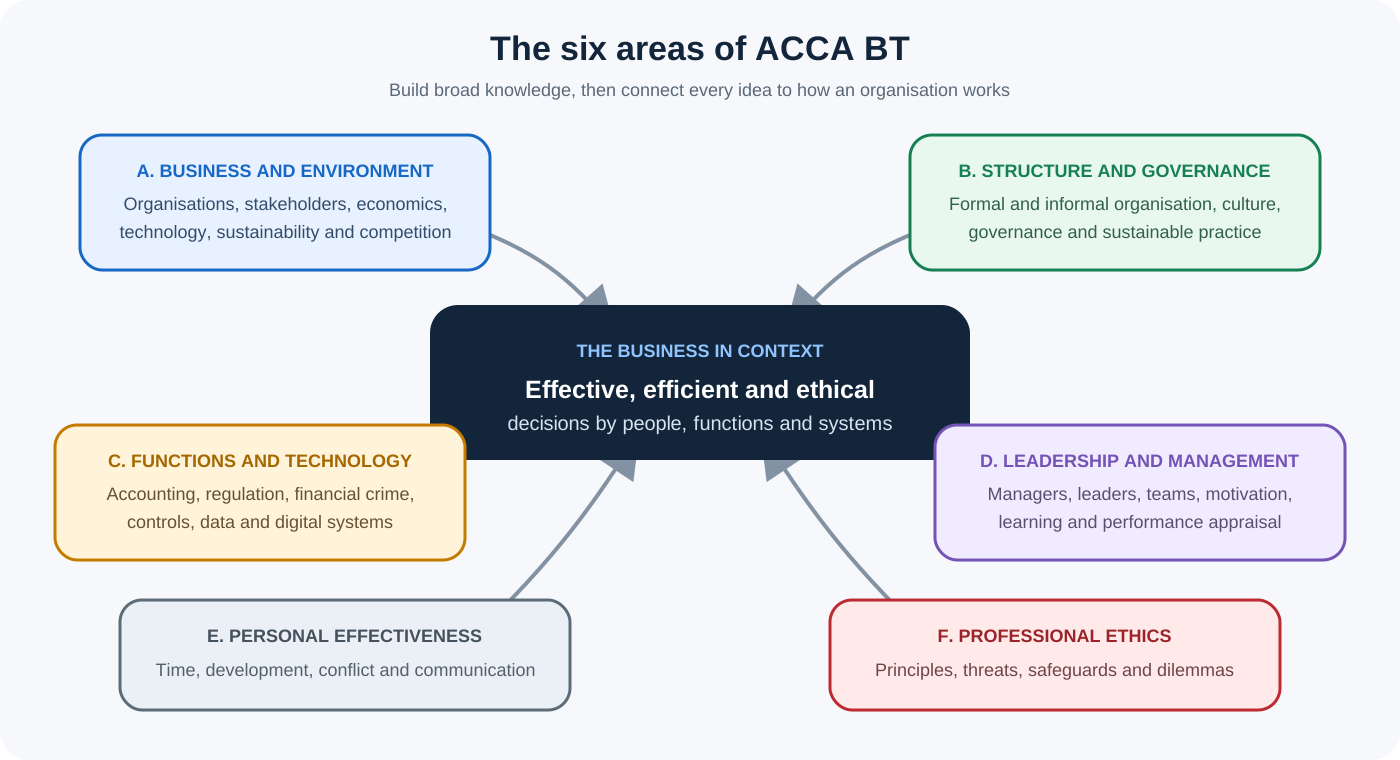
A. The business organisation and its external environment
Learn why organisations exist, their different types and sectors, stakeholder interests and power, and the political, legal, economic, social, technological, environmental and competitive influences on them. This includes macroeconomics, microeconomics, sustainability, SWOT, the value chain and competitive forces.
B. Organisational structure, culture, governance and sustainability
Understand formal and informal organisation, entrepreneurial, functional, divisional, matrix and boundaryless structures, centralisation and decentralisation, organisational culture, committees, agency and governance, corporate social responsibility and sustainable practice.
C. Business functions, regulation and technology
Know how accounting relates to other business functions, the purposes of financial and management accounting, audit and assurance, financial reporting, regulation, fraud, money laundering, financial systems and internal control. Technology includes cloud computing, artificial intelligence, big data, analytics, blockchain and cyber security.
D. Leadership and management
Distinguish leadership, management and supervision. Learn the main management and leadership theories, individual and group behaviour, team roles and development, motivation, learning, training and performance appraisal.
E. Personal effectiveness and communication
This area covers time management, ineffective behaviour, competence and personal development, coaching, mentoring, counselling, workplace conflict and effective communication.
F. Professional ethics
Know the fundamental principles of integrity, objectivity, professional competence and due care, confidentiality and professional behaviour. Understand the public interest, professional regulation, corporate codes, ethical threats, dilemmas and safeguards.
BT pass rule: learn enough about every topic to recognise it, distinguish it from similar ideas and apply it to a short scenario. Do not become an expert in three areas while ignoring the other three.
2. Know the exam structure
BT is a two-hour on-demand computer-based exam. All questions are compulsory, all answers are objective and the pass mark is 50%. No written explanations or calculations are required, and a calculator is not needed.
| Section | Structure | Marks | Study implication |
|---|---|---|---|
| A | 16 one-mark and 30 two-mark objective questions | 76 | Any syllabus topic can appear, so breadth and fast retrieval matter. |
| B | 6 multi-task questions worth 4 marks each | 24 | There is one MTQ on each of the six syllabus areas. |
The average rate is 1.2 minutes per mark. Approximately 90 minutes for Section A and 30 minutes for Section B is a sensible control, but answer easier questions efficiently so you retain review time. Questions do not have to be attempted in numerical order.
3. Build breadth before depth
The current syllabus contains many definitions, models and writers. The aim is not to reproduce essays about them. You must recognise which idea fits a question and reject closely related distractors.
Use a syllabus tracker with three states:
- red: you cannot define the topic or recognise it in a question;
- amber: you know the definition but confuse it with another concept; and
- green: you can answer mixed questions on it without notes.
Every syllabus heading should reach at least amber before intensive revision. This prevents familiar topics such as teams or marketing from crowding out economics, governance, technology or ethics.
4. Use OpenTuition as an active study system
OpenTuition provides a complete BT teaching route. Use it actively:
- Read the relevant chapter in the free BT notes and identify its key distinctions.
- Watch the matching BT lecture, pausing to predict examples and classifications.
- Close the notes and write a short retrieval summary from memory.
- Attempt the related BT practice questions without support.
- Record the reason for each error, then reattempt the topic later in a mixed set.
Your error log should be precise. "Confused agency theory with stakeholder theory" or "treated a professional body's disciplinary action as a criminal prosecution" gives you something to correct. "Governance weak" does not.
5. Learn concepts in comparison families
Objective questions often place related terms beside each other. Revise them as comparisons rather than isolated definitions:
| Family | Distinctions to master |
|---|---|
| Organisation | Private, public and not-for-profit; tall and flat; centralised and decentralised; formal and informal. |
| Governance | Agency, stewardship and stakeholder approaches; executive and non-executive roles; different committees. |
| Finance | Financial and management accounting; internal and external audit; strategic, tactical and operational information. |
| People | Leader, manager and supervisor; group and team; motivation theories; coaching, mentoring and counselling. |
| Technology | Cloud, AI, big data, analytics and blockchain; risk, control and cyber-security responses. |
| Ethics | Five fundamental principles; five ethical threats; safeguards; regulatory, professional and legal consequences. |
For each pair, write one sentence explaining the difference and one short example. Then practise questions where the concept is not named in advance.
6. Turn theory into short scenario decisions
BT tests basic application as well as recall. A scenario may describe behaviour without naming the theory. Your job is to match facts to the defining feature.
Use this three-step process:
- Recall the rule: state the defining characteristic in your own mind.
- Find the evidence: identify the exact phrase in the scenario that matches or contradicts it.
- Check the alternatives: explain mentally why each plausible distractor fails.
For example, stakeholder power and interest are separate dimensions; a customer may have high power but limited interest. A person who is overloaded because they accept every request may lack assertiveness as well as prioritisation. A supervisor may motivate a team without controlling all departmental resources.
7. Use a controlled objective-question method
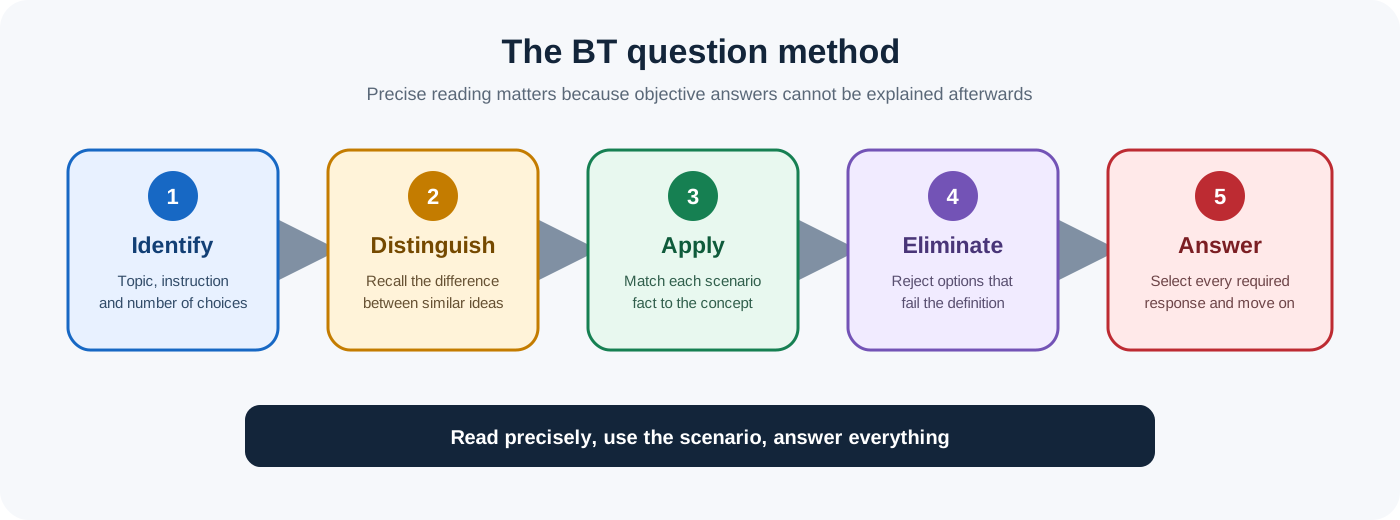
Read whether the question asks for the correct, incorrect, true or false statement and how many responses are required. In multiple-response and matching questions, selecting only some correct options does not earn partial marks, so check the complete set before submitting.
Do not invent hidden complications. ACCA states that these are not trick questions. If one answer clearly fits the definition and the others do not, select it and continue. When uncertain, eliminate options that contradict the model, choose the most defensible remaining answer and attempt every question.
8. Prepare specifically for the six MTQs
Section B contains one four-mark multi-task question from each syllabus area, with no crossover between the six areas. An MTQ may ask you to select several responses, match descriptions, click the appropriate part of a diagram or choose from drop-down lists.
Read the requirements before the scenario so you know which facts to find. Then:
- identify the syllabus area and topic;
- treat each task as a separate mark opportunity;
- use only facts relevant to that task;
- check how many selections are required; and
- review the whole MTQ before leaving it.
MTQs are not set at a higher intellectual level than Section A, but the additional reading and varied interfaces require practice in the CBE environment.
9. Turn the latest examiner feedback into habits
The September 2024 to August 2025 examiner's report reinforces several practical lessons:
- Study systematically. Workplace experience and common sense do not replace formal study.
- Cover all six areas. Economics and unfamiliar management theories often require extra attention.
- Know precise boundaries. Distinguish stakeholder power from interest, governance theories, management levels and the authority of professional bodies.
- Read scenarios carefully. A short phrase may identify the correct model or behaviour.
- Attempt everything. Use elimination when uncertain and return later to questions consuming too much time.
- Do not question-spot. Section A covers the syllabus broadly and Section B guarantees one MTQ from each area.
10. An eight-week BT study plan
| Week | Main focus | Required output |
|---|---|---|
| 1 | Organisations, stakeholders and external environment | Complete short topic tests and a stakeholder/economics comparison sheet. |
| 2 | Structure, culture, governance and sustainability | Classify structures and compare governance approaches. |
| 3 | Business and accounting functions, regulation and crime | Map functions, reporting roles, fraud and regulatory responsibilities. |
| 4 | Systems, controls and technology | Link risks to controls and technologies to business applications. |
| 5 | Leadership, management, teams and motivation | Build a comparison grid of the main theories and writers. |
| 6 | Personal effectiveness and communication | Apply time, conflict and communication principles to scenarios. |
| 7 | Professional ethics and whole-syllabus review | Practise principles, threats, safeguards and mixed objective sets. |
| 8 | MTQs and full mock exams | Complete timed mocks, update the error log and reattempt weak topics. |
11. Use mocks to become exam-ready
Use the OpenTuition BT revision mock and ACCA's current specimen exam under realistic conditions. Practise the actual question interfaces, complete every item and respect the two-hour limit.
Afterwards, group errors by syllabus area and by cause: missing knowledge, confused concepts, poor scenario reading, wrong number of selections or rushed timing. Relearn the smallest missing rule, then answer new questions on it. Rereading a familiar solution is not a reattempt.
You are ready when you can achieve a safe pass in mixed mocks, complete all six MTQ areas, explain the important comparisons without notes and finish with enough time to review flagged questions.
12. BT resources to use
- OpenTuition ACCA BT home
- Free BT notes
- Free BT lectures
- BT practice questions
- BT revision mock exam
- BT flashcards
- Ask the BT Tutor forum
- OpenTuition AI Tutor for BT
- ACCA BT/FBT syllabus and study guide: September 2026 to June 2027
- Latest ACCA BT/FBT examiner's report: September 2024 to August 2025
- ACCA BT/FBT essentials on one page
The BT pass formula is simple: broad coverage, precise distinctions, active recall and enough mixed question practice to recognise each concept in context.