

ACCA Advanced Performance Management (APM) is not passed by reproducing every model you have learned. It asks whether you can act as a strategic performance adviser: connect the organisation's objectives to evidence, judge whether its measures and systems are fit for purpose, anticipate behavioural consequences and recommend practical action.
The numbers matter, but the value lies in what you do with them. A correct ratio followed by a description of whether it rose or fell is not an APM evaluation. You must explain why the movement matters, what caused it, how reliable the evidence is and what senior management should conclude.
This is the APM exam-pass study guide. It covers the September 2026 to June 2027 syllabus, exam structure, performance reporting, data science and technology, strategic performance management, performance optimisation, professional skills and a ten-week plan. For the separate resource-by-resource workflow, see How to Study for ACCA APM Using OpenTuition.
Reviewed 16 July 2026. The 2026-27 syllabus has been materially restructured and contains additions and removals, so candidates carrying forward older notes must update them.
1. Understand what APM is really examining
A strong APM answer starts with the requested decision, not with a model. Identify the recipient and objectives, select relevant evidence, challenge weaknesses and finish with a justified conclusion.
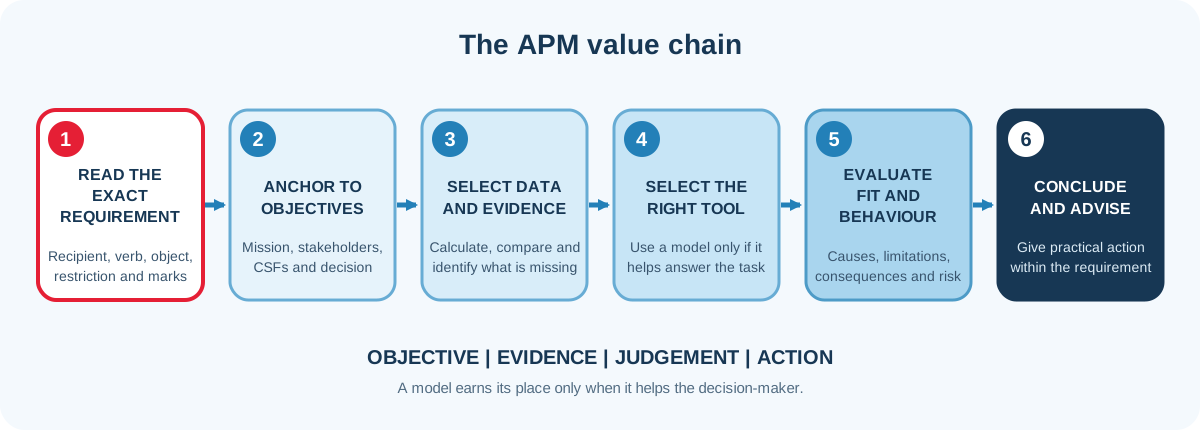
APM is about the measurement and management of performance, not about proposing a new business strategy whenever a result is poor. Recommend a strategic action only when the requirement asks for it. Often the real task is to evaluate a report, measure, system, technique or proposed change.
APM pass rule: objective, evidence, judgement and action. Every paragraph should help the recipient answer the exact question asked.
2. Know the exam structure and control your time
APM is a 3 hour 15 minute computer-based exam. All three questions are compulsory and the pass mark is 50%.
| Component | Current syllabus source | Marks | Answer target |
|---|---|---|---|
| Section A case study | Issues drawn across sections A and B | 40 technical + 10 professional skills | About 90 minutes |
| One Section B question | Section C: Performance reporting | 20 technical + 5 professional skills | About 45 minutes |
| One Section B question | Section D: Data science and technology for performance and insights | 20 technical + 5 professional skills | About 45 minutes |
The production targets leave about 15 minutes across the exam for navigating exhibits, planning and review. Professional skills are earned through the technical answer, so do not reserve separate writing time for them.
Section A requires a response in the role of an adviser to senior management, normally a report to the board. All four professional skills are examined. Each Section B question examines at least two of analysis and evaluation, scepticism and commercial acumen.
3. Learn the new syllabus as four connected systems
The technical syllabus applicable from September 2026 is organised into four areas. Sections A and B provide the strategic and operational foundations; Sections C and D are each guaranteed a Section B question.
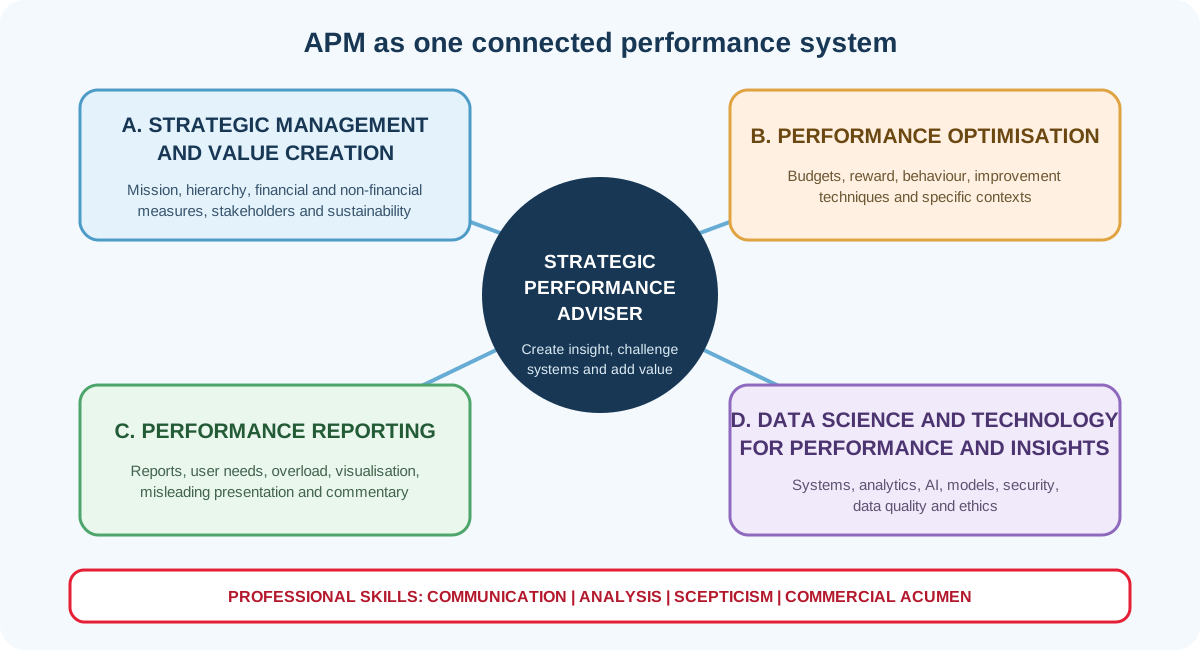
- A - Strategic management and value creation: strategic performance management, the performance hierarchy, financial and non-financial measures, and sustainability.
- B - Performance optimisation: budgets and control, performance and reward, improvement techniques, and performance in service, not-for-profit and complex organisations.
- C - Performance reporting: evaluating reports, avoiding overload and misleading presentation, data visualisation and useful narrative commentary.
- D - Data science and technology: information systems, data silos, security, big data, analytics, machine learning, AI, model outputs and data ethics.
4. Update older materials for the 2026-27 changes
The syllabus has been regrouped and several boundaries have changed. Do not assume that an old APM textbook remains complete.
| Removed | Newly explicit or added | Important distinction |
|---|---|---|
| BCG model and Porter's Five Forces | Total shareholder return (TSR) | Porter's generic strategies and Value Chain remain. |
| McKinsey 7S model | Environmental cost categories and related decisions | SWOT, PEST, Balanced Scorecard and Performance Pyramid remain. |
| Transfer pricing | Service Level Agreements in complex structures | Managerial and divisional performance measures remain. |
| IRR and MIRR | Net promoter score and expanded data-science outcomes | NPV remains an examinable financial performance measure. |
Use the current syllabus as the final authority. Older questions can still be valuable for technique, but remove or adapt requirements that depend on deleted learning outcomes.
5. Make the step up from PM
APM builds directly on Performance Management (PM), and the current examiner report shows that weak basic calculations still cost candidates marks. Refresh ratios, budgeting, variances, cost behaviour and core performance measures before attempting advanced evaluation.
| PM-level task | APM-level task |
|---|---|
| Calculate a ratio or variance | Select the relevant calculation, check its basis, explain the cause and assess its significance for objectives. |
| Describe a model | Evaluate whether its assumptions, dimensions and measures fit this organisation and decision. |
| Suggest a KPI | Trace the objective through CSFs to a controllable, balanced measure with clear data and behavioural consequences. |
| State an advantage or disadvantage | Evaluate the change from the current position, including people, systems, cost, risk and implementation. |
| Comment on performance | Separate evaluating performance from evaluating whether the performance report is fit for purpose. |
6. Use OpenTuition as an active APM study system
Complete ACCA's Ethics and Professional Skills Module before APM if possible, particularly its commercial-awareness work. Then use this active cycle:
- Read the matching chapter in the free APM notes.
- Watch the relevant APM lecture, pausing before the tutor evaluates the scenario.
- Close the materials and reconstruct the model's purpose, assumptions and limitations.
- Attempt an exam requirement in the ACCA Practice Platform using the real response tools.
- Compare your answer with the marking guide and examiner commentary.
- Rewrite the weakest requirement and record whether the failure was knowledge, selection, application, depth, conclusion or timing.
Use the APM revision lectures to integrate topics, not as a substitute for attempting complete scenarios.
7. Decode every embedded requirement precisely
All APM requirements are embedded in the scenario. Read them before the detailed exhibits. For every part identify:
- the recipient and decision;
- the exact verb and object - for example, evaluate the report, not the organisation's performance;
- any restriction, such as not recommending new measures;
- the exhibits and data required;
- the professional skills available; and
- the time ceiling.
Use headings that follow the requirement's order. If six named dimensions are supplied, assess all six systematically. Do not replace the stated task with a familiar essay.
8. Build paragraphs that create information from data
A useful APM paragraph normally contains four moves:
- Evidence: select a relevant fact, comparison or calculation.
- Reason: explain the likely cause or what the evidence reveals.
- Consequence: connect it to an objective, stakeholder, risk or behavioural effect.
- Judgement: conclude on suitability, significance or action.
Do not turn every number into prose. Select the measures that explain the overall picture, compare them with a meaningful target or benchmark and investigate contradictions. A fall in cost may be favourable until its effect on quality, retention or long-term capability is considered.
9. Master performance reporting because it is guaranteed
One Section B question will come from section C. Use a disciplined method when asked to evaluate a management report.
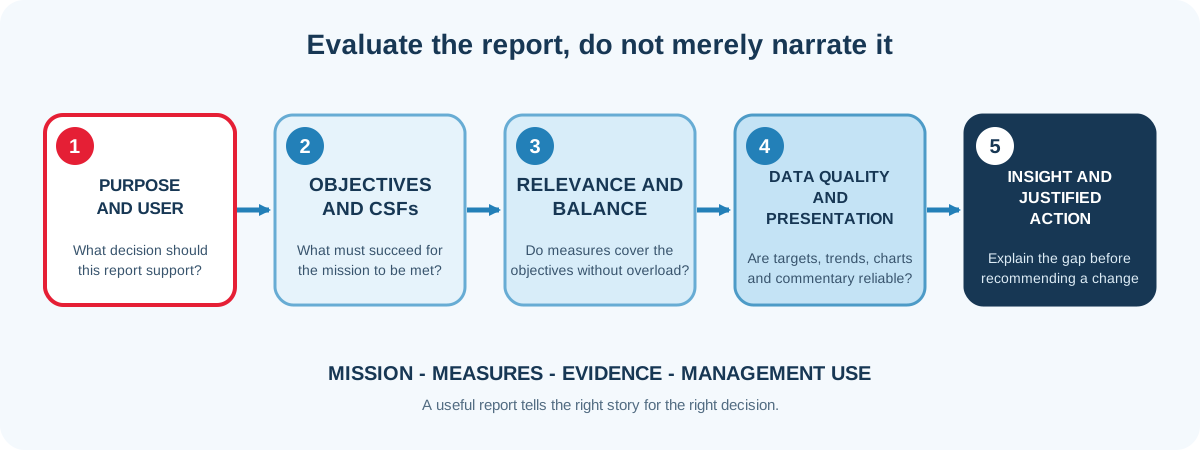
- Start with the mission, objectives and needs of the intended user.
- Test whether each objective has relevant, sufficient and balanced measures.
- Check comparators, targets, trends, definitions, controllability and data quality.
- Identify overload, omissions, short-term bias and excessive financial focus.
- Assess charts, scales, selective periods and narrative wording for misleading presentation.
- Recommend a change only after showing why the present information is inadequate.
10. Prepare data science and technology as another guaranteed area
The other Section B question will come from section D. Know what each technology does, then evaluate its performance-management impact in context.
- Systems: unified databases, data warehouses, ERPS, KMS, CRMS, cloud, networks, RFID, automation and cybersecurity controls.
- Data science: goal definition, selection, cleaning, transformation and storage before analysis.
- Analytics: descriptive, diagnostic, predictive and prescriptive analysis, plus regression, patterns, trends, ranges and distributions.
- AI and machine learning: possible insights and recommendations, but also bias, opacity, model drift, auditability and ethical data use.
Translate an operational benefit into the exact outcome requested. Faster access is not automatically a financial advantage; explain how it can reduce cost, avoid loss, increase capacity or protect revenue. Cloud computing is not merely remote access, and AI is not a synonym for every new information system.
11. Connect strategy, measures and sustainability
For section A of the syllabus, think in a chain: mission and stakeholder needs lead to strategic objectives, CSFs, KPIs, targets and action. Test whether the measures are coherent across strategic, tactical and operational levels.
Balanced Scorecard and Performance Pyramid are frameworks for connecting perspectives and levels, not templates to impose mechanically. Evaluate whether a proposed measure is relevant, controllable, timely, clearly defined and capable of changing behaviour in the intended direction.
Use financial measures such as ROCE, ROI, EPS, TSR, EBITDA, RI, NPV and EVA alongside non-financial evidence. Sustainability can affect objectives, targets and reporting through the 3Ps, integrated reporting, environmental cost categories and lifecycle, input-output and activity-based analysis.
12. Evaluate performance optimisation as a change system
Section B of the syllabus covers how performance is improved, controlled and rewarded. For any proposed technique, establish the current problem and then evaluate what will change.
- Planning and control: fixed, flexible, rolling, activity-based, zero-based and incremental budgets; planning and operational variances; beyond budgeting.
- People and reward: accountability, HRM, management style, remuneration and the risks of gaming or dysfunctional behaviour.
- Improvement: ABM, Kaizen, target and lifecycle costing, JIT, Six Sigma and DMAIC, TQM, costs of quality, Value Chain, VBM and BPR.
- Context: service organisations, not-for-profit entities, value for money, league tables, alliances, joint ventures, complex supply chains and SLAs.
Implementation matters. Consider leadership, culture, training, data, ownership, incentives, disruption, cost and whether the proposed measure drives the behaviour required by the strategy.
13. Use calculations and spreadsheets to support judgement
APM may require fewer calculations than PM, but basic errors undermine the evaluation. The latest report found weaknesses in ROCE and dividend per share as well as incomplete attempts.
- Label inputs, years, units and assumptions.
- Use opening or average capital when the measure requires it.
- Complete every requested calculation before polishing narrative.
- Show workings in the spreadsheet and refer to the result in the written response.
- Sense-check direction, scale and consistency with the scenario.
- Interpret the result against an objective or comparator; do not stop at "increased" or "decreased".
14. Earn professional skills marks through the technical answer
| Skill | What the marker should see |
|---|---|
| Communication | A professional Section A report, concise introduction, logical headings, appropriate tone and direct adherence to instructions. |
| Analysis and evaluation | Selective calculations and evidence, causes and implications, balanced appraisal and justified conclusions. |
| Scepticism | Assertions, missing information, model assumptions and contradictory evidence challenged for a specific reason. |
| Commercial acumen | Advice that fits the organisation, sector, stakeholders, resources, systems, culture and external constraints. |
Professional skills marks are not awarded for naming the skill. They arise when your technical answer shows it.
15. Convert the latest examiner feedback into a checklist
- Answer the exact object. Evaluating a report is different from evaluating performance.
- Obey restrictions. Do not invent new measures when the requirement excludes them.
- Keep PM knowledge active. Ratios and other underpinning calculations remain examinable.
- Cover every named item. Do not ignore quality circles, a supplied benefit or one dimension of a model.
- Evaluate the change. Explain the impact on targets, standards, rewards, culture, leadership and systems.
- Complete the consequence chain. Link operational effects to the requested profit, performance or strategic implication.
- Know the technology precisely. Cloud, AI, ERPS and analytics are not interchangeable terms.
- Use the spreadsheet. Make calculations clear, complete and easy to trace.
- Stop at the mark limit. Extra discussion of an unasked issue earns nothing.
16. Follow a ten-week APM study plan
| Week | Main focus | Required output |
|---|---|---|
| 1 | PM refresh: ratios, budgets, variances and core measures | Complete a clean calculation pack and explain every result. |
| 2 | Strategic role, stakeholders, mission, objectives and risk | Build objective-CSF-KPI chains for two organisations. |
| 3 | Performance hierarchy, financial and non-financial measures | Evaluate a Balanced Scorecard and Performance Pyramid. |
| 4 | Sustainability, TSR, environmental costs and integrated thinking | Complete one mixed sustainability and performance case. |
| 5 | Budgets, control, reward and behavioural consequences | Evaluate one control system and one reward proposal. |
| Week | Main focus | Required output |
|---|---|---|
| 6 | Improvement techniques, services, not-for-profit and complex structures | Compare techniques and advise on implementation in context. |
| 7 | Performance reporting and data visualisation | Complete two timed section C requirements. |
| 8 | Information systems, analytics, AI, security and data ethics | Complete two timed section D requirements. |
| 9 | Integrated Section A cases and professional report writing | Complete two 90-minute reports and debrief them. |
| 10 | Full CBE mocks and targeted repair | Complete at least two full timed exams and reattempt weak parts. |
17. Know when you are exam-ready
You are ready when you can:
- distinguish evaluating a report, measure, system, technique and performance;
- move from mission to objective, CSF, KPI and action;
- calculate core financial measures accurately and interpret them selectively;
- evaluate behavioural and implementation effects, not just technical advantages;
- assess a report against user needs, completeness, balance and presentation;
- explain technology and analytics precisely, including financial and ethical implications;
- challenge an assumption using evidence and state what information is missing;
- write a clear, scenario-specific conclusion within the time limit; and
- complete a Section A report in about 90 minutes and each Section B response in about 45 minutes across several mocks.
Debrief every mock in three layers: technical selection, depth of application and exam execution. Repair all three before the next attempt.
18. APM resources to use
- OpenTuition ACCA APM home
- Free APM notes
- Free APM lectures
- APM revision lectures
- Ask the APM Tutor forum
- OpenTuition AI Tutor for APM
- ACCA APM syllabus: September 2026 to June 2027
- ACCA guidance on the 2026-27 APM syllabus changes
- Latest ACCA APM examiner's report: September/December 2025
- ACCA APM essentials on one page
- ACCA guidance on professional skills for APM
- ACCA APM technical articles
- ACCA APM examining-team approach
- ACCA APM question-practice guidance
The APM pass formula: answer the exact requirement, select evidence that serves the objective, evaluate its meaning and limitations, and give the senior decision-maker a justified conclusion within time.