

ACCA Advanced Financial Management (AFM) is not a test of how many formulas you can remember. It asks whether you can act as a senior financial executive or adviser: build a reliable financial analysis, understand what the result means, challenge the assumptions and recommend a commercially sensible course of action.
The calculations can be demanding, but they are only part of the answer. A technically correct valuation with no interpretation, scepticism or recommendation is not a complete AFM response. Passing requires you to connect numbers to strategic decisions.
This is the AFM exam-pass study guide. It covers exam structure, advanced investment appraisal, valuation, acquisitions, reconstruction, treasury risk, spreadsheet technique, professional skills and a ten-week plan. For the separate resource-by-resource workflow, see How to Study for ACCA AFM Using OpenTuition.
Reviewed 16 July 2026 for the AFM syllabus applicable from September 2026 to June 2027. ACCA confirms that there are no additions, deletions or amendments from the preceding syllabus year.
1. Understand what AFM is really examining
A strong AFM answer follows the decision process used in practice. Identify the decision and recipient, select the relevant information, construct the appropriate model, interpret the output, test its limitations and then advise.
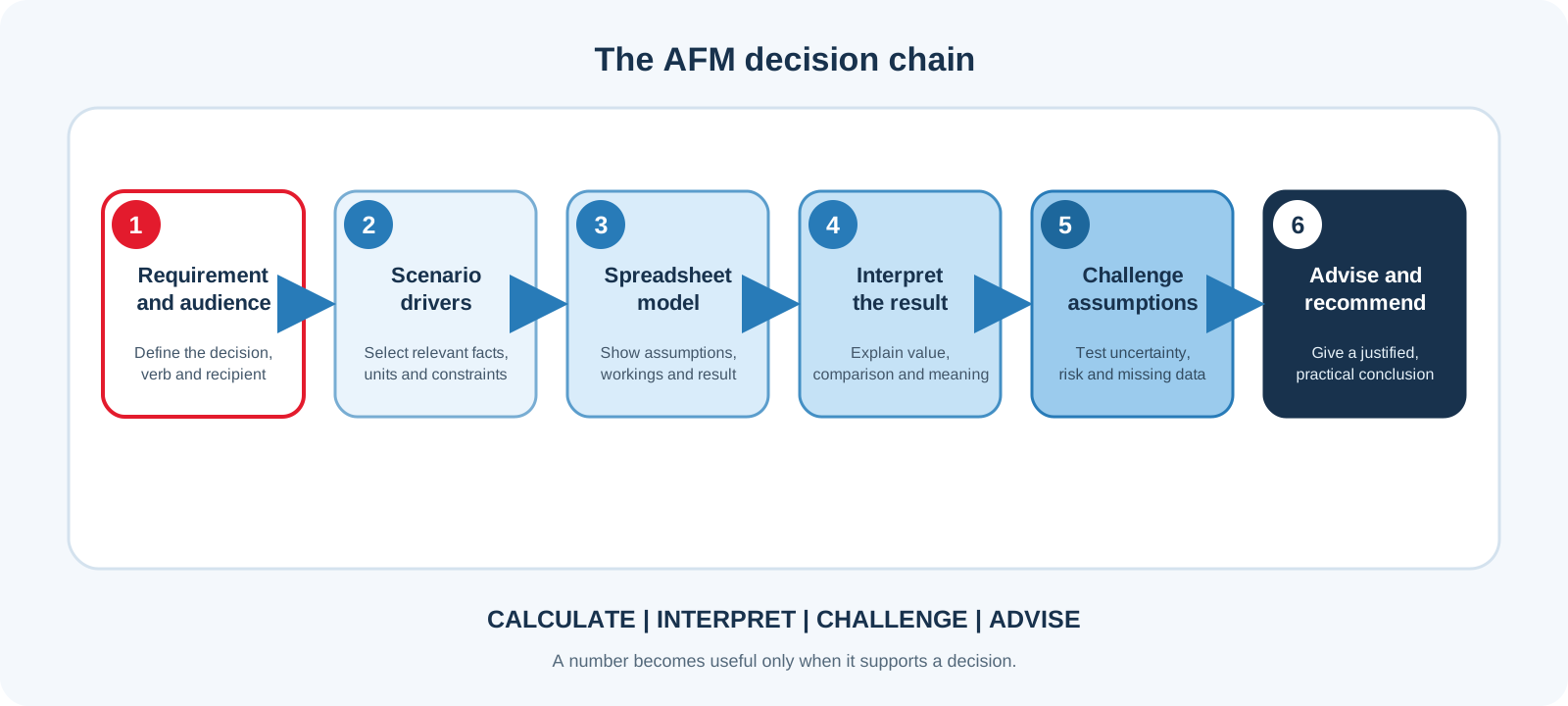
Your recommendation may be stated to be on financial grounds when the requirement says so, but it must still be clear. Then explain the assumptions, risks and non-financial factors which could change or complicate the decision.
AFM pass rule: calculate, interpret, challenge and advise. Do not stop after the number.
2. Know the exam structure and control your time
AFM is a 3 hour 15 minute computer-based exam. All three questions are compulsory and the pass mark is 50%.
| Component | What to expect | Marks | Core writing time |
|---|---|---|---|
| Section A case study | An integrated scenario drawing on at least two technical syllabus sections, normally requiring a specified response format | 40 technical + 10 professional skills | About 90 minutes |
| Section B question | A scenario containing both calculations and narrative | 20 technical + 5 professional skills | About 45 minutes |
| Section B question | A second compulsory scenario containing both calculations and narrative | 20 technical + 5 professional skills | About 45 minutes |
The latest examiner's report translates 50 marks into 90 minutes and 25 marks into 45 minutes. This leaves 15 minutes across the exam for overall reading, planning and review. Use that allowance flexibly, but set a finish time for every question and obey it.
All four professional skills are examined in Section A. Each Section B question examines at least two of analysis and evaluation, scepticism and commercial acumen. Section B has no wholly narrative question.
3. See the syllabus as five connected decisions
AFM has five technical syllabus sections. They are connected by the role of the senior financial adviser rather than existing as five separate subjects.
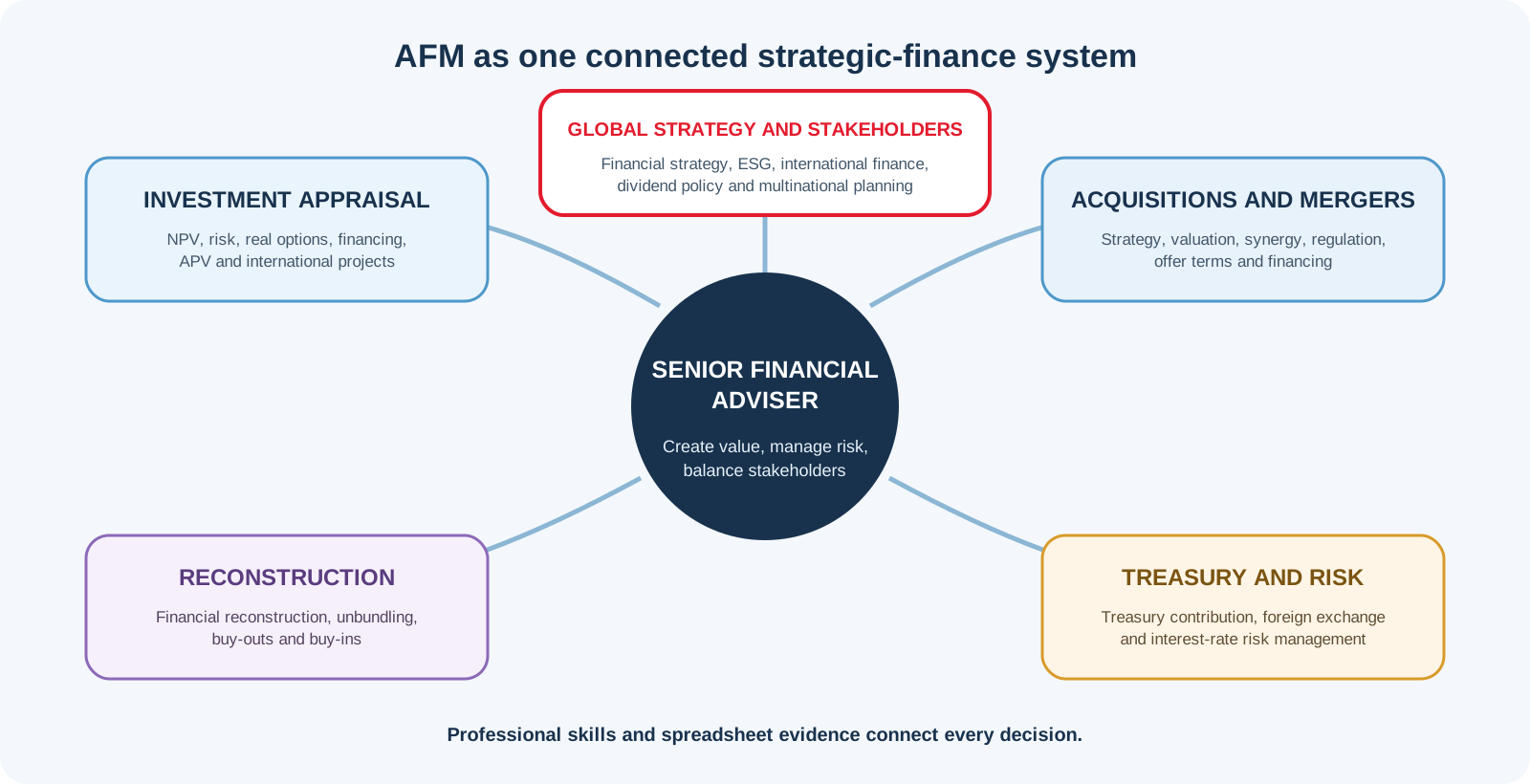
- Role of the senior financial adviser: financial strategy, stakeholders, ESG, international finance, dividend policy and multinational planning.
- Advanced investment appraisal: NPV, risk, real options, project finance, adjusted present value, free cash flow and international investment.
- Acquisitions and mergers: strategy, valuation, synergy, regulation, offer terms and financing.
- Corporate reconstruction and reorganisation: financial reconstruction, unbundling, buy-outs and buy-ins.
- Treasury and advanced risk management: the treasury function and the management of foreign exchange and interest rate risk.
Every exam has question content focused on advanced investment appraisal and treasury and advanced risk management. All other areas remain fully examinable in either section.
4. Make the step up from FM
AFM builds on FM. Before advanced work, be fluent in NPV, WACC, CAPM, capital structure, dividend policy, valuation and basic hedging.
| FM-level approach | AFM-level approach |
|---|---|
| Calculate an NPV from supplied cash flows | Construct international after-tax cash flows, select a discount rate, assess financing, risk and strategic consequences, then advise. |
| Calculate WACC | Judge whether WACC is appropriate, derive a project-specific rate or use APV where financing changes materially. |
| Value a company | Choose and reconcile suitable valuation methods, evaluate synergy and offer terms, and assess how value is divided. |
| Calculate one hedge | Compare alternative hedges, handle contract details correctly and recommend a policy in context. |
| State an advantage or disadvantage | Evaluate its significance for this organisation, its stakeholders and the proposed decision. |
5. Use OpenTuition as an active AFM study system
Complete ACCA's Ethics and Professional Skills Module before AFM if possible. Its work on innovation and scepticism directly supports the judgement expected in this exam.
- Read the matching chapter in the free AFM notes.
- Watch the relevant AFM lecture, pausing before each model or conclusion is completed.
- Rebuild the model from a blank spreadsheet without copying the tutor's workings.
- Attempt an exam requirement in the ACCA Practice Platform using the real response options.
- Compare your workings, interpretation and recommendation with the marking guide and examiner commentary.
- Correct the model and rewrite the weakest narrative requirement.
Use the AFM revision lectures to integrate topics. Classify errors as input, timing, tax, currency, discount rate, model, spreadsheet, interpretation, assumption, recommendation or time-control failures.
6. Decode the requirement before building the model
Read every requirement before working through the exhibits. For each part identify:
- the decision and the person receiving your advice;
- the exact verb and whether a recommendation is required;
- the financial model and response option needed;
- the relevant exhibits and units;
- the professional skills being assessed; and
- the time limit.
Copying scenario facts earns no marks without analysis or evaluation. Use a fact only when you explain what it changes: a cash flow, assumption, risk, stakeholder consequence or recommendation.
7. Build spreadsheets that a marker can follow
The spreadsheet is not merely a calculator. It is part of your communication and a source of method marks. Use it for detailed calculations and keep the word processor for the report, interpretation and advice.
- Label inputs, units, currencies and dates clearly.
- Separate assumptions from workings and results.
- Use formulas which refer to cells rather than retyping numbers.
- Show intermediate workings: tax, working capital, exchange rates, discount factors, contract numbers and premiums.
- Keep different cash-flow streams or alternative hedges visibly separate.
- Use a compact summary block for the results transferred into your written answer.
- Sense-check signs, scale, timing and whether a result is economically plausible.
Do not hide all the logic inside one formula. ACCA confirms that credit is available for a correct approach even when an early error affects the final figure, but the workings must be visible.
8. Master advanced investment appraisal
Investment appraisal is guaranteed syllabus territory. Build an NPV from incremental, relevant, after-tax cash flows and treat each layer deliberately:
- capital expenditure and any disposal proceeds;
- revenues and costs with cumulative, specific inflation;
- taxable operating cash flow, tax payments and tax-allowable depreciation;
- the change in working capital, not merely the total balance;
- exchange rates, remittances, withholding or additional tax where relevant;
- terminal cash flows and recovery of working capital; and
- an appropriate discount rate.
Keep cash flows in the currency in which they arise until the correct translation point. Apply nominal rates to nominal cash flows and real rates to real cash flows. Do not mix project cash flows with financing flows when using a conventional NPV.
After the calculation, state what the NPV indicates on financial grounds. Then discuss the assumptions most capable of changing the decision, explaining both why the assumption is uncertain and its directional impact. Merely saying "perform sensitivity analysis" is not a discussion.
9. Know when APV, project-specific rates and real options matter
Use the technique that fits the decision rather than forcing every project into a standard WACC.
| Technique | Decision use | Common danger |
|---|---|---|
| Project-specific cost of capital | Adjusts for business and financing risk different from the investing company | Using the wrong comparator, book values or inconsistent gearing assumptions |
| Adjusted present value | Separates the ungeared base-case project value from financing side effects | Mixing financing benefits into cash flows already discounted at a geared rate |
| Real options | Values managerial flexibility to delay, expand, redeploy or abandon | Treating every strategic benefit as an option without identifying the underlying flexibility |
| Sensitivity or probability analysis | Explores uncertainty and decision resilience | Producing extra numbers without explaining what they mean for the decision |
10. Turn valuations and acquisition models into advice
Valuation questions reward a clear bridge from the chosen basis to the commercial decision. Distinguish carefully between:
- free cash flow to the firm discounted at WACC and free cash flow to equity discounted at the cost of equity;
- enterprise value and equity value;
- standalone target value, synergy value, combined value and the consideration paid;
- value created by the transaction and the share of that value received by each shareholder group; and
- cash, share or mixed offers and their effect on risk, control and reported position.
State the valuation date and keep the treatment of debt consistent. If a perpetuity starts after an explicit forecast period, value it at the correct point and then discount it back. If synergy is given as a present value, do not add it again as an annual cash flow.
A positive total acquisition gain does not prove that the offer is acceptable to both sides. Evaluate the price, exchange ratio, financing, integration risk, deliverability of synergies, regulatory issues and the distribution of gains.
11. Use a disciplined method for foreign exchange hedging
Risk-management questions become manageable when you define the exposure before touching a rate.
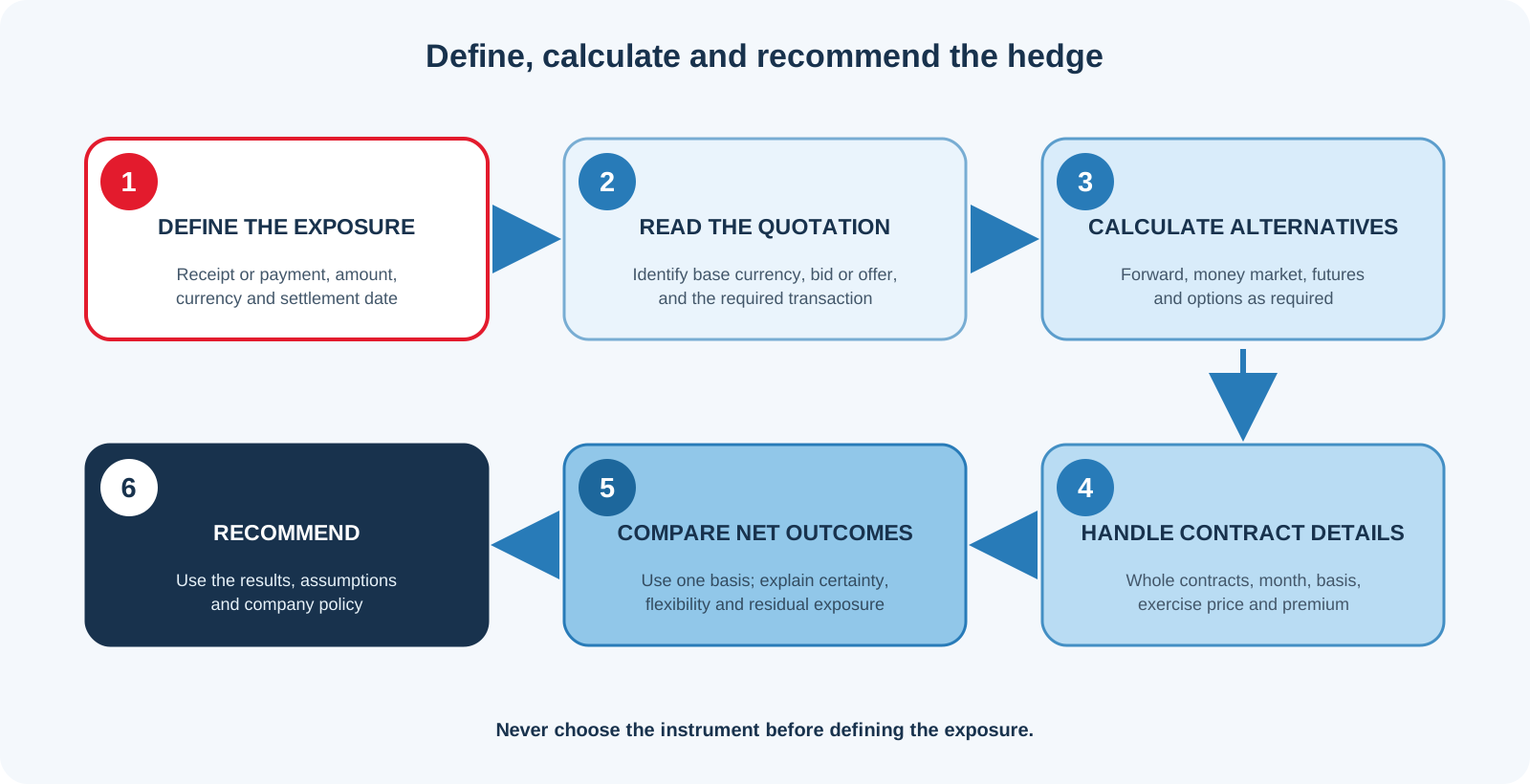
For every currency hedge, state whether the company will receive or pay the foreign currency, the amount, date and relevant quotation convention. Then determine the transaction required under each instrument.
- Forward: select the correct bid or offer rate and state the locked home-currency outcome.
- Money-market hedge: construct the borrowing, conversion and deposit sequence with consistent timing and interest conventions.
- Futures: choose buy or sell, contract month and a whole number of contracts; calculate basis and explain any under- or over-hedge.
- Options: choose the correct call or put, exercise price, month and whole contracts; include the premium in the correct currency and at the correct time.
Compare net outcomes on the same basis, then discuss certainty, flexibility, participation in favourable movements, transaction exposure, forecast confidence and policy fit. Recommend one response using your own results.
12. Prepare interest-rate risk with the same precision
Identify whether the organisation will borrow or invest, the principal, start date, duration and benchmark rate. Then evaluate the suitable technique:
- forward rate agreements;
- interest-rate futures;
- interest-rate options, including caps, floors and collars; and
- interest-rate swaps.
Be precise about whether rates rising or falling create the risk, which contract position provides protection, and how basis, premiums, exercise decisions, counterparty exposure and flexibility affect the recommendation.
13. Do not neglect reconstruction, treasury and global strategy
These areas often provide the narrative marks that distinguish a balanced candidate.
- Financial reconstruction: assess why the existing claims are unsustainable, propose a workable rearrangement and evaluate how value, control, liquidity and stakeholder wealth change.
- Business reorganisation: understand unbundling, sell-offs, demergers, management buy-outs and buy-ins, including strategic rationale and implementation risk.
- Treasury: evaluate centralisation, funding, liquidity, cash management, risk policy, tax planning and strategic advice. Focus on the exact contribution requested, not a memorised list.
- International strategy: consider capital mobility, trade barriers, exchange controls, remittance restrictions, tax, transfer pricing and operational coordination.
- ESG and ethics: connect the scenario issue to financial consequences, stakeholders, reputation and a feasible response.
14. Earn professional skills marks through the technical answer
| Skill | What the marker should see |
|---|---|
| Communication | A professional Section A report with title, introduction, logical headings, concise analysis, a conclusion and calculations placed in a clear spreadsheet appendix. |
| Analysis and evaluation | Appropriate models, transparent workings, meaningful comparisons and conclusions drawn from the results. |
| Scepticism | Important assumptions and supplied information are questioned, with the possible effect on the result and recommendation explained. |
| Commercial acumen | Advice is practical for the organisation, recognises constraints and stakeholders, and considers implementation and wider consequences. |
Professional skills are integrated. A report heading alone cannot compensate for weak analysis, and the word "assumption" does not demonstrate scepticism unless you challenge its reliability and consequence.
15. Use the formula sheet without becoming dependent on it
The exam provides the AFM formula sheet and maths tables. The spreadsheet also includes NPV, IRR and MIRR functions, and a separate workspace may be provided for Black-Scholes inputs where relevant.
You must still know what each formula measures, which inputs are required, the timing convention and whether the result answers the requirement. Practise with the current official AFM formula sheet and maths tables from the beginning of your course.
16. Convert examiner feedback into a checklist
- Answer the stated requirement. Do not replace it with a familiar discussion.
- Show complete workings. Make the spreadsheet logic and units visible.
- Read every detail. Dates, currencies, tax treatment, quotation direction and contract specifications matter.
- Keep cash-flow logic clean. Use cumulative inflation, changes in working capital and correctly timed tax and terminal flows.
- Use whole contracts. Explain the resulting under- or over-hedge.
- Do not double-count. Treat present values, annual cash flows, synergy and financing effects consistently.
- Discuss assumptions. Explain why each could be wrong and how that would affect the result.
- Recommend clearly. Do not sit on the fence after completing the calculation.
- Use scenario evidence. Repetition earns nothing; consequence and action earn marks.
17. A ten-week AFM study plan
| Week | Main focus | Required output |
|---|---|---|
| 1 | FM foundations, financial strategy, stakeholders and spreadsheet setup | Rebuild a clean NPV, WACC and valuation model from blank sheets. |
| 2 | Advanced NPV, inflation, tax, working capital and international projects | Complete one full international investment appraisal. |
| 3 | Project-specific cost of capital, APV and financing | Compare WACC and APV approaches and explain the choice. |
| 4 | Real options, sensitivity, probability and decision risk | Value and interpret a project containing managerial flexibility. |
| 5 | Business valuation, free cash flow and dividend policy | Produce reconciled enterprise and equity valuations. |
| Week | Main focus | Required output |
|---|---|---|
| 6 | Acquisitions, synergy, offer terms and financing | Calculate total value created and its division between shareholders. |
| 7 | Reconstruction, reorganisation and treasury strategy | Answer one calculation-and-advice reconstruction scenario. |
| 8 | Foreign exchange and interest-rate risk management | Complete two multi-instrument hedge comparisons. |
| 9 | Timed Section A integrated cases and professional skills | Complete two 90-minute reports with spreadsheet appendices. |
| 10 | Full CBE mocks and targeted repair | Complete at least two full timed exams and reattempt weak requirements. |
If you have longer, extend each technical phase but keep producing complete calculations and written advice. Do not postpone exam-standard questions until every formula feels comfortable.
18. Know when you are exam-ready
You are ready when you can:
- turn a long requirement into a timed calculation-and-writing plan;
- build transparent spreadsheet models without tutor templates;
- complete an international NPV with consistent tax, inflation, currency and timing;
- select and apply WACC, project-specific rates, APV and valuation methods appropriately;
- evaluate an acquisition from both value-creation and stakeholder perspectives;
- construct and compare foreign exchange and interest-rate hedges accurately;
- challenge assumptions and explain their directional effect;
- give a clear, scenario-specific recommendation; and
- finish a 50-mark case in 90 minutes and each 25-mark question in 45 minutes across several mocks.
Debrief every mock in three layers: calculation method, interpretation and professional advice. Repair all three before the next attempt.
19. AFM resources to use
- OpenTuition ACCA AFM home
- Free AFM notes
- Free AFM lectures
- AFM revision lectures
- Ask the AFM Tutor forum
- OpenTuition AI Tutor for AFM
- ACCA AFM syllabus and study guide: September 2026 to June 2027
- Latest ACCA AFM examiner's report: September/December 2025
- ACCA AFM essentials on one page
- ACCA guidance on AFM professional skills
- ACCA AFM technical articles
- ACCA AFM frequently asked questions
- ACCA AFM CBE exam technique
The AFM pass formula: build a transparent model, explain what the result means, challenge what could change it and give the senior decision-maker a justified recommendation - within a disciplined time limit.