

ACCA Advanced Audit and Assurance (AAA) is not passed by reproducing lists of International Standards on Auditing. It asks whether you can think like an audit manager: identify what matters, challenge management's evidence, connect financial reporting to audit risk, design purposeful work and reach a defensible professional conclusion.
The step up from Audit and Assurance (AA) is therefore a step up in judgement. The scenario gives you more information than you can use. Your job is to select the significant issues, evaluate them at the correct stage of the engagement and communicate useful advice to the audit partner.
This is the AAA exam-pass study guide. It explains how to approach the planning case, business risk, risks of material misstatement, audit procedures, ethics, completion and reporting, other assignments and professional skills. For the separate resource-by-resource workflow, see How to Study for ACCA AAA Using OpenTuition.
Reviewed 16 July 2026 for the AAA-INT syllabus and examinable documents applicable from September 2026 to June 2027. This guide is based on AAA-INT. Candidates intending to claim the UK audit qualification must pass SBR-INT and AAA-UK. Candidates intending to claim the Irish audit qualification must pass SBR-IRL and AAA-IRL; AAA-IRL uses the AAA-UK syllabus together with the SBR-IRL syllabus. Check the official AAA variant guidance before choosing your exams. The core exam and answer methods in this guide remain applicable.
1. Understand what AAA is really examining
A strong AAA answer follows the logic of a real engagement. Start with the case fact, identify the financial reporting or professional issue, assess the audit consequence, decide what evidence or action is required and then conclude or report appropriately.
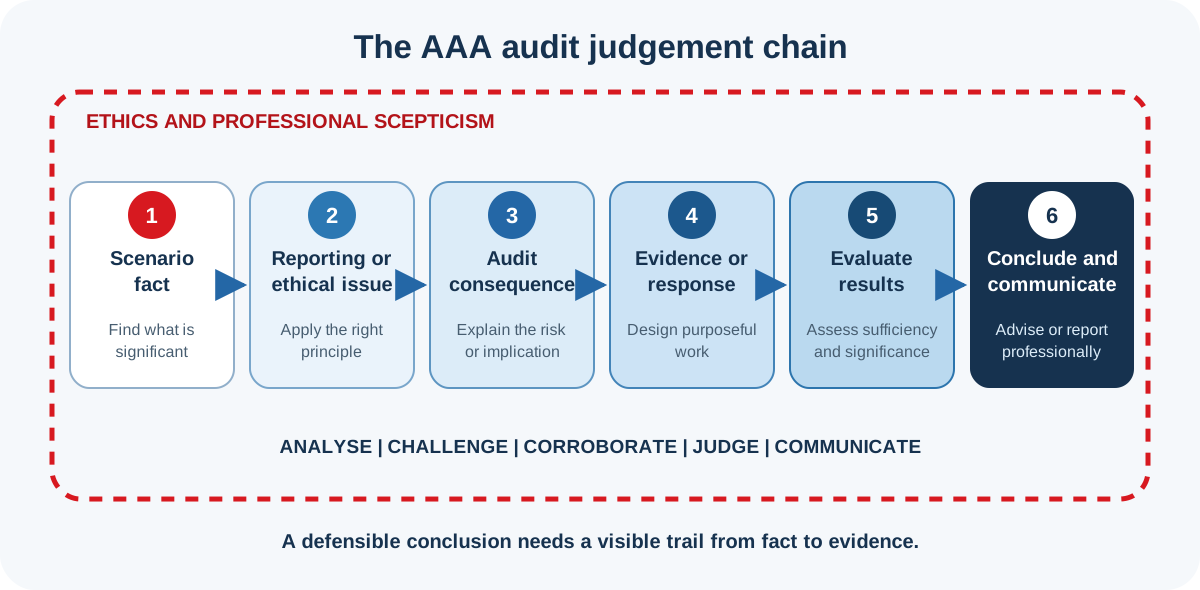
Professional scepticism and ethics run through the whole chain. Do not accept an estimate merely because management produced a schedule, and do not reject it merely because it is uncertain. Identify the assumption, test the supporting evidence, consider bias and explain the consequence for the engagement.
AAA pass rule: every point should move from a specific fact to an audit consequence and then to a justified response or conclusion.
2. Know the exam structure and protect your time
AAA is a 3 hour 15 minute computer-based exam. Both sections and all three questions are compulsory. The pass mark is 50%.
| Component | Typical focus | Marks | Time ceiling |
|---|---|---|---|
| Section A case study | Planning case for an audit partner or senior manager | 40 technical + 10 professional skills | About 98 minutes |
| One Section B question | Always predominantly completion, review and reporting | 20 technical + 5 professional skills | About 49 minutes |
| Other Section B question | Any other relevant syllabus area, including other assignments | 20 technical + 5 professional skills | About 49 minutes |
The ceilings use 1.95 minutes per mark and include reading and planning. In Section A, all four professional skills are examined. Each Section B question examines at least two of analysis and evaluation, professional scepticism and judgement, and commercial acumen.
Read the requirements before studying the detailed exhibits. Record a finish time for every requirement and stop when it arrives. A concise, complete answer to all three questions is much safer than perfecting the planning case and leaving completion and reporting unfinished.
3. See the syllabus as one connected assurance cycle
The syllabus contains seven technical areas. Study them as stages and conditions of professional work, not as isolated chapters.
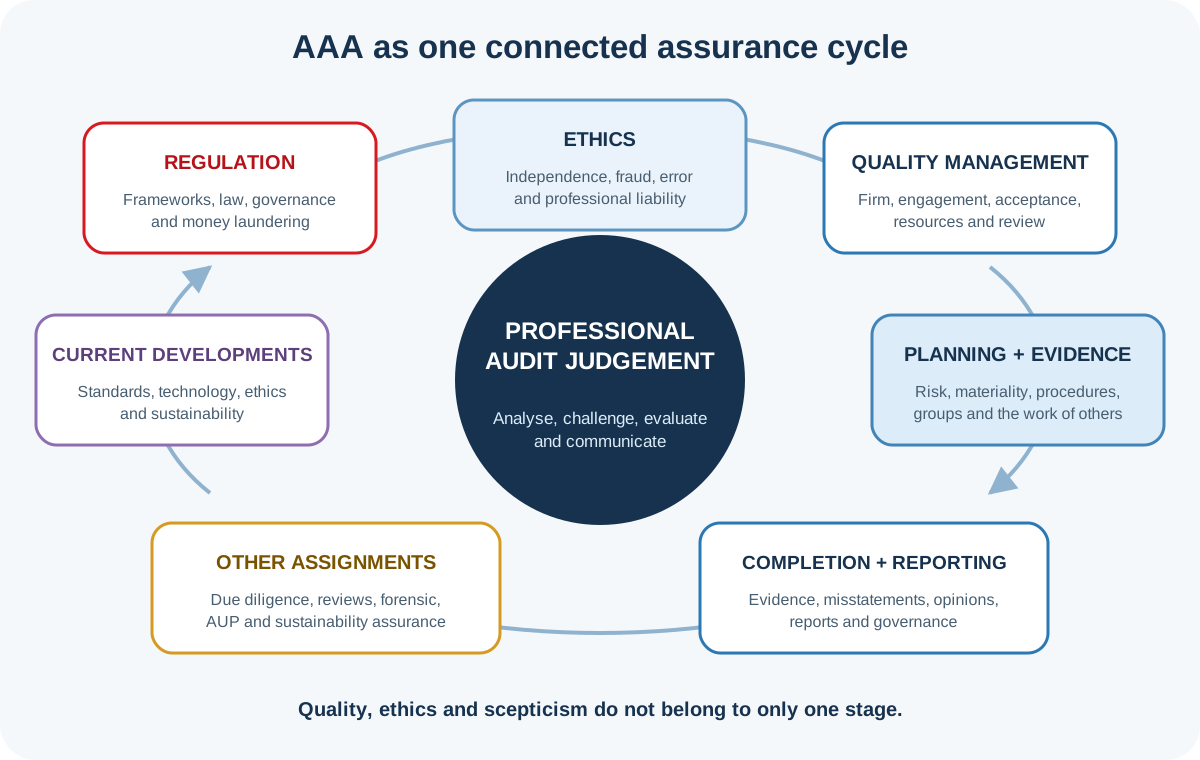
- Regulatory environment: international frameworks, laws, regulations and money laundering.
- Professional and ethical considerations: the Code, fraud, error and professional liability.
- Quality management: firm and engagement quality, tendering, fees, acceptance and continuance.
- Planning and conducting an audit: materiality, business risk, risk of material misstatement, evidence, groups and the work of others.
- Completion, review and reporting: subsequent events, going concern, misstatements, final review, auditor reporting and communication with those charged with governance.
- Other assignments: due diligence, prospective information, forensic work, performance audits, reviews, agreed-upon procedures and sustainability assurance.
- Current issues and developments: changes affecting audit, ethics, technology and sustainability assurance.
4. Make the step up from AA and use SBR knowledge
AAA assumes the audit foundation from AA and the accounting knowledge examined in SBR. ACCA recommends attempting and passing SBR before AAA.
| Earlier-exam approach | AAA-level approach |
|---|---|
| Identify an audit risk | Evaluate the significant risk of material misstatement, use materiality and case evidence, and prioritise it where required. |
| List a financial reporting rule | Apply the SBR-level treatment, identify the possible misstatement and explain its effect on the audit. |
| State an audit procedure | Design a principal procedure that targets the exact assertion, judgement or evidence gap. |
| Name an ethical threat | Explain how the threat arises, its significance, the consequences and whether safeguards make the engagement acceptable. |
| Select an audit opinion | Evaluate evidence, materiality and pervasiveness, then explain the opinion and the required report treatment. |
Keep your SBR knowledge active, but do not turn an AAA answer into an accounting lecture. Explain only enough financial reporting to establish the correct treatment and the possible misstatement. Then move to the audit consequence.
5. Use OpenTuition as an active AAA study system
- Read the matching chapter in the free AAA notes.
- Watch the relevant AAA lecture, pausing before the tutor reaches each conclusion.
- Close the materials and reconstruct the audit logic from memory.
- Attempt a requirement in the ACCA Practice Platform using the actual response workspace.
- Compare your answer with the marking guide and examiner commentary, not just the published answer.
- Rewrite the weakest requirement and record why marks were lost.
Use the AAA flashcards for retrieval and the AAA revision lectures for integration. Classify errors as failures of knowledge, stage, application, procedure, conclusion, style or timing.
6. Decode Section A from the partner's email
The partner's email in Section A always contains the detailed requirements and mark allocations. Read it first. For each requirement identify:
- the engagement and its current stage;
- the exact verb and scope;
- which exhibits must be used;
- whether business risk, risk of material misstatement, evidence, ethics or another output is required;
- the professional skill being tested; and
- the time ceiling.
Your briefing notes are addressed to an audit partner or senior manager. Do not waste time defining materiality, audit risk or other elementary concepts for that audience. Use a clear header, a brief purpose-focused introduction and headings that mirror the requirements.
7. Never confuse business risk with risk of material misstatement
This distinction is fundamental.
- Business risk concerns an event or condition that may prevent the client achieving its objectives. Evaluate its likelihood and significant operational, financial, regulatory or reputational consequence, considering any mitigation given.
- Risk of material misstatement (RoMM) concerns how a fact or accounting treatment may cause the financial statements to be materially wrong before audit. Identify the affected balance, class of transaction or disclosure and explain the direction or nature of the possible misstatement.
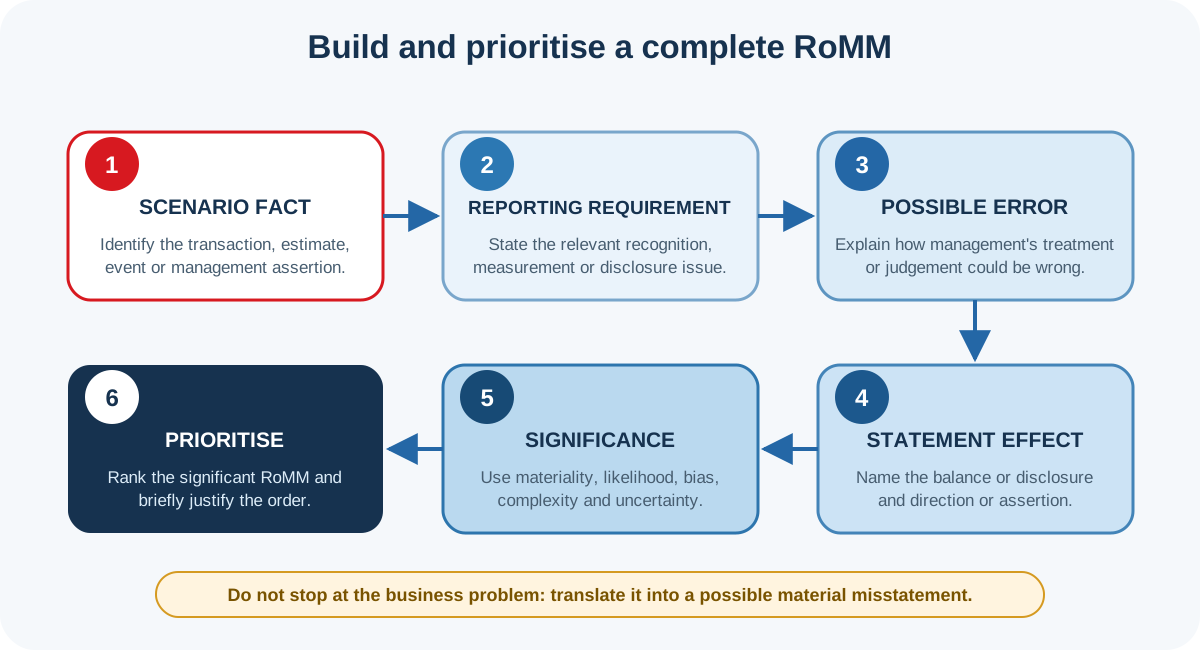
A business problem may create one or more RoMMs, but they are not the same answer. For example, rising input prices may threaten margins and contract performance as a business risk. The audit implications might include impairment, an onerous contract provision or pressure to manipulate revenue, depending on the facts.
Prioritise RoMMs when instructed, using materiality, likelihood, estimation uncertainty, management bias, complexity and the magnitude of possible misstatement. Do not simply write "high risk" beside every item. The latest examiner's report specifically notes that business risks did not require prioritisation in that sitting, while RoMMs did. Follow the exact requirement.
8. Use materiality as judgement, not decoration
Materiality is useful only if it affects your evaluation. In a planning requirement:
- select an appropriate benchmark and percentage using the information and instructions provided;
- show the calculation clearly and state one workable threshold;
- justify the selection using the entity, users, volatility, listing status and engagement circumstances;
- compare relevant amounts with that threshold consistently; and
- remember that qualitative factors can make an item significant even below the number.
Do not recalculate materiality separately for every risk unless asked. Do not justify a lower figure merely by repeating that audit risk is high. Explain why the chosen benchmark and position in the range make sense for this client and engagement.
9. Design procedures that produce the evidence required
A principal audit procedure should show an action, a source and a purpose. Ask: what will the auditor do, to which document, person, asset or data set, and what assertion or judgement will the resulting evidence address?
Compare these:
| Weak procedure | AAA-level procedure |
|---|---|
| Check invoices. | Inspect a sample of supplier invoices for development expenditure and agree the nature and date of each cost to the project ledger to assess whether only directly attributable costs incurred after recognition criteria were met were capitalised. |
| Discuss with management. | Discuss the technical-feasibility assessment with the project director and corroborate it to approved design milestones, test results and funding forecasts. |
| Review board minutes. | Inspect minutes for approval of the project, identified technical failures and decisions to suspend work, and assess whether these contradict management's recognition and impairment assumptions. |
| Obtain a representation. | Obtain written representations on management's key assumptions only as supporting evidence after performing substantive procedures; do not use them as a substitute for evidence expected to exist. |
Tailor the work to the engagement objective. A due diligence procedure investigates information relevant to an acquisition decision; it is not automatically an audit procedure and may have different materiality, scope and reporting considerations.
10. Earn professional skills marks through technical work
Professional skills are not awarded for inserting their names into an answer. They must be visible in how you analyse and communicate the technical issues.
| Skill | What the marker should see |
|---|---|
| Communication | Professional Section A briefing notes with an appropriate header, brief introduction, logical headings, clear explanations and relevant content. |
| Analysis and evaluation | Case facts and calculations are connected, implications are developed, alternatives are weighed and conclusions follow from evidence. |
| Scepticism and judgement | Management assertions and evidence are challenged intelligently, RoMMs are prioritised and evidence sufficiency is evaluated. |
| Commercial acumen | The answer recognises the client's industry and business model, the audit firm's resources and exposure, practical constraints and engagement consequences. |
Professional scepticism is not automatic disbelief. Commercial acumen is not speculation unsupported by the case. Both require a balanced conclusion that acknowledges what is known, what is missing and what action is realistic.
11. Integrate ethics, acceptance and quality management
For each ethical or professional issue, use this sequence:
- Fact: identify the service, relationship, fee, pressure or action in the scenario.
- Threat or requirement: explain the relevant ethical, legal, acceptance or quality issue.
- Significance: show why it matters to independence, objectivity, engagement quality or users.
- Safeguard or action: recommend a response that addresses the actual cause.
- Conclusion: state whether the engagement or service may be accepted or continued and on what conditions.
Base threats on scenario facts. If a separate team is specified, evaluate its effectiveness rather than recommending it again.
Quality management may be examined at firm or engagement level and at any audit stage. Consider competence, time, resources, direction, supervision, review, consultation, engagement quality review, monitoring and whether commercial pressure threatens quality.
12. Master completion and reporting because it is guaranteed
One Section B question will always predominantly examine completion, review and reporting. Prepare a repeatable decision chain:
- What evidence, event, misstatement or uncertainty has been identified?
- Is the accounting treatment and disclosure appropriate?
- Is the matter material, and if relevant, pervasive?
- What further work or management action is required?
- What is the effect on the opinion and the auditor's report?
- What should be communicated to management or those charged with governance?
For a material misstatement, the opinion is qualified if the effect is not pervasive and adverse if it is pervasive. For an inability to obtain sufficient appropriate evidence, the opinion is qualified if the possible effect is not pervasive and a disclaimer is required if it is pervasive.
A Key Audit Matter is selected from matters communicated with those charged with governance that required significant auditor attention and was of most significance. It does not provide a separate opinion and does not replace a modified opinion. An Emphasis of Matter paragraph highlights an appropriately presented or disclosed matter fundamental to users' understanding; it also does not replace modification.
For going concern, distinguish whether the basis of accounting is appropriate, whether a material uncertainty exists, whether disclosure is adequate and what evidence supports management's assessment. Under ISA 570 (Revised 2024), when the going concern basis is appropriate and no material uncertainty exists, the auditor's report includes a separate Going Concern section. If a material uncertainty exists and the disclosure is adequate, the opinion remains unmodified and a separate Material Uncertainty Related to Going Concern section is required. Inadequate disclosure leads to a qualified or adverse opinion, depending on pervasiveness; an inappropriate going concern basis leads to an adverse opinion.
13. Prepare other assignments by objective and report
For every non-audit assignment, know six things: the intended users, subject matter, responsible party, suitable criteria, level of assurance or factual-findings basis, and the form of report.
- Due diligence: investigate matters relevant to a proposed transaction within the agreed scope, limitations and users' needs.
- Prospective financial information: evaluate assumptions, preparation and presentation, distinguishing best-estimate from hypothetical assumptions.
- Forensic work: preserve evidence, define purpose and legal context, maintain objectivity and report factual findings appropriately.
- Agreed-upon procedures: perform procedures agreed with specified parties and report factual findings without providing assurance.
- Review engagements: provide limited assurance using enquiry and analytical procedures, supplemented where necessary.
- Sustainability assurance: assess acceptance, scope, criteria, materiality, evidence and reporting in accordance with the current sustainability assurance framework.
14. Keep standards and current developments current
The 2026-27 examinable-documents list assumes the same IFRS Accounting Standards and IFRS Sustainability Disclosure Standards as SBR. It also includes, among other material, ISA 240 (Revised), ISA 250 (Revised), ISA 570 (Revised 2024), the ISA for Less Complex Entities, ISSA 5000, sustainability-related ethics and independence standards, and guidance on automated tools and techniques.
Do not study current issues as an isolated essay. The syllabus says they are likely to be integrated into the case or a Section B scenario. Be ready to explain how a development changes risk assessment, evidence, quality, ethics, reporting or the practicality of an engagement.
Build your final revision checklist from the official examinable documents for your variant and exam year. Documents may be examinable even if their effective date is in the future.
15. Convert examiner feedback into a revision checklist
- Tailor every answer. Generic definitions and standard lists earn little at AAA.
- Read instructions exactly. Use only the exhibits requested and answer the stated engagement objective.
- Separate business risk from RoMM. Evaluate the correct risk and prioritise only where required.
- Apply one materiality threshold consistently. Sense-check the calculation and justify the benchmark.
- Develop depth. Explain why the fact is significant and what it changes for the audit.
- Design evidence-producing procedures. A vague verb and document name are not enough.
- Use the correct perspective. Audit, due diligence, sustainability assurance and agreed-upon procedures have different objectives.
- Prepare completion and reporting. It will appear in every exam session.
- Write for the recipient. Section A is professional advice to an audit partner, not a textbook chapter.
16. A ten-week AAA study plan
| Week | Main focus | Required output |
|---|---|---|
| 1 | Regulation, ethics, fraud, money laundering and liability | Write scenario-specific ethical evaluations with conclusions. |
| 2 | Quality management, tendering, fees, acceptance and continuance | Complete one acceptance task and one quality-management task. |
| 3 | Business risk, RoMM, materiality and analytical procedures | Build and prioritise a full planning risk schedule. |
| 4 | Audit evidence and principal procedures | Write targeted procedures for estimates, revenue and assets. |
| 5 | Groups, component auditors, experts, internal audit and technology | Complete a mixed evidence and group-planning requirement. |
| Week | Main focus | Required output |
|---|---|---|
| 6 | Completion, going concern, misstatements and auditor reporting | Complete two full reporting questions and justify every conclusion. |
| 7 | Other assignments and their reports | Compare audit, review, due diligence, AUP and forensic objectives. |
| 8 | Sustainability assurance, current issues and professional skills | Answer an integrated technical-article or exam-standard scenario. |
| 9 | Timed Section A planning cases | Complete two cases within 98 minutes each and debrief them. |
| 10 | Full CBE mocks and targeted repair | Complete at least two full timed exams and reattempt weak requirements. |
If you have longer, extend each technical phase but keep producing applied answers. Do not wait until all standards feel perfect before attempting complete questions.
17. Know when you are exam-ready
You are ready when you can:
- read the partner's email and build a requirement-led plan quickly;
- evaluate business risks and RoMMs without confusing them;
- apply SBR-level reporting knowledge from an auditor's perspective;
- calculate and use materiality consistently;
- design procedures that produce relevant, reliable evidence;
- evaluate ethical threats, safeguards and quality implications in context;
- reach correct completion and reporting conclusions;
- demonstrate all four professional skills through technical work; and
- complete all three questions within 195 minutes across several full mocks.
Debrief rule: after every mock, mark the answer against the scenario-specific marking guide and examiner commentary. Rewrite the weakest requirement while you still remember why your original approach failed.
18. AAA resources to use
- OpenTuition ACCA AAA home
- Free AAA notes
- Free AAA lectures
- AAA flashcards
- AAA revision lectures
- Ask the AAA Tutor forum
- OpenTuition AI Tutor for AAA
- ACCA AAA-INT syllabus and study guide: September 2026 to June 2027
- ACCA AAA examiner's report: September/December 2025
- ACCA AA and AAA-INT examinable documents: September 2026 to June 2027
- ACCA AAA essentials on one page
- ACCA guidance on AAA professional skills
- ACCA AAA CBE exam technique
The AAA pass formula: identify the significant fact, apply the correct reporting or assurance principle, explain the audit consequence, obtain the evidence and reach a professional conclusion - within a disciplined time limit.