
Sources of Management Information

1 Introduction
This chapters considers the information needs of an organisation, particularly in respect of control systems to ensure that the organisation maintains performance.

Judge information by the decision it supports. Assess relevance, reliability, timeliness, completeness, understandability and cost, then identify the consequence of any weakness. When applying lean-information principles, address the specified principle rather than listing generic implementation problems.
2 Information needs for different levels of decision making
The different levels of decision making were discussed in the previous chapter. The information needs of the decision makers will be different and depend on the type of decision.
2.1 Strategic planning
The information needed at this level is likely to be more external information and is likely to be more forecasts of the future.
2.2 Management control / Tactical planning
At this level there will be a need for both external and internal information. The focus is also more likely to be on current information.
2.3 Operational control
Here the information needs will almost exclusively be internal, and will be past and current information.
3 Sources of information
3.1 Internal sources of information
Source | Information |
|---|---|
Sales ledger system | Number and value of invoices |
Purchase ledger system | Number and value of invoices |
Payroll system | Number of employees |
Fixed asset system | Date of purchase |
In addition the following internal, non-accounting sources may be used
Source | Information |
Production | Machine breakdown times |
Sales and marketing | Types of customer |
3.2 External courses of information
There is much information to be obtained from external sources as illustrated below:
Source | Information |
Suppliers | Product prices |
Newspapers, journals | Share price |
Government | Industry statistics |
Customers | Product requirements |
Employees | Wage demands |
Banks | Information on potential customers |
Business enquiry agents | Information on competitors |
Internet | Almost everything via databases (public and private), discussion groups and mailing lists. |
4 Attributes of good information
In order to be useful to management, information should possess the following attributes: [ACCURATE]
Accurate: Sufficient for its purpose. Note that at higher managerial levels information does not normally need to be as accurate as at lower levels
Complete: Obviously, incomplete information is likely to mislead
Cost-beneficial: Benefits should exceed costs
User-targeted: It should provide the information by needed by the user to make the decision/perform the job
Relevant: Irrelevant information distracts and wastes people’s time.
Authoritative: Well, you know how unreliable some web-site data is: sometimes deliberately misleading, sometimes sloppy, sometimes out-of-date.
Timely: Information should be received quickly enough to enable better decisions. There is no need for all information to be ‘instantly’ available and speed often has a cost.
Easy to use: Well-set out and annotated.
Another mnemonic is PAIL. This can be used to assess the quality of reports:
Purpose What is the purpose of the information or report. What should it highlight? What is the important information it has to get convey?
Audience Care has to be taken to assess the appropriate level of detail, layout and terminology used in reports so that users will properly understand the information that is provided.
Information. The information provided must match the purpose of the performance report. In particular, non-financial performance is a very important determinant of the long term success of any enterprise.
Layout. Layout must help users to understand the information presented and to see quickly the important amounts, trends, results and explanations.
One of the most common criticisms of reports is that they present too much information and are much too cluttered. There might be valuable information there but it is almost impossible to find and interpret it. There is always the suspicion that large volumes of information have been deliberately provided to obfuscate the facts and to blunt the message.
Although graphical information can be presented in a misleading way, graphical displays can be used to greatly enhance the impact and understanding of information.
5 Control systems
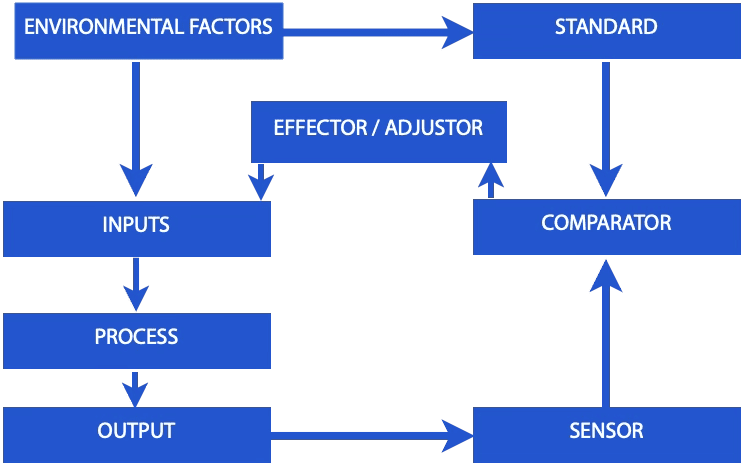
Control systems are necessary throughout an organisation in order to monitor performance so that corrective action may be taken where appropriate.
An example is a budgetary control system, where costs might be compared against budget and action taken to attempt to correct any over-spends.
Another example is a quality control system, where production is compared against pre-defined standards, and again appropriate action is taken when the quality deviates from the standard.
All control systems operate in the same basic way, and you should be aware of the diagram below and the terminology.
6 Feedback / feedforward control
Feedback control is where the outputs of a process are measured and information is then provided regarding corrective action, after the outputs have been produced.
Variance analysis is an example of this. At the end of (say) each month, variances are calculated. If there is an overspend in January, then attempts will be made to correct the problem for the future. It is however too late to do anything about January!
Feed forward control is where a problem is identified in advance and corrective action taken - before the problem occurs.
An example of this is one use of the budgeting process. If a budget is prepared for the coming year and forecasts an unacceptably low profit, then ways will be looked for of changing plans in order to increase the profit. For example, increasing selling prices or cutting costs.
7 Negative / positive feedback
These terms refer to the way that feedback results in control.
Negative feedback is where the control mechanism reduces the problem, and is what we would desire to achieve. For example if actual costs are above budgeted costs, negative feedback would be applied
Positive feedback however, is where the departure from the plan is to be encouraged. For example, if sales are ahead of budget the organisation would try to encourage that behaviour.
8 Integrated reporting
8.1 Definition
Integrated reporting:
Is a concise communication of an organisation’s strategy, governance and performance.
Demonstrates the links between its financial performance and its wider social, environmental and economic context.
Shows how organisations create value over the short, medium and long term.
Its aim is to:
Enable more effective decision making at board level.
Improve the information available to investors.
Encourage more integrated thinking and business practices.
It is encouraged by the International Integrated Reporting Council.
8.2 The six capitals
Conventional reporting usually refers to only one sort of capital: financial.
Integrated reporting recognises that more important resources are needed for business success. Together they are known as the ‘six capitals’.
Financial capital: the pool of funds available for the production of goods, delivery of services and for investment.
Manufactured capital: manufactured physical objects such as equipment, factories, IT equipment, offices. Non-current assets used by the business.
Intellectual capital: patents, know-how, brand names and the tacit (informal) knowledge that organisations have about the nature of their activities, such as appropriate procedures.
Human capital: the skills, qualifications, abilities and experience of employees.
Social and relationship capital: the personal or inter-company relationships and networks that build trust, respect and cooperation.
Natural capital: renewable and non-renewable environmental resources. For example, an agricultural business relies on productive land; a fishing business relies on a supply of fish and knows that over-fishing will not result in a sustainable business.
In its integrated report, a business should ideally make reference to their six capitals as these should be maintained at appropriate levels to allow business to create value in the future. For example, if a harsh human resources policy drives employees to competitors then the organisation might be weakened. Note, however, that the capitals might not be independent and that sometimes capitals should be reduced. For example, human capital might be replaced by manufactured capital (people replaced by machinery and computers) and this might lead to increased financial capital. What’s important for an organisation’s long-term future is that the levels of capital are consciously managed. Forgetting about any of them could lead to problems.
8.3 Guiding principles
The following Guiding Principles underpin the preparation of an integrated report, informing the content of the report and how information is presented:
Strategic focus and future orientation
An integrated report should provide insight into the organisation's strategy, and how it relates to the organisation's ability to create value in the short, medium and long term, and to its use of and effects on the capitals
Connectivity of information
An integrated report should show a holistic picture of the combination, interrelatedness and dependencies between the factors that affect the organisation's ability to create value over time
Stakeholder relationships
An integrated report should provide insight into the nature and quality of the organisation's relationships with its key stakeholders, including how and to what extent the organisation understands, takes into account and responds to their legitimate needs and interests
Materiality
An integrated report should disclose information about matters that substantively affect the organisation's ability to create value over the short, medium and long term
Conciseness
An integrated report should be concise.
Reliability and completeness
An integrated report should include all material matters, both positive and negative, in a balanced way and without material error
Consistency and comparability
The information in an integrated report should be presented:
(a) on a basis that is consistent over time; and
(b) in a way that enables comparison with other organisations to the extent it is material to the organisation's own ability to create value over time.
8.4 Content elements
An integrated report includes eight Content Elements that are fundamentally linked to each other and are not mutually exclusive:
Organisational overview and external environment
What does the organisation do and what are the circumstances under which it operates?
Governance
How does the organisation's governance structure support its ability to create value in the short, medium and long term?
Business model
What is the organisation's business model?
Risks and opportunities
What are the specific risks and opportunities that affect the organisation's ability to create value over the short, medium and long term, and how is the organisation dealing with them?
Strategy and resource allocation
Where does the organisation want to go and how does it intend to get there?
Performance
To what extent has the organisation achieved its strategic objectives for the period and what are its outcomes in terms of effects on the capitals?
Outlook
What challenges and uncertainties is the organisation likely to encounter in pursuing its strategy, and what are the potential implications for its business model and future performance?
Basis of presentation
How does the organisation determine what matters to include in the integrated report and how are such matters quantified or evaluated?
9 Non-traditional profit-based performance measures
9.1 The triple bottom line
Nowadays, there is an increased awareness of organisations’ environmental impact and responsibilities, and also concern about their sustainability.
This has led some organisations to extend their traditional reporting to incorporate information on social and environmental matters in addition to traditional profit measures It is often referred to as the “3P approach”: Profit, Planet and People.
Profit: nothing new here as this is the traditional reporting of financial performance.
Planet: deals with environmental and sustainability issues, sometimes known as the organisation’s environmental footprint. Metrics can include energy use, use of renewable
energy, raw material and product kilometres (ie transportation), release of CO2, recycling,
replacement of trees, release of effluent into rivers. Non-quantitative information can also be included, such as proclaiming ambitions to ensure production is sustainable and nondetrimental to the areas from which resources are obtained.People: deals with social issues. Metrics can include reporting on the ethnic and gender
composition of the work force, comparisons of the wages between different groups, health
and safety, training, job security.
9.2 Beyond budgeting
Historically, the way in which direction and control was established over an organisation was through the use of budgets for costs, revenues and therefore profits. Budgets have the merit of quantifying targets but they also have considerable potential disadvantages:
They are time-consuming and costly to put together
They can constrain responsiveness and flexibility. For example, vital capital expenditure might be postponed because it does not appear in a budget.
Rarely strategically focussed: most are simply for a year rather than the longer term and many are inward-looking, budgeting for modest improvements on last year’s performance rather than taking note of what competitors might be achieving.
They often concentrate on cost reduction, not long-term value creation.
Strengthen vertical control and command and constrain flexibility further down organisations.
Encourage ‘gaming’ and perverse behaviour. For example, manipulation of when sales are recorded.
Updated too infrequently.
Based on unsupported assumptions and guesses.
Reinforce departmental barriers rather than sharing and cooperation so that each department focuses on attaining its budget targets rather than striving to attain the whole organisation’s goals.
In contrast, beyond budgeting attempts the following:
The creation of a performance management system that measures success against the competition and not against an internally focused budget. The motivation and reward process is based on the success of the team compared to the competition.
The target setting process is based on the agreement of external benchmarks.
The motivation of managers and employees through delegating responsibility to them so that they can make decisions themselves rather than being constrained by an historical, possibly out-of-date budget.
The empowerment of operational managers through giving them the means to act independently and to access to resources such as cash (within agreed parameters).
The organization is based on customer-oriented teams which are responsible for satisfied and profitable customers. Strategy and action planning is delegated to operational managers and takes place continuously and flexibly.
The two fundamental elements of the beyond budgeting model are:
Leadership based on the principle of the empowerment of managers and employees, and
New more adaptive management processes.
The new leadership principles (devolution) should unlock the full potential of managers and employees in order to enable the organization to react in an appropriate way and as quickly as possible to new opportunities and risks in the market environment.
Adaptive management processes are not based on fixed targets and resource plans like under the budgeting model. Instead, they enable an organization for a high degree of flexibility to respond quickly in the most appropriate way to new developments.