
The Cost of Capital


1 Introduction
This chapter should be revision of your studies for previous examinations.
However, you do need to work through the chapter carefully. You will already be aware of the need to know the Cost of Capital in order to perform net present value calculations, and in this chapter we look at how it may be calculated.
2 The cost of equity
If a company is trying to decide whether or not to invest in a new project, they will need to know the cost of the money being used. If the project is being financed by shareholders (either by way of a new issue of shares, or by the use of retained earnings), then we need to be able to calculate the rate of return that shareholders will require.
One way that we are able to estimate the likely cost of future equity finance is to look at the existing shares and determine what rate of return the shareholders are currently demanding.
We can do this for quoted shares by using the principle that the market value of a share depends on the future expected dividends and the shareholders required rate of return.
For quoted shares we know the market value (it is printed in the newspapers!) and therefore if we know the future expected dividends, we can simply work backwards.
S plc has in issue $1 shares with a market value of $2.40 per share. A constant dividend of 30c per share has just been paid.
What is the shareholders required return ( ke ), (and therefore the cost of equity to the company)?
Show answerHide answer
The problem with this example is that it assumes that shareholders are expecting a constant dividend. In practice, as we discusses before, it is more likely that they are expecting growth in dividends.
When there is growth in dividends we use the following formula.
The formula is:
(Note: this formula is given on the formula sheet - “The Growth Model”
– but needs rearranging to get the formula here)
where: | ke = the shareholders required rate of return ( = cost of equity) |
D0 = the current dividend | |
P0 = the current market value per share (ex div) | |
g = the rate of dividend growth p.a. |
T plc has in issue 50c shares with a market value of $4.20 per share. A dividend of 40c per share has just been paid.
Dividends are growing at 6% p.a..
What is the cost of equity?
Show answerHide answer
U plc has in issue $1 shares with a market value of $3.60 per share. A dividend of 30c per share has just been paid.
Dividends are growing at 8% p.a..
What is the cost of equity?
Show answerHide answer
3 Estimating the rate of growth in dividends
When using the formula for the cost of equity, we need to know the rate of dividend growth that shareholders expect in the future. If this figure is given us in the examination then there is obviously no problem.
However, you may be expected to estimate the dividend growth rate using one of two approaches:
using the rate of growth in the past
using the ‘rb’ model
3.1 Past dividend growth
Count the years of growth, not the number of figures. The five dividends in Example 4 below span four years of growth, so the average rate is the fourth root of 33,000 ÷ 28,000, less one: 4.2% a year. Taking the fifth root, or simply averaging the year-by-year rates, gives the wrong answer, and the same working estimates growth from any run of past figures a question gives, such as sales or cash flows.
It is now the year 2001, and X plc has paid out the following total dividends in past years:
1996 | $28,000 |
1997 | $29,000 |
1998 | $32,000 |
1999 | $31,000 |
2000 | $33,000 |
Estimate the average rate of growth of dividends p.a..
Show answerHide answer
3.2 ‘rb’ growth
This approach considers the reason for growth in dividends. In order to have long-term growth in dividends, the company needs to achieve long-term growth in earnings.
In order to achieve long-term earnings growth, the company needs to expand, which will require additional investment. The only long-term, continual source of finance that shareholders will be in a position to expect is the retention of earnings. If all earnings are distributed as dividends then shareholders will not be in a position to expect growth, whereas the more of the earnings that are retained for expansion then the more growth shareholders will be expecting.
The growth can be estimate using the following formula:
g = r b | |
where: | b = the proportion of earnings retained in the company |
r = the rate of return that the company can earn on re-investment |
What follows is a short illustration of the principle of rb growth:
Y plc retains 40% of earnings each year and is able to reinvest so as to earn a return of 20% p.a.
What is the expected growth rate in dividends?
Show answerHide answer
Z plc has in issue $1 shares with a market value of $2.80 per share. A dividend of 20c per share has just been paid (earnings per share were 32c).
The company is able to invest so as to earn a return of 18% p.a..
Estimate the rate of growth in dividends
Estimate the cost of equity
Estimate the market value per share in 2 years time
Show answerHide answer
4 The cost of debt
If we intend to raise debt to finance a project then we need to estimate the return that debt lenders will require. The best way we can estimate this is to look at existing debt in the company and calculate the current cost.
If the company has traded debt, we can do this by using the valuation theory backwards! We know the current market value and the future receipts and can therefore calculate the investors’ required rate of return.
There is one additional problem however. Although it is the investors required rate of return that determines the rate of interest that the company has to pay, we assume that any debt interest payable attracts tax relief for the company and that therefore the actual cost of debt to the company is lower. (Note: throughout this examination we ignore the effect of income tax on the investor)
4.1 Irredeemable debt
Irredeemable debt is debt that is never repaid. It does not exist in practice, but in the examination you assume debt to be irredeemable unless told otherwise.
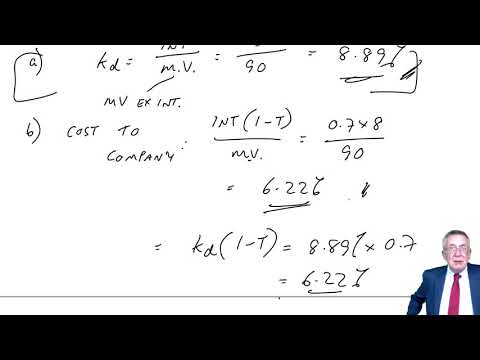
F plc has in issue 8% irredeemable debentures quoted at 90 p.c. ex int.
What is the return to investors ( kd ) ?
What is the cost to the company, if the rate of corporation tax is 30% ?
Show answerHide answer
4.2 Redeemable debt
G plc has in issue 6% debentures quoted at 85 ex int.
The debentures are redeemable in 5 years time at a premium of 10%
What is the return to investors ( kd ) ?
What is the cost to the company if the rate of corporation tax is 30%?
Show answerHide answer
5 The weighted average cost of capital (WACC)

In the previous sections we have seen how to calculate the cost of both equity and debt.
However, most company are financed using a mixture of both equity and debt.
It is useful for our later work to be able to calculate the average cost of capital to the company. We do this by calculating the cost of each source of finance separately (as in the previous sections) and then calculating a weighted average cost, using the ex div/int market values of the equity and debt.
J plc is financed as follows:
Equity – 5 million $1 shares quoted at $2.50 cum div, on which a constant dividend of 32c per share is about to be paid.
Debt - $4M 8% debentures quoted at 92 ex int.
Corporation tax is 30%
Calculate the weighted average cost of capital
Show answerHide answer
K plc is financed as follows:
Equity – 10 million $1 shares quoted at $3.20 ex div, on which a dividend of 20c per share has just been paid. Dividends are growing at 8% p.a..
Debt - $6M 10% debentures quoted at 105 ex int. The debentures are redeemable in 6 years time at a premium of 10%
Corporation tax is 30%
Calculate the weighted average cost of capital
Show answerHide answer
The weighted average cost of capital is often (but certainly not always) the rate that we use for the discounting of cash flows when we do investment appraisal. However, this chapter is simply about the arithmetic – we will discuss the relevance of the WACC in later chapters.