
Professional Ethics

1 Introduction
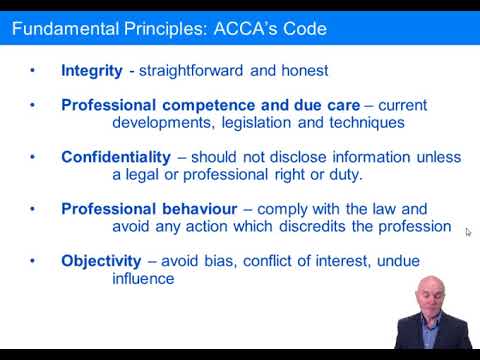
The ACCA Code of Ethics and Conduct ('the Code') sets out certain fundamental principles about how its members should behave. It also recognises how its members could be subject to certain threats which would compromise their behaviour and suggests ways in which members can safeguard themselves against the operation of those threats.
The Code applies to all members of ACCA and also to all ACCA students. It applies not only to those in public practice ('auditors') but also those in industry and commerce ('in business').
An ACCA registered student, affiliate or member who fails to comply with the Code will be liable to disciplinary action.
The conceptual framework approach to professional ethics recognises that there are:
Fundamental principles to be followed
These are subject to threats
Threats must be addressed.
2 Fundamental principles
The ACCA’s fundamental principles are as follows:
Integrity requires professional accountants to be honest and straightforward in all professional and business relationships. If they see something is amiss, they should say so and shouldn’t try to conceal it; they shouldn’t ‘turn a blind eye’; they shouldn’t try to be ambiguous; they should state things plainly.
Objectivity in making professional or business judgments must not be compromised. They must avoid bias, conflict of interest and undue influence.
Professional competence and due care must be exercised. They must keep themselves up-to-date with legislation and recent developments. They shouldn’t take on work which they are not qualified for or for which they have no skills. They must be diligent, they must be careful.
Confidentiality must be respected. Auditors, in particular, have access to information that is highly confidential and may be price sensitive. That information must be held confidentially. Members should not disclose confidential information unless they have a legal or professional duty to do so. An example of a legal duty to disclose information can arise if a member thinks that a client or the person they are working for is involved in money laundering.
Professional behaviour requires accountants to comply with the law and avoid any actions which discredit the profession. So, for example, when they are trying to advertise their services they shouldn’t say that other members are bad or poor. They should confine themselves to promoting what they are good at; they shouldn’t criticise other professionals.
3 Threats to the fundamental principles
Threats to compliance with the fundamental principles arise from
Self-interest
Self-review
Advocacy
Familiarity
Intimidation.
Note also there are management threats, where the auditor performs managerial functions for the client. These are not a separate category of threat, but covered under several of the above, such as self-interest and familiarity.
Where such threats exist, the auditor must:
Eliminate the circumstance that creates the threat(s); or
Apply safeguards, where available, to reduce the threats to an acceptable level (see ‘Safeguards’ below); or
Decline or end the specific professional activity.
3.2 Self-interest threats
Self-interest threats include the following:
Financial: For example if an auditor owns shares in the client, the auditor could be accused of wanting the client’s profits to look good, so that the share price and/or dividends increase thereby enriching the auditor.
Close business relationships are also threats. For example, if a partner retired from an audit partnership and then immediately went to work for a client, they could be accused of having lined themselves up for a job and to do that they perhaps did not do their audit rigorously. A period of at least two years should pass before an ex-partner takes up an appointment with a client. Having a partner on the client board is also unacceptable.
Close family and personal relationships between the auditor and owners or directors of the company they are auditing lay the auditor open to suggestions that the audit has been neither objective nor independent, and that the auditor did not show the proper degree of integrity.
Loans and guarantees from the client to the auditor should be looked at carefully. If the audit client is a bank and it makes a loan on normal business terms to a member of the audit staff, for example a mortgage, this would normally be regarded as acceptable. If however the bank (the audit client) made a large loan to the firm that was not on normal lending terms, this would compromise the auditor's independence (i.e. that favourable terms are for a 'clean' audit opinion). Certainly no loans or financial relationships should exist between a client and an auditor if it is not normal business for the client to make loans.
Overdue fees put the auditor at some risk as there is a possibility that client will never pay those fees. This could lead to accusations that the auditor has not modified the audit opinion to reduce the likelihood that a worried lender or other creditor might commence liquidation proceedings against the company. If there are overdue fees the auditor should not make the situation worse and should not incur any more chargeable time until those fees have been settled. If fees remain outstanding, the auditor should resign.
Contingent fee arrangements are not permitted for audit engagements. An example of a contingent fee is one that is calculated based on reported revenue or profit.
High percentage fees. If the auditor earns a high percentage of total income from one audit client, then the auditor will rely too much on that client and can’t afford to lose them. This can give the client too much leverage over the auditor. The total fees from a public interest entity ('PIE') client, (e.g. a company listed on a stock exchange) should not exceed 15% of the firm's total fees for two consecutive years. If they do, safeguards must be applied or the engagement ended (see ‘Safeguards’ below). No figure is mentioned for non-PIE clients, but auditors need to be mindful of this threat.
Low-balling refers to the practice of quoting a very low audit fee to win a client, in the hope of gaining more lucrative non-audit work. This means really that the audit does not pay for itself so how, therefore, could a proper audit be done? Winning an audit is a competitive business and the audit fee is an important factor to clients. There is nothing illegal about low-balling and quoting a lower fee is not, in itself, unethical. However, an auditor could find it difficult to claim that a proper audit has been carried out if a loss were made on the audit.
Recruiting staff on behalf of a client should not be undertaken. The danger here is that if members of staff are recruited by the auditor, particularly financial staff, then subsequently the auditor might be reluctant to criticise the performance of those staff members as the advice they gave on recruitment looks bad. However, providing recruiting services to a non-PIE client is not prohibited as long as the hiring decision is left to the client. Similar considerations should be taken into account when asked to perform any management function for the client.
3.3 Self-review threats
Self-review threats arise when an auditor does work for a client and that work may then be subject to self-checking during the subsequent audit. For example, if the auditor prepares the financial statements, and then has to audit them, or the auditor performs internal audit services and then has to check that the system of internal control is operating properly. Auditors could obviously be reluctant to criticise the work which their own firms have earlier undertaken, and this could interfere with independence and objectivity.
Generally auditors must be very careful when undertaking such work. Certainly it is common for auditors to do additional work for their clients, but what is important that the work is done by an entirely different team from the audit firm.
Self-review threats can also arise if a member of the audit team:
Recently served as a director/officer of the client
Is seconded ('lent') to the client for a temporary assignment.
3.4 Advocacy threats
Advocacy is where the assurance or audit firm promotes a point of view or opinion to the extent the subsequent objectivity is compromised. An example would be where the audit firm promotes the shares in a listed company or supports the company in some sort of dispute (e.g. with the tax authorities). Advocacy can interfere with professional scepticism.
As always, the audit firm should weigh up the risks to its objectivity, integrity and independence and should withdraw from performing further work if those risks are too high.
3.5 Familiarity threats
Familiarity threats arise because of the close relationship between members of the audit team and the client. The close relationship can arise by friendship, family or through business connections. There is no general definition of what’s meant by close relationships, but if you were an auditor and your brother was the Finance Director of a client firm then there probably is a close relationship! If however the finance director was a remote cousin of yours, there might not be a close relationship. Note that there does not have to be any family or legal relationship: friendship can threaten independence and integrity.
Long association of senior personnel creates a familiarity (and self-interest) threat. The Code requires that an engagement partner cannot serve a PIE client for more than seven years (the 'time-on' period). This is to prevent too close a relationship and friendship growing between the two parties. The problem is that when a close relationship does grow, objectivity and scepticism are more likely to be lost.
After the time-on period, the 'cooling-off' period for an engagement partner is five years.
3.6 Intimidation
The final groups of threats are intimidation threats. These can deter the assurance team from acting properly.
Examples could be threatened litigation, blackmail, or there might even be physical intimidation, though it is to be hoped that that is rare. Blackmail could be more subtly applied. For example, if a gift or hospitality from a client were to be accepted, the possibility of that being made public would create an intimidation threat to objectivity.
3.7 The supply of other services
The issue of whether the auditor should provide audit clients with other services, such as taxation and management consultancy, is a controversial one as there are both pros and cons. For example, auditors will know a great deal about the operations of their clients and this can make the performance of other work much more efficient. If entirely new firms have to be brought in to supply these services, much of the information they find out about the client will already be known by the auditor and there is a real duplication of effort.
The provision of many non-assurance services will create a self-review threat (e.g. bookkeeping, internal audit, tax calculations and valuations material to the financial statements).
Another danger, of course, is that the auditors come to rely too heavily on the fees earned from the other work and are therefore reluctant to risk losing a client if they express a modified audit opinion (i.e. self-interest threat). Large audit firms can at least use separate departments, though this may be difficult with small firms.
In the US, listed companies are not allowed to obtain other services from their auditor. This is to ensure that the auditor is independent and performs only the audit. In most jurisdictions, there are no hard and fast rules but the overall guidance on ethics relating to objectivity and independence should be adhered to.
4 Safeguards
Use a four-part ethics answer: identify the scenario fact, name the threat, explain how objectivity or independence could be affected, and give a practical safeguard. Defining a threat without applying it to the facts earns little credit.
Applying safeguards may be a suitable response to address an identified threat. Other responses are to eliminate the source of the threat or decline/end the activity.
The ACCA Code of Ethics (2019) defines safeguards as "actions, individually or in combination, taken by the professional accountant that effectively eliminate threats to compliance with the fundamental principles or reduce them to an acceptable level".
A professional accountant’s action is not a safeguard unless it is effective.
The ‘test’ of what is acceptable is whether a “reasonable and well-informed party … would be likely to conclude that … compliance with the fundamental principles is not compromised”.
Safeguards vary depending on the facts and circumstances. Examples of actions that might be safeguards to address threats include:
Assigning additional time and qualified personnel (e.g. for a self-interest threat).
Having an appropriate reviewer (not a member of the team) review the work performed (for a self-review threat).
Using different partners/engagement teams with separate reporting lines for the provision of non-assurance services to an audit client (for self-review, advocacy or familiarity threats).
Involving another firm to (re-)perform part of the engagement (for most threats).
Disclosing to clients any referral fees/commission arrangements for recommending services/products (for a self-interest threat).
Separating teams when dealing with matters of a confidential nature (for a self-interest threat).
5 Breaches of ACCA’s Code
In the event of a breach of an independence provision, the firm must:
End, suspend or eliminate the interest or relationship that created the breach and address the consequences of the breach;
Comply with any legal or regulatory requirements applying to the breach and consider reporting the breach to ACCA;
Promptly communicate the breach to the engagement partner and those responsible for the firm’s independence policies and procedures;
Evaluate the significance of the breach and its impact on the firm’s objectivity and ability to issue an auditor’s report;
Depending on the significance of the breach, determine whether to end the audit engagement or if it is possible to take action that satisfactorily addresses the consequences of the breach.
For a breach of any provision of the Code, the firm must:
evaluate its significance (e.g. does it affect the auditor’s ability to comply with the fundamental principles?)
act as soon as possible to address the consequence; and
determine whether to report it to ACCA.
Professional ethics
10 questionsAnswer the questions one at a time. Your progress is saved so you can leave and come back.
Open chapter practice