
Fraud, Laws and Regulations

1 Definitions

Fraud is an intentional act by one or more individuals that uses deception to obtain an unjust or illegal advantage.
There are two types of fraud that result in misstatement of the financial statements:
Fraudulent financial reporting. For example, overstating profits to attract investors and lenders.
Misappropriation of assets. For example, the theft of cash, inventory or non-current assets.
Error is an unintentional mistake in financial statements including the omission of an amount or disclosure.
Teeming and lading is a fraud on trade receivables. The theft of money from customer A is concealed by allocating later receipts from customer B to customer A’s account. (‘Robbing Peter to pay Paul’)
2 Fraud in an Audit of Financial Statements
Answer the responsibility that was asked for. Management and those charged with governance have primary responsibility for prevention and detection. The auditor seeks reasonable assurance that the financial statements are free from material misstatement, whether caused by fraud or error.
It is management’s responsibility to prevent and detect fraud – not the auditor’s. Auditors are not expected to find every fraud, but they are expected (with reasonable assurance) to find material misstatements, whether caused by fraud or error.
At the planning stage, the susceptibility of material misstatement due to fraud should be discussed with the engagement team members. Examples of fraud risk factors (i.e. that increase the risk of fraud) include:
Deficiencies in internal control (e.g. lack of segregation of duties, inadequate monitoring)
Significant accounting estimates that are difficult to corroborate
Easy-to-steal assets (e.g. cash and small but high-value inventory items)
Known history of breaches of laws or regulations
Pressures on management to meet financial targets.
A fraud must be communicated to those charged with governance (TCWG) if it results in material misstatement or if management is implicated. Other frauds should be communicated to a suitable level of management. It is important, even for what appears to be a small fraud, to investigate for how long it has been going on, how much is involved and who is involved.
The auditor will usually obtain written representations (see Chapter 28) from management and TCWG:
Acknowledging their responsibilities for the prevention and detection of fraud;
Confirming that they have disclosed to the auditor their knowledge of actual, suspected or alleged fraud.
Note that any fraud (or error) that is immaterial does not affect the audit opinion and so will not be drawn to the attention of the users of financial statements.
3 Laws and Regulations
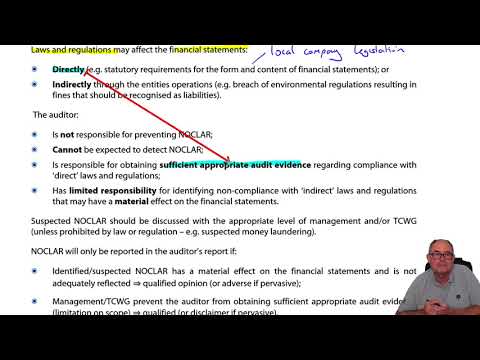
As for fraud, it is management (and TCWG) who is responsible for the prevention and detection of Non-Compliance with Laws and Regulations (NOCLAR).
NOCLAR is defined as acts of commission or omission, intentional or unintentional, committed by a client or TCWG ... contrary to laws or regulations. The definition excludes personal misconduct (i.e. unrelated to business activities).
Laws and regulations may affect the financial statements:
Directly (e.g. statutory requirements for the form and content of financial statements); or
Indirectly through the entity’s operations (e.g. breach of environmental regulations resulting in fines that should be recognised as liabilities).
The auditor:
Is not responsible for preventing NOCLAR;
Cannot be expected to detect NOCLAR;
Is responsible for obtaining sufficient appropriate audit evidence regarding compliance with ‘direct’ laws and regulations;
Has limited responsibility for identifying non-compliance with ‘indirect’ laws and regulations that may have a material effect on the financial statements.
Suspected NOCLAR should be discussed with the appropriate level of management and/or TCWG (unless prohibited by law or regulation – e.g. suspected money laundering).
NOCLAR will only be reported in the auditor’s report if:
Identified/suspected NOCLAR has a material effect on the financial statements and is not adequately reflected ⇒ qualified opinion (or adverse if pervasive);
Management/TCWG prevent the auditor from obtaining sufficient appropriate audit evidence (limitation on scope) ⇒ qualified (or disclaimer if pervasive).
Fraud, laws and regulations
10 questionsAnswer the questions one at a time. Your progress is saved so you can leave and come back.
Open chapter practice