
Non-Current Assets

1 Relevant assertions
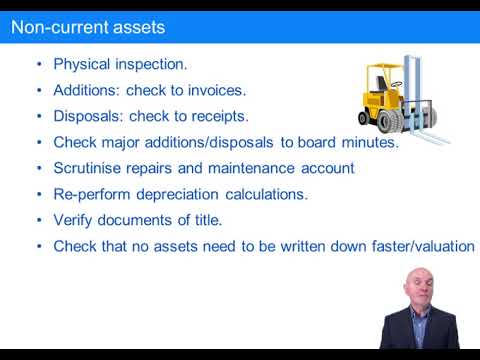
As for any account balance, the relevant assertions for non-current assets are existence, rights and obligations, completeness, accuracy, valuation and allocation, classification and presentation. See also Chapter 24 for an illustration of documentation for non-current assets.
2 Audit procedures
Tailor non-current-asset procedures to the scenario. Separate capital expenditure from repairs, inspect invoices and the assets, verify additions and disposals, and recalculate depreciation for the correct period. Generic procedures earn little when the requirement identifies a specific issue.
Physical inspection. Remember many non-current assets have a very high value. One of the simplest ways to check on the existence of the asset is to actually see it. The direction of testing for existence is from the accounting records (non-current asset register) to the physical assets. If an asset no longer exists, it must be derecognised (see disposals). In addition to checking whether the asset exists, physical inspection may allow the auditor to detect if the asset needs to be written down (impairment) because it is damaged or no longer used.
Purchase invoices and cash receipts. Additions of new non-current assets and disposals of old ones should be checked to invoices and to receipts respectively. If the addition is material you would probably expect to trace it back to a purchase requisition and if it is very material, it is likely that the acquisition will have been discussed in the board meeting and should be found in board minutes. Similarly larger material disposals will often be discussed at board level.
Scrutiny of repairs and maintenance. A non-current asset addition should be capitalised whereas repairs and maintenance costs should be expensed. Therefore it is important to scrutinise the repairs and maintenance account for items which should be more properly recognised as non-current asset additions to ensure completeness.
Reconciliation of the carrying amounts in the general ledger accounts to the non-current asset register. The financial statement balances are supported by the detail in the non-current register and should reconcile to the cost and accumulated depreciation amounts.
Reperformance of depreciation calculations. It is important to check the accuracy of depreciation calculations. This may be possible through a 'proof in total' or 'reasonableness test' (a substantive analytical procedure) on the total depreciation expense for a class of assets. However, if there are fully-depreciated assets (on which there should be no further depreciation) it may be necessary to reperform a sample of detailed calculations on individual assets in the asset register.
Check disposals. When checking disposals it is important to make sure that the non-current asset register is properly adjusted, the cost of the item is taken out of the cost account and that the accumulated depreciation is taken out of the accumulated depreciation account, and that the profit or loss of disposal is properly calculated. Remember that where an asset is 'traded-in' in part exchange for a new asset, the fair value of the old asset should be accounted for as disposal proceeds and included in the cost of the new asset.
Inspect documents of title. This confirms ownership: physical inspection merely tells you the asset exists but how do you know the company owns it? They could have sold an asset and could be renting it back. Therefore documents of title are extremely important.
3 Revaluations
Where an asset has been revalued, confirm that the requirements of IAS 16 Property, Plant and Equipment have been met (e.g. all assets in the same class have been revalued).
Agree the revaluation amount (e.g. to a valuation report or market data for similar assets).
Confirm that the gain has been correctly accounted for in other comprehensive income and shown separately in a revaluation surplus in the statement of changes in equity.
Recalculate depreciation expense based on the revalued amount. Remember that an amount equivalent to the additional depreciation expense on the revalued amount may be transferred from the revaluation surplus to retained earnings (i.e. within equity) in accordance with IAS 16.
Non-current assets
10 questionsAnswer the questions one at a time. Your progress is saved so you can leave and come back.
Open chapter practice