
Corporate Governance

1 Why corporate governance is needed
Corporate governance may be defined as "the system by which companies are directed and controlled".
Therefore, the objectives of corporate governance are:
To ensure that the company’s assets are used efficiently and productively and in the best interests of its shareholders and other stakeholders;
To eliminate or mitigate conflicts of interest, particularly those between management and shareholders.
The problem with bad corporate governance is that although the shareholders own companies, the day-to-day management and direction of companies is given to the Board of Directors. In large companies many shareholders are relatively passive and the Board of Directors is given more or less free rein to make whatever decisions they wish.
Auditing was instituted so that at least once a year, when the financial statements (FS) were presented to the members of the company, an auditor would examine them and give some expression of opinion to the members of the company as to whether the financial statements were “true and fair”. Without that assurance the members of the company really would have a little idea whether or not the information could be relied on. The auditor therefore examines the financial statements and this adds credibility to those statements, the shareholders have a much better idea of the performance of the directors and the company.
Note that shareholders appoint the independent auditor, they also appoint the directors. The problem is that once directors were appointed, shareholders often didn’t take much further interest in what the directors were doing and there were annual gaps between financial statements being issued. This hands-off approach has recently been found entirely inadequate and additional safeguards have been instituted to try to ensure that directors act in the best interests of the members of the company. Directors should act for the shareholders but often acted for themselves – the agency problem. In agency terms, the shareholders are the principals and the directors are their agents. Agents should act in the best interests of their principals.
2 Principles of corporate governance
The Organisation for Economic Co-operation and Development (OECD) promotes six Principles of a corporate governance framework:
It should promote transparent and fair markets and support effective supervision and enforcement.
It should protect shareholders' rights and ensure all are fairly treated (i.e. including minority shareholders).
It should provide for stock markets to contribute to good corporate governance (e.g. by prohibiting insider trading).
It should recognise the rights of all stakeholders, not just shareholders.
It should ensure timely and accurate disclosure of all material matters, including financial position, performance, ownership and governance.
It should ensure the strategic guidance of the entity, effective monitoring of management by the board and the board’s accountability to the entity and their shareholders.
3 The UK Corporate Governance Code
Turn each governance point into four steps: state what the code expects, identify the scenario departure, explain why it matters, and recommend a specific corrective action. A vague recommendation such as ‘improve independence’ does not tell management what to change.
The OECD principles are put into effect in a variety of ways in different countries. The ACCA has specified that for AA, the UK Corporate Governance Code published by the Financial Reporting Council (FRC) is an example of best practice.
The Principles of the Code emphasise the value of good corporate governance to the long-term success of the company.
Main principles of the UK Code
Board Leadership and Company Purpose
Division of Responsibilities
Composition, Succession and Evaluation
Audit, Risk and Internal Control
Remuneration
Comply or explain
The Code has no force in law and is enforced on listed companies through the Stock Exchange. Listed companies are expected to ‘‘comply or explain’’ and this approach is the trademark of corporate governance in the UK.
Listed companies have to state that they have complied with the code or else explain to shareholders why they haven’t. This allows some flexibility and non-compliance might be acceptable in some circumstances.
Board Leadership and Company Purpose
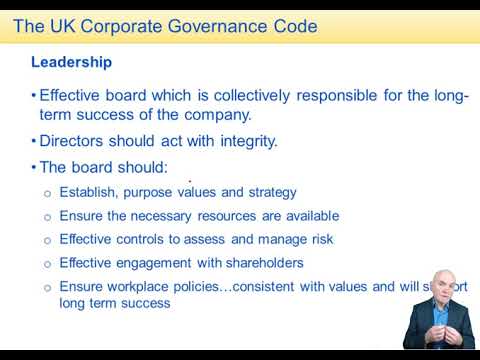
Every company should be headed by an effective board which is collectively responsible for the long-term success of the company.
All directors must act with integrity, lead by example and promote the desired culture.
Division of Responsibilities
There should be a clear division between the running of the board and the executive responsibility for the running of the company’s business. No one individual should dominate decision making. This means that the roles of CEO and chair should not be performed by one person as that concentrates too much power in that person.
The chair is responsible for leadership of the board and should be independent on appointment (e.g. not an employee within the last 5 years).
At least half the board should be non-executive directors (NEDs) who are considered independent (e.g. no close family ties with executive directors, no significant shareholdings, etc).
NEDs should provide constructive challenge and strategic guidance and hold management to account.
Composition, Succession and Evaluation
Appointments to the board should be subject to a formal, rigorous and transparent procedure led by a nomination committee. A majority of the committee should be independent NEDs.
The board and its committees should have a combination of skills, experience and knowledge. The length of service of the board as a whole should be considered and membership regularly refreshed. The post of chair should not be held beyond nine years.
The board should undertake a formal and rigorous annual evaluation of its own performance and that of its committees and individual directors.
All directors should be submitted for re-election annually.
Audit, Risk and Internal Control
The board should establish formal and transparent policies and procedures to ensure the independence and effectiveness of internal and external audit and the integrity of financial statements.
The board should present a fair, balanced and understandable assessment of the company’s position and prospects. The financial statements should state whether the board considered the appropriateness of the going concern basis of accounting and identify any material uncertainties for at least 12 months from the date of approval of the financial statements.
The board should establish procedures to manage risk, oversee internal controls and determine the nature and extent of the principal risks the company is willing to take to achieve its long-term strategic objectives.
The board should establish an audit committee of independent NEDs.
Remuneration
In essence, remuneration should be sufficient to attract, retain and motivate directors of sufficient quality… but avoid paying more than is necessary.
A significant proportion of executive directors’ remuneration may be structured to link rewards to corporate and individual performance. In other words, profit related pay is encouraged. Directors should not receive high pay irrespective of company performance.
There should be a formal and transparent procedure for developing policy on executive remuneration and for fixing the remuneration packages of individual directors. No director should be involved in deciding his or her own remuneration. This means that a remuneration committee (NEDs) should be formed to fix directors’ remuneration.
4 The audit committee
The audit committee should be composed of independent NEDs:
a minimum of three members (or two for smaller companies);
the chair of the board should not be a member;
at least one member must have recent and relevant financial experience;
the committee as a whole must have competence in the relevant business sector.
The main roles and responsibilities of the audit committee include the following:
Monitoring and reviewing the effectiveness of internal audit. Companies don’t have to have an internal audit department, but the need for one must be reviewed annually.
Monitoring the integrity of the financial statements and reviewing significant financial reporting judgements.
Review the internal financial controls and risk management systems (unless there is a separate risk committee or the board does this).
Making recommendations to the board about the appointment, reappointment and removal of the external auditors and agreeing the terms of engagement. (Note that the external auditors are appointed by members in general meeting, but the board puts forward the nomination.)
Annually assessing the independence, objectivity and effectiveness the external auditors including confirming that there are no self-interest or familiarity issues and that partners and staff are rotated properly.
Acting as a forum to link directors and auditors. Auditors will typically write to the audit committee about any problems they may be having on the audit or obtaining all the information they require. If the auditors are worried in some way about the financial statements they will raise those concerns with the audit committee.
Developing and implementing policy on the engagement of the external auditor to supply non-audit services: skills, approval and non-approval for certain services, ensuring any threats to independence and objectivity are reduced to acceptable levels and monitoring the fees for those services and the total fee for all services provided by the external auditor.
Corporate governance
10 questionsAnswer the questions one at a time. Your progress is saved so you can leave and come back.
Open chapter practice