Skip to contentSkip to search

ACCA Forums

AFM*** P4 December 2014 Exam was.. Instant Poll and comments ***

Oopentuition_teamAdmin11y ago

Please vote in our Instant Polls about the P4 December 2014 Exam.
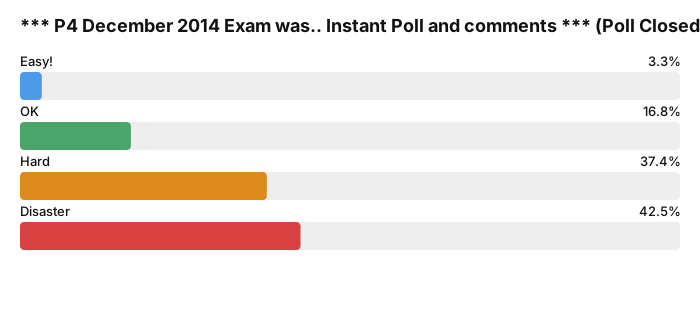
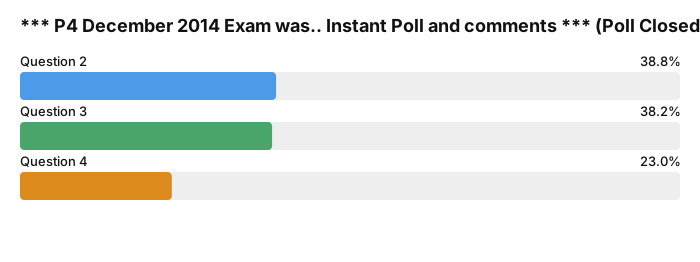
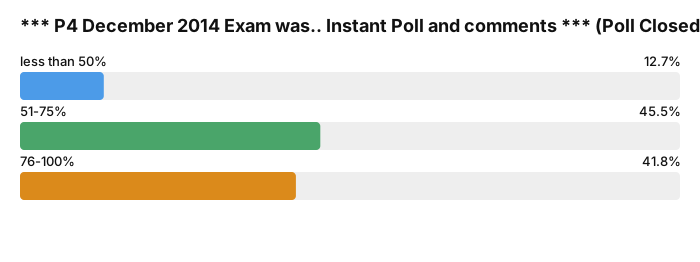
*** P4 December 2014 Exam was.. Instant Poll and comments *** poll results *** P4 December 2014 Exam was.. Instant Poll and comments *** poll results *** P4 December 2014 Exam was.. Instant Poll and comments *** poll results Please note, the ACCA have asked us to allow posting comments only after 5pm UK time.
Former userFormer user11y ago#151
I heard some students assumed some figures they could not calculate. How can assuming a value for the discounting rate make a pass in this exam? What we will learn? That it's important to rush an answer to the managers so they can decide whether to invest or not based on an assumption? Who is to blame then? ACCA for trying to rush calculations on important measures to complex real life situations... I am dissapointed and unmotivated to continue. I have enjoyed to learn such interresting ways of measuring performance. I liked all and learned all... But the exam was unfair.
RRamesh11y ago#152
I think it is like this. The market price of 7.5 to multiply with the number of shares. That is 12000. Divide that by 7.2 which gives 1667, which is the free cash flow to equity of that company. Then find the FCFE of the other company and add the 400 synergy benefit. Add up all the three and multiply by 7.5. This gives about 19000 or 17000.approx (I am not sure)which is the FCFE of combined company. So increase in value is 17000 less 12000.
Oopiod11y ago#153
Salam Contract, literally called Bai al-salam is similar to a forward contract where the buyer pays in advance for the delivery of raw materials or fungible goods (a commodity that is freely interchangeable with another in satisfying an obligation) at a given date. The spot price of the item includes the profit of the person who has taken the task of purchasing good and, of course, the cost of the product.
Former userFormer user11y ago#154
the p4 examiner have no intentions of passing the candidates... i mean why the hell he complicate so much?? i was hell prepared for p4 but in the end it was all just a mess.... an extreme one
AAndy11y ago#155
Elvericia: ACCA have to pass a certain number of candidates. I've no idea what that percentage is but hopefully there won't have been too many geniuses sitting it in December 2014 and all of us people of a high but not Mensa level of intelligence will get given some of the credit we deserve for the months of hard work and waste of life we endured. I'm fully prepared to sit this one again in June though and then at least ACCA are introducing quarterly sessions after that so the chances of getting more reasonable questions will be higher (although with this sedistic examiner I'm not holding out too much hope). Just got to keep grinding away and we will all get there eventually
Former userFormer user11y ago#156
First of all...i apologize to the examiner that I was not prepared at all to write this exam (by this I mean zero studies / preparation).. but i deeply sympathize with my fellow colleagues as after not preparing for this exam i too felt very confused with the Q1 requirement..I actually thought wow this is the first time i used almost all the given formulae.. We should also prepare a student report with our feedback on these exams..submit them after every exam to the ACCA.. Feel disappointed that I could not give enough respect to a paper I was interested; Definitely can expect a FAIL although i had plans to pass it this time.. Anyway it was good exam experience and hard lessons learned!
GGewen11y ago#157
That is why you are suppose to start within your section B questions first there is usually at least one you know you can get full 25 marks for, for example question 3.
GGewen11y ago#158
That is why you are suppose to start within your section B questions first there is usually at least one you know you can get full 25 marks for, for example question 3.
Bbmparadzi11y ago#159
I agree with your reasoning in question 1, and applied a similar technique did not see any options in the question so hopefully we are right together and get passes! :)
Bbmparadzi11y ago#160
@ajs90 said: I decided to do section B questions first and managed to get 3&4 done to what I hope is a satisfactory standard. I didn't have time for, I think, 3c relating to legal risks so i skipped it and moved on to question 1 with 90mins left. Question 1 - wowza what a nightmare. The question was closely related to one of acca's technical articles --> https://www.accaglobal.com/uk/en/student/acca-qual-student-journey/qual-resource/acca-qualification/p4/technical-articles/conditional-probability.html I didn't manage to finish the assessment of the project with the offer to sell the project after year 1 however I'm pretty sure that this was not a real option question. A lot of people will disagree with me on this but if you read the article linked to above it shows how to assess an offer to sell using probability adjusted cash flows (you look at the probability adjusted present value of cash flows after year 1 and then compare this value to selling the project - the article explains this much better than me). There was no standard deviation in the question so there was no way to calculate the value of a real option. As I said though I didn't do any better as I didn't finish the last 2 parts of Q1 (which will also have cost me at least 3/4 professional marks and caused me to fail I'm fairly certain). My issue is not the difficulty of the question, it's the time constraint. I really struggle to see why ACCA papers, particularly at the professional level, are so time pressured?! Surely examining someone's ability to sit and think through a problem is more valuable than assessing how quickly than can get a semi-sensible scatter of relevant numbers down. Giving more time would improve the quality of answers, ensuring that candidates are assessed on what they know rather than how quick they can work. Surely it's better for an individidual to work a little slower but work in a neat methodical manner providing sensible logical and useful advice for the given scenario. No doubt a reduction in time pressure would also make the markers job easier as well because answers could be presented better. Even before this I was considering writing to acca to get an understanding of why we are given a tight time constraint, I don't see much value in it. If candidates have the knowledge but it takes them longer to get it down then I think they deserve to pass, there should not be a punishment for being a slow writer or for being having a bit more thinking time. In the real world it is a much bigger error to steam in to your work and make mistakes than to stop and take a few minutes to really consider what you need to do and how best to present it. This reality should be reflected in the ACCA exams. Super frustrating to know more than you have time to write. I'd like to know what others think on this. AJ
I agree with your reasoning for Q1 and hopefully we get passes for that line of thinking! :)
Aadalber11y ago#161
June 2014 Examiner´s report: .... On the whole it was not evident that the exam was time- pressured. It was also evident that in the main candidates managed time adequately between the three questions.... I was like.... haha :D
JJarix11y ago#162
Supergage if u use 77%....it was still not possible for g to be bigger than ke. Ke was given as 11% ....so if u use g according to ur cal should have been 11%* 77=8%....if u uses 23. Something % g would have been 2.4 I think
JJarix11y ago#163
It was not compulsory to use blackshool in this question bcos attempting it would be like difficult to ascertain the volatility. But if u have used it fine and also if not fine. The examiner was testing expected values and decision tree for the cash flows. Below is the comment of the examiner in one of his articles 'A commonly used way of evaluating decisions is via the use of expected values. An expected value summarises all the different possible outcomes by weighting the possible outcomes by their probabilities and then summing the result. Problems where one or more decisions have to be taken can become more complex and may require the use of a decision tree, with expected values being used to evaluate each of the decisions. A decision tree is a diagrammatic representation of a problem, where the decision maker needs to consider the logical sequence of events. Since one event may depend upon another, we may get situations where event one has a certain probability of occurring and event two, which depends on event one occurring, has another probability of occurring. In such circumstances, we have a situation of combined probabilities Eg if event one has a 0.6 chance of occurring and subsequent event two a 0.75 chance of occurring, then overall the probability of both events occurring is: 0.6 x 0.75 = 0.45 ie a 45% chance of occurring. We shall look at such concepts in the following example, which demonstrates how techniques acquired in Papers F5 and F9 can be used in the Professional level papers.
Fflippy11y ago#164
@jarix said: It was not compulsory to use blackshool in this question bcos attempting it would be like difficult to ascertain the volatility. But if u have used it fine and also if not fine. The examiner was testing expected values and decision tree for the cash flows. Below is the comment of the examiner in one of his articles 'A commonly used way of evaluating decisions is via the use of expected values. An expected value summarises all the different possible outcomes by weighting the possible outcomes by their probabilities and then summing the result. Problems where one or more decisions have to be taken can become more complex and may require the use of a decision tree, with expected values being used to evaluate each of the decisions. A decision tree is a diagrammatic representation of a problem, where the decision maker needs to consider the logical sequence of events. Since one event may depend upon another, we may get situations where event one has a certain probability of occurring and event two, which depends on event one occurring, has another probability of occurring. In such circumstances, we have a situation of combined probabilities Eg if event one has a 0.6 chance of occurring and subsequent event two a 0.75 chance of occurring, then overall the probability of both events occurring is: 0.6 x 0.75 = 0.45 ie a 45% chance of occurring. We shall look at such concepts in the following example, which demonstrates how techniques acquired in Papers F5 and F9 can be used in the Professional level papers.
@jarix i did not use the bsw model..i failed to recognise it..but i used the expected value instead..i feel kind of relieved after seeing u saying this hehe
Former userFormer user11y ago#165
@keyboard said: if suppose in any case g > ke then use …return on equity (ROE) for G (for FCFE) if g>ke then use..return on capital employed(ROCE) for G (for FCFF) @jarix… spot on!!! same as mine! :P
thx, jarix also many tnx. as stated following G i have calculated WACC and compared g with WACC; because of high gearing wacc was lower than g. anyway, WHAT on earth was in my mind with FCFE to use WACC and to be confused .. OMG, time pressure. anyway, I also notice that using real option may be an innapropriate. however, is it possible to derive volatility from probability? a direct relation? using the standard deviation distribution table based on probability.. have to think on it. best wishes to all! this exam is the best, I will take as many times as necessary :)
Mmeheryar11y ago#166
the disastrous paper. i was unable to identify that we had to use blackscholes in the absence of deviation later of my friends told me that we had to use blackscholes LOL. secondly Q1. was too long plus the data was too scattered that we had to go through the whole question a lot of times in order to understand that what exactly the examiner is asking us to do. i was very disappointed. very unpredictable paper.well hope for the good.
SssKhan11y ago#167
Hello Bro. please send me an email on [email protected] and lets talk about this paper. thanks
Former userFormer user11y ago#168
June for sure..for the third time......greatest battle ever :(
JJarix11y ago#169
supergaga/ The volatility in real pricing is the standard deviation. The sd is the square root of the variance. The variance is derive from the difference between the mean and the individual variables. To answer the question ...it was possible to find the variance but variance cannot adequately tell the pattern of probabilities. In this question the use of expected value to solve the cash flow was the appropriate method or even decision tree.
Aabdulrahman11y ago#170
This is my 7th Attempt on P4..i didn't expect such a paper this time... my question is, is it practical to do the first question within 90 minutes..we need 30 minutes of reading time to understand the question. what a hell lot of information on the question.. I humbly request open tution to forward all this comments to ACCA an examiner to make them understand what the students feel and be flexible on the marking scheme. Thanks..
Rriotheone11y ago#171
I can say that I knew the syllabus and techniques very, very well and managed to get q1 done well with quite a confidence. But I felt behind time by 30 mins after Q1, rushed with 2 other questions and didn't attempt around 15-20 points. The most pathetic thing, looking back at Q1, he was giving like 12points for (a) part which is just a discussion around EU and 18 points for calculating market value of debt, MV of equity, ungear then weight average then gear betas, discounting debt, calculating WACC, discounting cash flows, calculating NPV, weight it around probabilities, calculating call option using BSOP and calculating put option. I am not going to pick nice words for that, this is stupid and irrational, ACCA discredit itself with this bs structure of the exam.
Former userFormer user11y ago#172
Anyone know if we will be able to get model answer or a tutor's attempt at the paper from anywhere? This is my last paper and I'm desperate to gauge how well I've done! My attempt was a bit of a scatter gun approach, and because Q1 took so long the written stuff in 2 and 3 tended to be quite brief and included some guesses. Also have no idea how you're supposed to get the 4 marks for a report, would take twice as long to have calculations in a separate appendix and keep switching back and forth between the two. Hoping I've done enough 1) a) is diversification and buying undervalued companies a valid risk diversification strategy? - entering new markets is a good way to further diversify risk as market risk will be diversified. companies will be undervalued when management is not performing well. however in perfect markets the company will not be undervalued. companies more likely to be undervalued in imperfect markets, but this makes these investments more risky. so yes it is a valid strategy although you can diversify risk but your overall risk exposure may actually increase. Basically I waffled a lot on this and not sure how much was correct! b) why might EU not want Nahara to buy the other co? - competition commission, cons of a monopoly, foreign govt owned so political risk as well c) i)value of Fugae - g=br, FCFE @ ke, add synergy, time by 7.5, subtract consideration (mvE + mvD). Think I worked out the value of Fugae to be 922.5m ii) value of luxury transport project with and without option - probabilities (pretty sure I got these right but didn't include any workings) ,expected value discounted @ WACC (I used Avem's WACC in error but noted this later on when I realised), black scholes option (just did Pe-Pa to show there was intrinsic value), asset beta of luxury business weighted to .15 and regeared iii) evaluate i) and ii) - Avem should buy F, should proceed with luxury transport project as positive NPV, should take option as has intrinsic value (assuming £50m paid today) 2 a) centralised treasury - inter company hedging, greater power in the finance market (eg borrowing), can use treasury to achieve group's targets decentralised - motivate local staff, can react quicker to local issues, should know local regulations better (eg Islamic finance), autonomy b) Calculate swap & option - swap seemed fairly easy, didn't attempt the option due to time c) Salam - spec not allowed, not allowed for cash, gold, silver etc, must be backed by existing tangible assets, no unethical trades like gambling, must be compliant with sharia law so more expensive to set up 3a) EU Free Trade Zone characteristics and goals - remove barriers to trade eg import tariffs and embargoes, all members treated equally rule to reduce political conflicts impacting trade, competition is better for customers and shareholders eg through lower prices b) IRR, MIRR, VAR at 95% and 90% - did all calculations, D was better in 3 of them so go for D especially as MIRR is superior to IRR c) what are the legal costs and how to mitigate - food standards agency regulations/fines, mitigate by Joint Venture, making provisions, pay legal consultants with expertise in that market
Qquestforknowledge11y ago#173
the exam for me was a disaster, i attempted question 2 and 3 first. they were ok but for the islamic finance that i have never read and i dont even know what it is all about. when i started question section a and b was not bad. when i reached section i didnt know what to do. i felt like leaving the hall. anyway let me taste failure for the first time. will take try it again in June with P7. maybe luck will be on my side. Sir John is always there.
Former userFormer user11y ago#174
So we were 2 laughing the way back home LOL I never had seen a paper that difficult and it is my last paper :(
005021986x11y ago#175
Q1 was a complete disaster, ran out of time and could do only a, b and WACC calculation.Q2 and Q4 were reasonable specially the theory part of the question. It is my third attempt & last hurdle to qualify. In difficulty and time pressure, this paper is leaving Paper P2, far behind. Last time I manged to get 38%, don't know what it is going to be this time. Its a total waste of time and hard earned money.
Former userFormer user11y ago#176
while it was 15 mins remaining.. I started laughing at the paper. It was a Disaster! The most difficult paper of all time
Llzy_jzy11y ago#177
@pedroorange said: Anyone know if we will be able to get model answer or a tutor's attempt at the paper from anywhere? This is my last paper and I'm desperate to gauge how well I've done! My attempt was a bit of a scatter gun approach, and because Q1 took so long the written stuff in 2 and 3 tended to be quite brief and included some guesses. Also have no idea how you're supposed to get the 4 marks for a report, would take twice as long to have calculations in a separate appendix and keep switching back and forth between the two. Hoping I've done enough 1) a) is diversification and buying undervalued companies a valid risk diversification strategy? - entering new markets is a good way to further diversify risk as market risk will be diversified. companies will be undervalued when management is not performing well. however in perfect markets the company will not be undervalued. companies more likely to be undervalued in imperfect markets, but this makes these investments more risky. so yes it is a valid strategy although you can diversify risk but your overall risk exposure may actually increase. Basically I waffled a lot on this and not sure how much was correct! b) why might EU not want Nahara to buy the other co? - competition commission, cons of a monopoly, foreign govt owned so political risk as well c) i)value of Fugae - g=br, FCFE @ ke, add synergy, time by 7.5, subtract consideration (mvE + mvD). Think I worked out the value of Fugae to be 922.5m ii) value of luxury transport project with and without option - probabilities (pretty sure I got these right but didn't include any workings) ,expected value discounted @ WACC (I used Avem's WACC in error but noted this later on when I realised), black scholes option (just did Pe-Pa to show there was intrinsic value), asset beta of luxury business weighted to .15 and regeared iii) evaluate i) and ii) - Avem should buy F, should proceed with luxury transport project as positive NPV, should take option as has intrinsic value (assuming £50m paid today) 2 a) centralised treasury - inter company hedging, greater power in the finance market (eg borrowing), can use treasury to achieve group's targets decentralised - motivate local staff, can react quicker to local issues, should know local regulations better (eg Islamic finance), autonomy b) Calculate swap & option - swap seemed fairly easy, didn't attempt the option due to time c) Salam - spec not allowed, not allowed for cash, gold, silver etc, must be backed by existing tangible assets, no unethical trades like gambling, must be compliant with sharia law so more expensive to set up 3a) EU Free Trade Zone characteristics and goals - remove barriers to trade eg import tariffs and embargoes, all members treated equally rule to reduce political conflicts impacting trade, competition is better for customers and shareholders eg through lower prices b) IRR, MIRR, VAR at 95% and 90% - did all calculations, D was better in 3 of them so go for D especially as MIRR is superior to IRR c) what are the legal costs and how to mitigate - food standards agency regulations/fines, mitigate by Joint Venture, making provisions, pay legal consultants with expertise in that market
Reading what you wrote is so so similar to what I did in exam. Ci)Did the whole of q1. Same value for fugue, I got 922.5. Ciii) I recall the question saying something like if avem buys fugue after the project starts they forgo the synergy benefits, so when I compared ci and Cii) I somehow got higher value for ci and recommended it proceed with the acquisition before proceeding with project so it doesn't forgo synergy benefits. Not sure tho. Overall thought I reaonably completed q1. But it took me 2 hours. 30 mins each for q2 and q3. Q2 I didn't complete the option calculation and the ultimate recommendation but did the rest (swap, theory etc) and q3 did everything except explain var and don't think I did the var calculations properly. Paper would have been doable with more time. Or less time pressure. That's the sole problem I had. No time to think, what's the point...
CChristine11y ago#178
i'm praying for a miracle pass for this paper. similar to everyone else, i didn't even know how to start question 1 and spent a long time re-reading the question. i thought of maximizing my time on q2 and 3 but even those questions were challenging. i had a miracle pass when i did P2 .....hopefully i can get another miracle for p4. can only hope for the best!
RRamesh11y ago#179
Let me tell you that , no matter, whether the exam is easy , ok hard or difficult the pass rate is going to be around 35%. All of us know about this. Now if the paper is very easy, then there is a problem, because most of them would have done it well and ACCA will not increase their pass rates. So even if you have made a small mistake you will be penalised heavily. But if the paper is tough, then even a big mistake may be penalised moderately because they cannot lower the pass rates. So personally, I prefer to face a tough paper and answer at least 85% of it. Then it is easier to pass. Most of the students start off with question1, and get stuck up and demotivated and they cannot answer the other easier questions and this is the reason why so many students feel frustrated. When you are attempting question 1, you must know that you have already scored some where around 25 to 30 marks and this will give you a lot of confidence and you can handle the question better?
Mmahoysam11y ago#180
The exam was difficult, but I managed to solve the entire paper and I am hoping for a pass!
Topic lockedNew replies are closed.