
Skip to content

ACCA Forums

AFM*** P4 December 2013 Exam was.. Post your comments ***

Oopentuition_teamAdmin12y ago
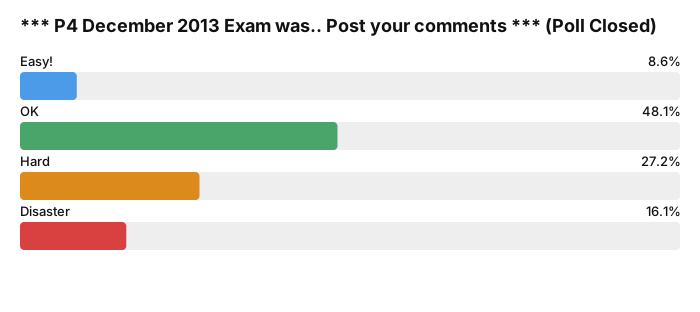
If you have visited this page before. please reload/refresh the page, the topic is now opened, and you should be able to post your comments Please post your comments about ACCA P4 December 2013 exam How did you do? How did this paper compare to previous exams? Vote in our Instant Poll *** P4 December 2013 Exam was.. Post your comments *** poll results
Rrmracca12y ago#61
Hi Tutor , Thanks a lot for all support during the study and revision phase:). Regards, RMR
Former userFormer user12y ago#62
@zain23, there's what's called OFR (OWN FIGURE RULE), So pls don't worry and relax. You are not marked wrong twice. So when you get a part wrong continue and the rest would marked right. Many thanks.
Former userFormer user12y ago#63
I mess on Q 1 too and it took me almost 2 hours too to finish !
Former userFormer user12y ago#64
Pa/Po = Value of Underlying asset = P.v Of Cash Inflows? Pe = P.v of Cash Outflows ? T = 2 Yrs? So it was like $28 & $35, which one is Pa & which one is Pe? Coz I got a call value(c) as negative, then put in the formula to get put, does it sounds about right? Hopefully, I get marks for the steps shown!
KKasia12y ago#65
So.... I believe it was easier than on June 2013 session. But - still I'm not sure if I will pass. Probably not as it is "killer" exam ;) In Q1 I got negative NPV of the project ... I thought I did something wrong but I left it as not having time to check where the error might be. So I was answering th question assuming my calculations are ok. I did Black-Scholes put option valuation. Well, maybe not commented it properly, but I was pretty sure my Cash flow calcs were wrong. Q3 - I think I got WACC of 8% (but maybe it was a rounding issue?). I wasn;t sure about premium in b) but I assumed it is the difference between: 1 share of $5.8 less 2 shares per $2.4, so $1.0 by 200 million shares. 50%-30% premium = 20% * 200 milion shares * $1 = $40m. I'm pretty sure it's wrong but it's the only thing I git in my mind at the exam with the time pressure and feeling that I failed Q calcs ;))) Q4 - I decided t do it only because few marks on Islamic finance that I was reading about last night (it was on tips to Dec 2013 exam!). Otherwise I'm not sure if I did a and b properly, it seemed that sale of supermarkets division was better. And that demerger doesn't make sense. Probably I was wrong. So overall - 3rd attempt to pass this monster exam will be in June 2014. So far I'm enjoying the idea that I DON'T HAVE TO REVISE TO EXAMS any longer and I can read some normal novels (well... until May 2014 ;) Good luck - with the results of P4 and with any other papers if you are going to take them this session!
Wwhim12y ago#66
The paper was lonnnnnnnnnngggg. Qt 2. FRA 3-7 gave around 738,000 of interest, locked. Futures gave 768,000 and 732,000. March buy 32 contracts. Options with 94.50 strike were much lower. About 61,900 in premiums. Best choice Futures as equal chance of rising or falling rates hence better expected value. For maximin manager FRA slightly better. Qt3. M has Vd of around 507 Million. But Debt of combined firm does not make sense then at 40:60. AS N has no debt. This confused me a lot. WACC for 8.88% or so, Took 9%. NPV of firm much higher than combined market cap. So acquisition should go ahead. Changing from 30-50% increases cost by 96 million. Not a big deal if benefits realized. Can do 1 year commercial paper, increase % of cost paid with shares or combine with rolling over existing debt. Too small to do bond offering by itself. QT 1 i HAD 55 MINUTES TO DO THIS! A) WTO part was ok. Cannot remember what exactly they asked here. Any comments appreciated. B) 1) That was a long calculation for the 14 marks. I would not be surprised if the examiner threw in 16-17 max marks IE you can get full14 getting a few things wrong. Exchange rates are easy with 1.08/1.02 differential. Sales and Operating margin was tedious and no space on columns. NPV was marginal. 2) Black scholes put option?. I had no clue how to calculate it., A lot of marks gone down the drain here. The reason is that I could not come up with Pe. There is nothing differed at this point. 3) Assumptions and risks. Wrote them in bullet form but could not discuss anything. No time. Do we get points for that? Good luck to all.
Ppblondon12y ago#67
PE is the exercise price ( not discounted) which was the £28m PA was the Pv of cash flow from year 3to year 5, together with the other variable you had to calculate the d1 and d2 and the call option .. after that you had to value the put option ( option to withdrawn) , I came up with a negative value .... Anyone else used the same approach?
Wwhim12y ago#68
USually Pe is the amount the company has to invest for it to be call option. This looks like a Put option setup. Just my opinion. I think I will be lucky to get 2 marks in that section.
Llee12y ago#69
Hey I would like to know whether it was a buy/ sell futures and call/ put options for question 2, anybody remember?
Llakeside12y ago#70
To be honest Q2 confused me, especially that interest was gonna go +/- 0.09% at the transaction date, so i assumed will be 2 situations of buy first and then do sell. Examiner will clarify later. I just pray to pass this time.
Former userFormer user12y ago#71
this wasn't a bad paper. question 1 was very long did. we have to do Black Scholes option pricing. or was that a curveball to throw us off. omg i forgot to multiple by 4 months for my future contracts. yes the cost of equity 12.6% and wacc was 9%.
Llee12y ago#72
Hey was question 2 a put or call option?
Former userFormer user12y ago#73
A. For currency hedge, 1. Decision Rule (for futures) Hedge Exposure Receipt Payment Other than $ Sell Buy $ Buy Sell 2. Decision Rule (for Options- Buy) Hedge Exposure Receipt Payment Other than $ Put Call $ Call Put B. For Interest rate hedge, 1. Futures Lending perspective - Buy futures today to hedge against interest rate falls , sell later Borrowing perspective - Sell futures today to hedge against interest rate rises , buy later When it comes to interest rate hedge, one must not forget to multiply by Loan Duration (which was 4 months) / 3 months for the no. of contracts. I think it was about 32 contracts i.e. $48m/2m x 4/3. , Buy June Futures (30/06) (the last one I think) , with one month to expiry as it expired on 30/06 with receipt on 1/06. Basis = Open Future Rate - Open Spot (rate of bank) , was something negative. Then Unexpired Basis = Basis x Time to expiry / Total months , Basis x 1/8 , from Now 1/11/13 to 30/06/14 i.e over 8 mths Closing Future Rate = Closing Spot rate + Unexpired basis Closing Future Px = 100 - Closing Future Rate Then do the usual comparison of Closing Future Px with the futures Px given to calculate profit/loss in future market on the 32 contracts ($48m) Then adjust with the spot (cash) market to get net figure. For Options - Buy Call Options Call option is exercised if Closing Future Px is higher than Exercise Px Compare Exercise Px (given in Q) with Closing Future Px to make decision whether to exercise or not. For Option Premium ($) = 32 contracts x $2M x Premium Given in table/100 x 3/12 For FRA, I have chosen 3V7 , is that right? I think it was receipt $48m in 3 month's time then invest it over 4 months for a project later. Just my thoughts. Anyway one will get mark for all steps shown, so even with some minor errors, no big deal!
Ssriram_ks1512y ago#74
I started off with Q2 first.. Q2 - I dunno if there was some mistake or something.. The spot Int rate was 4.09% but the options and futures were quoating at very low premiums.. I also dint find the amount of interest and then find out the effective rate... I just added/ subtracted the ticks from the spot rate to arrive at the effective rate... It is also a correct way of doing when the hedge is perfect but I dont see that in any of the text books.. Will i be deducted marks for not calculating the amount of interest but rather directly arriving at the interest rates..??? Q3 - PV of FCF was a huge 3k odd million figure for me... Tht would be a considerable premium to the market value... I dunno if I was right on it... But what did u guys get..??? It all seemed right though.. coz the growth rate was is perpetuity... Anyways part b was confusing.. I dint know what to write...?? and part c I just discussed the alternative forms of finance available with a cautious note on additional debt finance as the gearing was already 40%..? Did I miss something here too..?? Q1 - I got a negative NPV of 650,000... I dunno if it was right.. I also wrote an assumption to an effect that the extra 5% tax suffered was not available as credit.. In the options part you dont calculate the PV from year 2 or year 5 or so on... U just need to calculate the value of option with Pa - the total cash inflows from the project for the whole 5 years... Pe would be 28M... I got a 1.03 M value for option... SO the project would be worthwile if the value of option was also considered... Shame that I could not spend more time on the report... Time was up before I could phrase it in professional language and in a professional format... shame that really... On a whole, I expect to just make it.. Anybody else got the same answers as I did..??
Former userFormer user12y ago#75
I got a negative npv for my project and whilst I know it's not about getting the exact figures,I think it should Have been positive. Just wondering did I mess up on something silly on The CA for example on the machinery. I know the machinery was bought in T0,so were the first CA claimed in T1 Or T0? I put them in t1 as since this was the first year there were taxable Profits against which we could use the CA. I think I might have made the wrong call however so if people could say which is the correct way to deal with the CA that would be appreciated thanks! In relation to ques 1 b I used pe as the 28. Pa is the PV of the cash flows t3 -t5 as this is was the company would have to have given up if they sold the project to Bulud. For ques 2: Int rate risk. Buy futures,call options Delta. Did discussion of what it is and how use n(-d1) to calculate # options to hedge against a drop in Pa on a put option
Aabdulrahman12y ago#76
what was the requirement in Q1 B-2 Was it an application of Black and scholes formula
Cchisasula12y ago#77
Yes also got negative
Cchisasula12y ago#78
Sory FRA is 3-7
Former userFormer user12y ago#79
does anybody know how is P4 marked - per step, per chosen element, per fully accurate calculation? i am aware that once you made error it is taken only once... also if not taken past cost in calculation of NPV but with no saying in assumption this fact, is it marked or not?
Former userFormer user12y ago#80
Was not difficult but the time pressure knock me down , just let 's hope for the best in February
RRichard12y ago#81
Q1 - Put option as you have the option to sell. In fact this question is a replica of the article on investment appraisal by Sunil Bandari if I am not mistaken, Pa is the the sum of the PV from year 3 to 5 Q3 - As far as I can remember Equity value of M = 210M shares x 5.80 = $1,218M Equity value of N = 200M shares x 2.40= $ 480M Weighted Ba = [(1218x0.9)+(480x1.2)] / (1218+480) = 0.98 Therefore : 0.98 = Be x [60/(60+40x0.8) Hence Be = 1.5 Ke = 2% + 7% x 1.5 = 12.5% WACC = 12.5% x 0.6 + 4.55%x0.4x0.8 = 9% rounded Hope this helps
Former userFormer user12y ago#82
I agree with all contributors to this forum. Overall the paper was fair compared to the June 2013 Paper. However, time management remained a problem for most of us. The question that I enjoyed most was Question 2. It was about choosing 3-7 FRA, Buying March Futures contracts and buying March call options. I got 115 Ticks as the difference between March Futures price and the spot Interbank rate. However at close out there were 46 unexpired basis points. I just pray that the examiner will be lenient when marking our work so that we pass the paper
Former userFormer user12y ago#83
Much better compared to June paper. Q1 was almost twice as long last time.
AAyesha12y ago#84
hey some one plzz plzz answer my doubts 1. in q1 partb) pa= cashflows 4m yr3 onwards? I used dis and got d1 as 5.08. How in da world do we use a table 2 find dat value coz it shows max till 3 plus in part c ey asked 4 additional business risks...like??
Uukjoyia12y ago#85
https://www.accaglobal.com/content/dam/acca/global/PDF-students/acca/p4/exampapers/p4-2013-dec-q.pdf Can OT tutors give thier solution to the exam? like before stndard solution in feb 14?
JJames12y ago#86
Cost of equity 12.5% WACC 9%
JJames12y ago#87
Answer all the questions, know how to do, but not enough time, some steps may miss, but better than diet Jun 2013!
KKasia12y ago#88
Q3 premium calcs ... now I'm sure I was wrong. It should rather be: (5.80 / 2 + x -2.40)/2.40 = 30% => x (premium) = 0.22 per share and if premium = 50% than x = 0.7 per share. Well... completely wrong on exam, but something new learnt now ;) Has anybody done and may comment Q4 a? I'm afraid I did it too easily ... means I was wrong, again ...
Former userFormer user12y ago#89
I agree with all contributors to this forum. Overall the paper was fair compared to the June 2013 Paper. However, time management remained a problem for most of us. The question that I enjoyed most was Question 2. It was about choosing 3-7 FRA, Buying March Futures contracts and buying March call options. I got 115 Ticks as the difference between March Futures price and the spot Interbank rate. However at close out there were 46 unexpired basis points. I just pray that the examiner will be lenient when marking our work so that we pass the paper
ABantonio blaze12y ago#90
I spent a total of 2 hr 10 min on question 1! I put so much energy and time into q1 that by the time i got to the choice questions I was mentally exhausted as well as pressed for time. Ended up skimming through the choice questions but hopefully the tonnes i did in Q1 as well as the very little i did in the choice questions will be enough to take me across the finish line.
Sign into reply to this topic.