ACCA Forums
SBR*** P2 December 2015 Exam was.. Instant Poll and comments ***
@mentosshane, you forgot the interest component calculated on the opening liability which I got at approximately 0.50.
I remember there was a bal fig in that pension calculation which was taken to OCE. NCL was $2m either over or under stated, also can't remember. I also think the it was an operating lease in Q2. Really bloody hard paper.ffs.
This article is relevant to Papers F7 and P2
Complex lease terms mean that it is often difficult to determine how they should be classified. This article examines IAS 17 and sheds some light on the matter
Leases are classified currently under IAS 17, Leases, as finance or operating leases at inception, depending on whether substantially all the risks and rewards of ownership transfer to the lessee. Under a finance lease, the lessee has substantially all of the risks and reward of ownership. Situations that would normally lead to a lease being classified as a finance lease include the following:
the lease transfers ownership of the asset to the lessee by the end of the lease term
the lease term is for the major part of the economic life of the asset, even if title is not transferred
at the inception of the lease, the present value of the minimum lease payments amounts to at least substantially all of the fair value of the leased asset
the leased assets are of a specialised nature such that only the lessee can use them without major modifications being made
if the lessee is entitled to cancel the lease, the lessor's losses associated with the cancellation are borne by the lessee
gains or losses from fluctuations in the fair value of the residual fall to the lessee
the lessee has the ability to continue to lease for a secondary period at a rent that is substantially lower than market rent
All other leases are operating leases.
The lease classification is made at the inception of the lease but a lessee and lessor may agree to change the provisions of the lease. However, changes in estimates for example, changes in the residual value of a leased property, or changes in circumstances such as default by the lessee, do not give rise to a new classification of a lease. If the changes would have resulted in a different lease classification, had they been applied originally, then the revised lease agreement is treated as a new lease over the remaining lease term. The original accounting entries are not retrospectively amended.
Often lease indicators may not always point in the same direction causing lease classification to be difficult. Leases of specialised assets will usually be structured as finance leases. If an asset is specialised, then this implies that no other entity has a use for the asset. Consequently the lessor will only achieve its return on investment through the lease payments and it will structure the lease as a finance lease accordingly. If a lessor can sell or lease non-specialised assets to other parties at the end of the lease and is willing to accept the financial risk on this then this could be an indicator of an operating lease. Assets of a non-specialised may become specialised. For example, leased plant and equipment may be permanently installed in a building and its removal at the end of the lease may be impractical or too expensive for the lessor. Often specialised assets may have a significant remaining life at the end of the lease and sometimes this remaining life may be the major part of the economic life of the asset and therefore this indicator will point to it being an operating lease. However, it may be appropriate to disregard this indicator. Normally for there to be an operating lease with a significant part of the assets life remaining, there needs to be some realisation of funds through sale or further rentals. However, in the case of a specialised asset this will not normally occur, because it is of value only to the lessee. In these cases, the asset will normally transfer to the lessee at the end of the lease for a nil or nominal payment and be treated as a finance lease.
Where an asset has been leased several times during its economic life, and the lease is the last lease to take the asset to the end of its life, then many of the indicators may point towards a finance lease. For example, the present value of the minimum lease payments may approximate to the fair value of the asset at the inception of the final lease and there is unlikely to be an option to purchase the asset at fair value or to extend the lease at a market rent because the asset has reached the end of its life. However the asset will obviously be non-specialised and the final lease will not be for the major part of the economic life of the asset. The lease will be for the entire remaining useful life of the asset but IAS 17, Leases, focuses on economic life as an indicator of a finance lease. The lessor is recovering the investment in the asset through a number of leases and the substance of each of those leases will normally be an operating lease. Thus if the final lease were to be classified as a finance lease simply because of its position in the chain, this would normally be unacceptable. ?
Where an asset is leased and rents are nominal rents, the agreement is still a lease under IAS 17. The total value of the rents will fall short of the fair value of the asset, thus indicating an operating lease. Often, the rents are low because a premium will have been paid up-front which may be equivalent to substantially all of the fair value of the asset. In this case, the lease is probably a finance lease. Where rents are very low and no premium has been paid, the lease does not have a commercial basis and it would appear that the lessor is indifferent to the risks and rewards of ownership. Lease classification, in this case, is better judged by looking at the substance of the arrangement and the intentions of the lessor in granting a lease on such terms.
The presence of an option to extend the lease at substantially less than a market rent implies that the lessor expects to achieve its return on investment solely through the lease payments and therefore is content to continue the lease for a secondary period at a nominal rental. This is an indicator of a finance lease. It is reasonable to assume that the lessee will extend the lease in these circumstances. However, an option to extend it at a market rental may indicate that the lessor has not achieved its return on investment through the lease rentals and therefore is relying on a subsequent lease or sale to do so. This is an indicator of an operating lease as there will be no compelling commercial reason why the lessee should extend the agreement. The absence of any option to extend the lease does not provide evidence either way as to an operating or a finance lease and other factors will need to be considered to determine the classification.
In some cases, fluctuations in the fair value of the residual interest in the leased asset are passed back to the lessee. This indicates that the lessee is bearing the residual value risk, and the lessor’s return on investment is effectively fixed.
These indicators provide evidence of a finance lease. If the lease also requires the lessee to make good to the lessor any shortfall between the sale proceeds and a fixed ‘residual’ amount, then again this is evidence of the lessor’s return being fixed. Where the lessor retains the proceeds of the eventual sale of the asset, the lessor is bearing the residual value risk and where the sale proceeds are significant, then this could be evidence of an operating lease.
Issues sometimes arise in lease contracts where an asset is held on a finance lease and then it is all or partially sub- let to another party on identical terms and conditions. This can occur where several entities intend to share leased accommodation and arrange for one entity to lease the whole asset and then sub-let the relevant parts to the others. The issue that arises here is whether the lead entity should recognise the finance leases on a gross basis in its accounts or whether it should net off the transactions in its accounts.
In this case the entity should currently look at the de-recognition requirements of IAS 39, Financial Instruments: Recognition and Measurement. The treatment will depend on the terms of the individual transaction. If the two transactions are separate to the extent that the lead entity is liable to pay its rentals under the head-lease regardless of whether it actually receives its sub-lease rentals, then the de-recognition requirements will not be met and it will need to account for the two leases on a gross basis.
A contingent rent is such amount that is paid as part of lease payments but is not fixed or agreed in advance at the inception of lease rather the amount to be paid is dependent on some future event. However, it is not an interest payment as it is not connected with the passage of time therefore time value of money is not an issue. Contingent rent is commonly connected with an increase or decrease in future sales by the lessee or increase or decrease in the use of asset or inflation or deflation. Under IAS 17, contingent rents are excluded from minimum lease payments and are accounted as expense/income in the period in which they are incurred/earned.
If a lease contains a clean break clause, where the lessee is free to walk away from the lease agreement after a certain time without penalty, then the lease term for accounting purposes will normally be the period between the commencement of the lease and the earliest point at which the break option is exercisable by the lessee. If a lease contains an early termination clause that requires the lessee to make a termination payment to compensate the lessor such that the recovery of the lessor’s remaining investment in the lease was assured, then the termination clause would normally be disregarded in determining the lease term. Similarly the same principle applies, if the lease agreement states that the lease can only be terminated in remote circumstances, with the permission of the lessor or on entering a new lease agreement for the same or equivalent asset.
The IASB is preparing a standard that may clarify and change some of the above aspects of lease accounting. The current models lead to a lack of comparability and undue complexity because of the distinction between finance and operating leases. As a result, many users of financial statements adjust the amounts presented in the statement of financial position to reflect the assets and liabilities arising from operating leases which makes the deliberations of companies regarding classification of leases somewhat a futile exercise.
Written by a member of the Paper P2 examining team
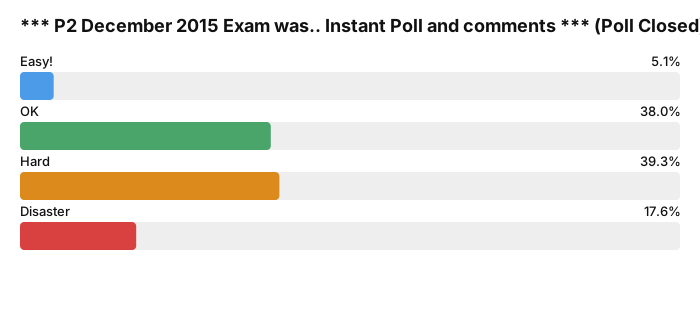
I thought the exam was OK - problem was time management as usual....
Difficult to complete all questions on time.
Q3 was about "Joint operation" IFRS 11 and also another section on IAS 37 Provisions etc
IFRS 9 Financial instruments I think that is FVTPL or FCTOCI
Q1 I though Godwill was 16$ for Salt and £24 for the foreign sub - there was impairment as well but I cannot remember the amount
Q4 the revenue should have been deferred...
Q4 was all about IFRS 15 the new standard on Revenue
Q4 b) ii
Does this make sense: there was only 1 performance obligation and that was not completed (only 65% complete) hence none of the revenue should be recognised?
Or can you split the performance obligation so that 65% revenue is recognised?
Would it not be the same as applying the logic to a building on "land" in that case. If the building has a useful life remaining of 20 years and is to be deconstructed after and you have a lease for 19, is that a finance lease? By the same logic, the Landfill site has a useful life of 20 yeears and you have it leased for that period its a finacee lease. Sorry, just a really confusing qustion and open for interpretation
oooppppssssss
I said the revenue should not be recognised at the end of year 1 as a condition for a contract is not met - consideration must be probable, which it wasn't
Also mentioned an adjusting event for the revenue as a contract condition was subsequently met and the consideration became probable. And they should recognise 65% on a % completion basis as it meets the conditions.
Simultaneously rec'd and consumed, created for customers use etc.
It was really hard... no knowing what was going through the examiners head.
Did anyone do the licences question in 2?
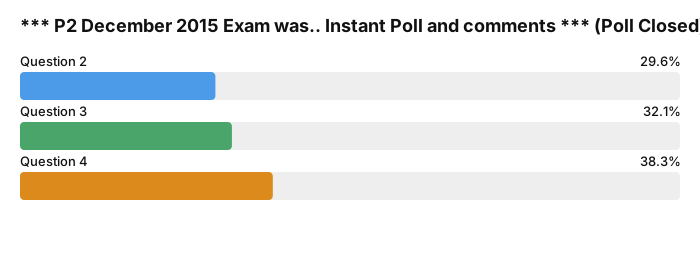
Q1 was manageable but spent too much time on it and still didn't finish. Couldn't remember at what rate to convert monetary items. Too many foreign currency parts to the question. For the other questions I just wrote points because of over run on question 1 :(
Yes, that is how I treated it too, but thought that there might have been re-measurement needed for the loan balance in the Sub. I didnt bother.
Ok, how did people calculate the "Provision" on the new handsets in part (c) of question 2 or 3???
I forgot to put in the interest on the service cost. Yikes. And I post the balancing figure in the T account to retained earnings. What a mess.
@rav2013 said: I said the revenue should not be recognised at the end of year 1 as a condition for a contract is not met - consideration must be probable, which it wasn't Also mentioned an adjusting event for the revenue as a contract condition was subsequently met and the consideration became probable. And they should recognise 65% on a % completion basis as it meets the conditions. Simultaneously rec'd and consumed, created for customers use etc. It was really hard... no knowing what was going through the examiners head. Did anyone do the licences question in 2?I said the same on the adjusting event said that the percentage completed would change now as contract terms have changed. However I said that the 65% of revenue should be recognised as 65% of the Construction of the printer was complete (construction contract) but then this should have been adjusted for the change in contract. These discussions questions are not straight forward at all.
Provision on handsets should be calculated based only on the 60% probability scenario I think
That is what I did too.. but I think we forgot about the interest. I took 7 to retained earnings of Parent.
Think I got 34M dinars then converted that at 9.5 cant remember.
Did anybody else get 15m goodwill for both? But the second needed impairment and translation?
Thought the exam was pretty tough to be honest - the second section is very tricky to manoeuvre, never sure what the question is asking!
can someone help me know the link between the sept 2015 and dec 2015 questions
were there repeating of areas/topics
So, I think basically the paper was OK... but too much work on the FX translations and adjustments in Q1. I am sure I messed up a lot...
b part of Q1 was OK, I wrote most on general differences between IFRS and UK GAAP, but also on the May amendments on IFRS for SME and that no deferred tax on revaluation gains under UK GAAP
Q2 cannot really remember, I did not really finish it, but classified the lease as operating one
Q4 with 15 marks on IFRS 15 was good for me... hope so at least ;) for the b part, I nearly forgot that the differences between the old and new standard were asked for and just wrote a few words on it. I argued that at the initial conditions the bonus should not be included, but in my opinion, contract was replaced by a new one (new transaction cost) and as then the bonus was likely, it should be included in transaction price
Cannot remember anything else and I just hope that I managed it narrowly.
Hope dies last ;)
Can anyone specify whether consideration for goodwill is translated at the current rate or historical rate? I forgot this important fact before taking the test and used historical, since it resulted in a prettier number :(
Q1 -- Time-consuming. Dealing with a net pension liability instead of a separate liability/asset threw me as I wasn't sure how to deal with contributions/payouts. The foreign exchange made things needlessly complicated and I kind of wish we'd gotten a sub-subsidiary or D-shaped group instead.
Q2 -- Avoided. Seemed like a classic technicality trap.
Q3 -- Joint operation. Could not remember for the life of me which IFRS governed that, so I hope I didn't lose a point. Wrote that nothing should be provided for as management's intent alone is not enough to constitute an obligation to transfer resources (it needs a legal or constructive obligation). I've seen this get fudged in the study materials, but for god's sake, that's what the flashcard says. BPP absolutely hammers home that major repairs are not to be provided for, so I'm going to absolutely enraged if the examiner finds some stupid excuse for it.
Q4 -- Easy points on the 4 remaining steps, but the part about what qualifies someting for IFRS 15 treatment -- I don't remember this in BPP at all, so I waxed poetic on what doesn't qualify for IFRS 15 treatment (financial instrument stuff, sale of PP&E, etc.) and hoped for the best. I wrote that the copier sale required a contract liability per IFRS 15 terminology (deferred revenue) as title wouldn't transfer. I was confused on whether the 2-year intervening period constituted a lease, or if I needed to discount anything, or what. For the percentage of completion job, I recalculated the POC to 60% or somewhere around there (ugly number) due to the revised estimates, and then I messed up the balance sheet in epic fashion by taking cost less profit to arrive at some kind of contract asset. Sigh...
It's too much to memorize. I've dumped 250 hours into studying P2 and it's still too much to bear while working with a Big Four firm that's unsympathetic and refuses to give me any study time. It's my bad luck, too, that the test dates all sync up with year-end busy seasons. Sometimes I think I need to quit working for a year to pass this stupid test.
But remember it is a "specialised asset". It cannot be used in any other way
Goodwill should be converted at CLOSING RATE
Joint Operation was IFRS 11 (but don't think you lose marks if you did not mention it)....
Copier - I think it needs to be discounted because it was over 2 years?
Question 1 confident on computation part all the fiddly bits I got tied up in and just made assumptions and moved on.
Part b struggled on this question. Part c was OK regarding ethics hoping to get half marks
I did question 2 about the licenses I wrote about intangible assets warranty provisions expected values etc, leases which I said was operating lease.
Question 4 reasonable section a should pick up some marks. B can't quite remember put about deferred income over 2 years. Second part I wrote about construction contracts and a little on ias10.
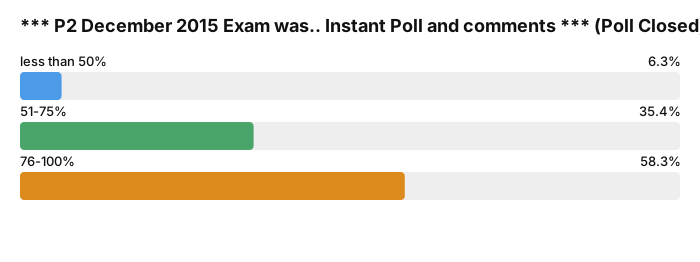
Very time pressured but first go at it doing self study in 3 hours managed to attempt everything. Feel like it was reasonable effort hope I do enough to pass if not back to the grind
Correctly. It was operating lease, as it was for 20 years and for land we cannot determine a useful life unless the ownership is transferred. In addition, the present value of minimum lease payments were 89% of the Fair Value. To be considered substantial, it has be to be more than 90 % of the fair value. Finally, the lessee did not have right to purchase the asset at bargain price at the end of lease term
@modernaire said: Can anyone specify whether consideration for goodwill is translated at the current rate or historical rate? I forgot this important fact before taking the test and used historical, since it resulted in a prettier number :( Q1 -- Time-consuming. Dealing with a net pension liability instead of a separate liability/asset threw me as I wasn't sure how to deal with contributions/payouts. The foreign exchange made things needlessly complicated and I kind of wish we'd gotten a sub-subsidiary or D-shaped group instead. Q2 -- Avoided. Seemed like a classic technicality trap. Q3 -- Joint operation. Could not remember for the life of me which IFRS governed that, so I hope I didn't lose a point. Wrote that nothing should be provided for as management's intent alone is not enough to constitute an obligation to transfer resources (it needs a legal or constructive obligation). I've seen this get fudged in the study materials, but for god's sake, that's what the flashcard says. BPP absolutely hammers home that major repairs are not to be provided for, so I'm going to absolutely enraged if the examiner finds some stupid excuse for it. Q4 -- Easy points on the 4 remaining steps, but the part about what qualifies someting for IFRS 15 treatment -- I don't remember this in BPP at all, so I waxed poetic on what doesn't qualify for IFRS 15 treatment (financial instrument stuff, sale of PP&E, etc.) and hoped for the best. I wrote that the copier sale required a contract liability per IFRS 15 terminology (deferred revenue) as title wouldn't transfer. I was confused on whether the 2-year intervening period constituted a lease, or if I needed to discount anything, or what. For the percentage of completion job, I recalculated the POC to 60% or somewhere around there (ugly number) due to the revised estimates, and then I messed up the balance sheet in epic fashion by taking cost less profit to arrive at some kind of contract asset. Sigh... It's too much to memorize. I've dumped 250 hours into studying P2 and it's still too much to bear while working with a Big Four firm that's unsympathetic and refuses to give me any study time. It's my bad luck, too, that the test dates all sync up with year-end busy seasons. Sometimes I think I need to quit working for a year to pass this stupid test.Colleague - here you've it. We MUST practice to read the technical articles before we enter the exam on the final day. You may have loose some easy marks, but the markers should have mercy - all the way!!! https://www.accaglobal.com/gb/en/student/exam-support-resources/professional-exams-study-resources/p2/technical-articles/revenue-revisited1.html
Woaaa seems like I got lucky by doing the September paper, the lease issue seems like a nightmare.
My experience is that this paper is fairly. I doesn't really matter what you came up with it's the methodology you used to get there. The classification will be worth 1 mark
P2 needs more time or reduction in question parts . We should have the time to think and apply standard properly. Always in a hurry makes it impossible to attempt exam properly
Friend you were told in the question to attempt all questions and not complete all questions! Thus time management is not an issue.
I wanted to know.. Is p2 marking a lineant one? Do they panelize you for a mistake once? Or is it that you get the whole answer incorrect if you have done a mistake in the calculations at the begining?
Can someone share what was the figure you got for the sofp? Managed to balance anyone?
Topic lockedNew replies are closed.