
Skip to content

ACCA Forums

PM*** F5 June 2011 Exam was … Post your comments here and vote in Instant Poll ***

OopentuitionAdmin15y ago
Please share here with community your comments about June 2011 F5 exam.
What came up? How did you do? How did this paper compare to previous exams?

Vote in our Instant Poll
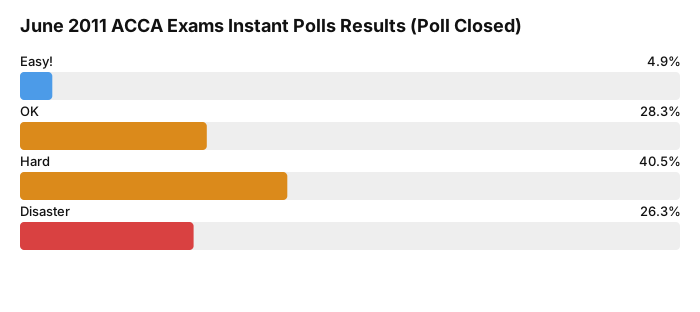
*** F5 June 2011 Exam was … Post your comments here and vote in Instant Poll *** poll results
Ii-acca15y ago#91
I found the demand equation P=750-0.015Q
Former userFormer user15y ago#92
@mukxdon said:
difficult paper indeed...didn't tick the questions i attempted at the front of th booklet possible consequences??

me too, i guess should be alright since each page u shade the question number ?
Hhonang15y ago#93
Anyone can tell me what ia d equation of demand equation ? And do we need to calculate variance between flexed budget and actual ??
Former userFormer user15y ago#94
@danny124 said:
for a demand of 350000 bags n in good weather condition. sales will be (9 -4)* 87500 ( less the unsold portion multiplied by 0.50.) did i miss anything

Thinking about it, did you get the 87,500 from multiplying the 350,000 by the probability?

My understanding wa sthat the table in part a) was just to work out possible profits, with the probabilities being used in part b)iii for the expected values.
Former userFormer user15y ago#95
miX oF hArd Nd eAsY pArtS.......:)
Pplatinumkp15y ago#96
in the payoff tables:

* if demand = production then its just the contribution times the number of bags
* if demand > production then there is no penalty and its just the contribution x the demanded units.
* if demand < production then its the contribution * demand - (unsold * 0.50).

Thats how you get the payoff table.

Then you can apply the mini max and the maxi max.... after that to get the expected values you just multiply each payoff table cell with the probability of that corresponding demand to get the value of x. Then sum all the productions to get the expected values... you then select the highest expected value out of the production choices.

Thats what I got at least. I can't remember the numbers but I do remember that the contribution from the 200,000 production level was $1m regardless of the level of demand.
Former userFormer user15y ago#97
@mudassirsiddiqui said:
throughput in a hospital case secnario
then maxim maximin and seasonal variation
then flexibudget
also demand and price equation also theory of sales mix contr variance


where was there seasonal variation??? :S
Former userFormer user15y ago#98
Just wanted to double check that you flexed the budget to the actual sales of meals of 1650?

Can anyone else tell me what they did?
Former userFormer user15y ago#99
What a shocker this paper was. Haven't seen anything like it my life! That throughput question had way too many figures and too much information it just confused me in the end. It will be interesting to find out whether the pass rate improves or drops for this session. I hope iv'e secured enough marks.
Former userFormer user15y ago#100
demand function: p= 835 - 0.1x
Former userFormer user15y ago#101
@platinumkp said:
in the payoff tables:

* if demand = production then its just the contribution times the number of bags
* if demand > production then there is no penalty and its just the contribution x the demanded units.
* if demand < production then its the contribution * demand - (unsold * 0.50).

Thats how you get the payoff table.

Then you can apply the mini max and the maxi max.... after that to get the expected values you just multiply each payoff table cell with the probability of that corresponding demand to get the value of x. Then sum all the productions to get the expected values... you then select the highest expected value out of the production choices.

Thats what I got at least. I can't remember the numbers but I do remember that the contribution from the 200,000 production level was $1m regardless of the level of demand.

Guys i did different when you have unsold if you are using the profit per unit (9-4) multiplied per the demand then you remove the COST OF PRODUCTION OF THE UNSOLD 4*unsold and then 0,5 per unsold (cost of disposal). HOPE I GOT IT RIGHT...
Former userFormer user15y ago#102
throughput was supposed to be a relatively simple chapter bt the fact the question was set in a different scenario (operation theatre, surgeons, anaesthesists) got me all confused!! :(

flexed budget has always been a bit beyond my understanding, cud hv managed if the question was set in the usual scenario, ie, of factory production n processes instead of restaurants n meals,i cud only fink of myself having a meal in the restaurant :P

just hope i get atleast 50!
Former userFormer user15y ago#103
so demand equation is calculated ...(735 - 720)/(1000-2000) = -0.015
720 = a -(0.015 * 2000)
720 = a -30
a = 720 + 30
a = 750
P = 750 - 0.015Q.........hope I was correct........
Former userFormer user15y ago#104
@kotesh said:
Just wanted to double check that you flexed the budget to the actual sales of meals of 1650?
1560 - not 1650! I hope;)
Former userFormer user15y ago#105
@winnaman123 said:
735 = a + b1000
750 = a+ b850
not sure this is right, value of a is the price when 0 demand, which was 750, as price increased by $15 when demand fell by 1000. Price was 735 at 1000 demand, so 750 is 0 demand. a is 750.

solve simultaneously: a= 838; b= -0.1
therefore p= 835 - 0.1x
Former userFormer user15y ago#106
I studied alot for this paper, variances , ema, cvp, linear and yet i was taken aback by it, it was very hard. no sign of the main parts advised to study
i did write something for everybit, but I think i messed up the data table and the part b in through put. the flex budget took me a long time to get me head around was not expecting that and hadnt looked at it. god i hope i did enough as i never want to see that f5 again.
Former userFormer user15y ago#107
Friends:
Demand equation was 50,000-66.66Q.

a negative of 1000demand for each $15 price range gives a gradient of -66.67.
Feeding that into the equation 1000=a-(66.67 x $735) means a is 50,000.

The EV in Q1 - I suspect we only had to get the probability of the 3 numbers given, ie (.45 x 350,000) + (.25 x 280,000) + (.35 x 200,000).

Looking at the blog, I think we are all missing the point. The maths is only 50% of the marks. The blurb about it that you can waffle on about is possibly easier to do, and just as important.

Jude
Former userFormer user15y ago#108
These questions should have been fair if the examiner had not put in an irrelevant and distractors into the various senarios. Almost all the questions were not straight forward. At least one or two questions could have been straight forward. Any way I could not finish all the questions but hope for a pass marks.
Aayman8515y ago#109
what variances were recomended to assess the performance of the restaurant manager?
Aayman8515y ago#110
i could only attempt 68 marks, hated the way throughput was laid out,,,
Former userFormer user15y ago#111
@samygold said:
Guys i did different when you have unsold if you are using the profit per unit (9-4) multiplied per the demand then you remove the COST OF PRODUCTION OF THE UNSOLD 4*unsold and then 0,5 per unsold (cost of disposal). HOPE I GOT IT RIGHT...

I did similar calculations but removed not just 0.5 for disposal but also the profit element relating to unsold goods that would have to be disposed. e.g. if 350,000 units were produced but only 280,000 were sold then it would be 350,000 * 5 = 1, 750, 000 expected profit. and then i would calculate 350,000 - 280,000 = 70,000 unsold items multiplied by 5 profit + and 70,000 *0.5 disposal cost. Therefore :

total profit on 350, 000 production is 1,750,000
profit on unsold 70,000 @ 5 (350,000)
disposal cost on 70,000 @ 0.5 ( 35,000)
actual profit 1,365,000 - goes to payfoff table.
Former userFormer user15y ago#112
Only Q5 was difficult. ? did not have time to complete it.
Former userFormer user15y ago#113
@eimearnid said:


lol
@winnaman123 said:
735 = a + b1000
750 = a + b 850
solve simultaneously: a = 835; b= -0.1

therefore p= 835 - 0.1x

lol
@jude28 said:
Friends:
Demand equation was 50,000-66.66Q.

a negative of 1000demand for each $15 price range gives a gradient of -66.67.
Feeding that into the equation 1000=a-(66.67 x $735) means a is 50,000.

The EV in Q1 - I suspect we only had to get the probability of the 3 numbers given, ie (.45 x 350,000) + (.25 x 280,000) + (.35 x 200,000).
Jude

LOL
Hhattie15y ago#114
paper F5 was ok...questions 1 and 4 were easy marks....but the flexed budget and price demand question were challenging......well i hope i get a 50%.
Ffbawany15y ago#115
I think ACCA really needs to get to grips with these papers. I mean every exam should be attempted by 10 randomly selected markers, and they should be given 2 hours rather than the 3 hr 15 mins given to students, and if all of them dont get at least 60%, then the exam should be re-written.

I know you're not meant to complete these exams, but just out of interest, is there anyone here who actually completely every part of this exam today?
Former userFormer user15y ago#116
the exam kit is not useful for this examination .if did not carefully study the textbook .I prepare alot EMA ,lifecycle, transfer pricing ., target costing ...... ,but noting in it , Q2 ,Q4 it is not difficult , but I did not prepare the balance score card .Q1,Q3,Q5 then totally been messed up . I guess the examiner knew what part we could not prepare well . so she got it !
Ppissukade15y ago#117
@kotesh said:
Just wanted to double check that you flexed the budget to the actual sales of meals of 1650?

thats how i did as well so average meals per day is 65 n then i charged rest accordingly

Can anyone else tell me what they did?
Aarishas15y ago#118
Rather hard questions, I could not cope with question 3 - about flexed budget, all other I managed to do but not sure that all are correct. Very very hope to pass! June and December'2010 were much easier, it's not fair!!-)))
Former userFormer user15y ago#119
I don't know why you are so angry at ann irons. I think it was a completely predictable paper. In the last two sessions linear programming and ABC were examined so I knew they won't come up. Instead, I have expected this pay-off stuff or a decision tree and of course throughput accounting.

I studied two days for this paper (Saturday and Sunday) and I found it very straightforward and easy. I couldnt do the flexed budget because the information on the actual food + drink mix was hidden in the question at the bottom of the paper and I couldn't find it... so -13 marks. But I did parts :) and c). For the additional two variances I wrote revise the budget and calculate planning and operational variances.

Q1: I also needed 5-6 minutes of thinking, what to do with disposal but then I found the right wayy, as some of you already wrote above.
Q2 and Q4: easy, straightforward
Q5: I was afraid of TPA as I could solve no one of them when practising, but this one was quite straighforward and easy.

As I had only two days to learn, I didnt learn any theory, but I could solve the theoretical questions in the paper. (remembered BSC from university, market skimming and penetration were easy, also maximin and expected values).
Zzaantjie15y ago#120
@fbawany said:
I think ACCA really needs to get to grips with these papers. I mean every exam should be attempted by 10 randomly selected markers, and they should be given 2 hours rather than the 3 hr 15 mins given to students, and if all of them dont get at least 60%, then the exam should be re-written.

I know you're not meant to complete these exams, but just out of interest, is there anyone here who actually completely every part of this exam today?

i attempted every question to the fullest but think messed up on bits not sure if it was good enought
Topic lockedNew replies are closed.