Skip to content

ACCA Forums

SBR*** ACCA Paper SBR March 2019 Exam was.. Instant Poll and comments ***

Oopentuition_teamAdmin7y ago
Vote in our Instant Polls about the ACCA Paper SBR March 2019 Exam
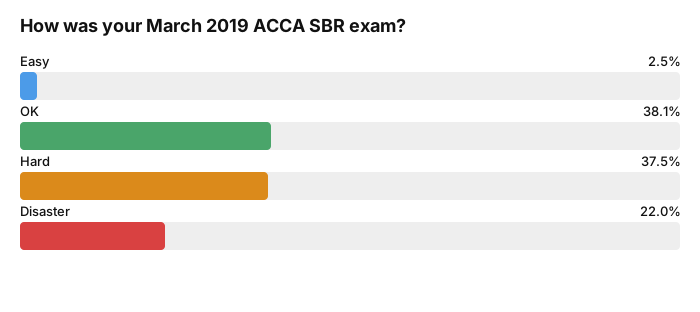
March 2019 ACCA SBR exam — historical results
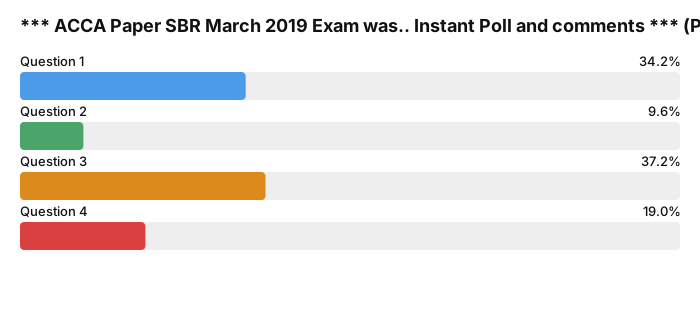
*** ACCA Paper SBR March 2019 Exam was.. Instant Poll and comments *** poll results Please post your comments below
BBalakrishna7y ago#2
Real disaster. Q1 was horrible and confusing. Dates are irrelavent
JRJohn Ramos7y ago#4
Not too bad. It was passable.
QQuintus7y ago#6
Can't believe this thread is still so inactive! Q1 was okay for me (hope this is not the Dunning–Kruger effect lol). I had the most trouble with Q3, where the first two parts (joint arrangement and FVTOCI) were completely alien to me since they weren't my focuses in my revision. I might have figured out more if I had more time but the time was just enough for me to at least answer each question (except FVTOCI - left that one empty; and I couldn't answer 100% for each question). I could answer the other questions, but I feel I missed quite some points. Fingers crossed.
Eelaine7y ago#8
Aaaaaa....…… In my opinion it was one of the hardest exams I sat for so far. Did not have enough time to discuss in detail.
BBalakrishna7y ago#9
Seriously hardest.... Some Qs looks ok but all are tricky. Absolutely gone case. Getting ready for June
Ddavide647y ago#11
Very hard exam. The first question threw me off a bit as I was not expecting foreign subs. Part a was fine where you had to describe functional currency, but the rest of the question was seriously confusing. Did you have to calculate the full disposal or not? The question about revenue looked like easy marks but in the end I also became confused. I wrote about the 5 step model for part A. The FVTOCI was horrible and the pension question was tricky as well. What did people right for the settlement treatment? Also for the joint arrangement, control or no control? The entity could prevent other parties from voting for majority, but also they would need one other vote themselves, so It wasn't control IMO. I'm scared my 100% exam record is has come to an end here but fingers crossed. Is it just me or was I the only one who hardly wrote any numbers down?
MCMindy Chong7y ago#12
I think it was an okay paper. But I don't think I have revised enough just to pass. I think those exposure draft questions are the hardest to tackle since I didn't have enough time to read through and digest.
JRJohn Ramos7y ago#13
What did you guys write about leases??
Ddavide647y ago#15
This is what I want to know. I wrote about the lease criteria which I'm not sure was asked for. It asked what will investors see in the financial statements in the new lease standard. I wrote half about disclosures and the other half about right to use asset, lease liability etc. Not sure if that would have got any marks. Clarification would be good
Ddavide647y ago#16
For the off balance sheet question, even if it wasn't asked for I wrote about the gearing ratio. Liabilities would be less hence debt would appear to be lower and the gearing ratio would appear to be much better. Anyone do this?
Ddavide647y ago#19
@racheldr said: Why would Liabilities be lower? There would be a lease liability now. Before there was no liability for operational lease.
I'm talking about the question regarding the ebitda/ROCE/interest cover ratios. Off balance sheet would show less liabilities which would mean less debt and less gearing.
Bbereank7y ago#20
@davide64 said: Very hard exam. The first question threw me off a bit as I was not expecting foreign subs. Part a was fine where you had to describe functional currency, but the rest of the question was seriously confusing. Did you have to calculate the full disposal or not? The question about revenue looked like easy marks but in the end I also became confused. I wrote about the 5 step model for part A. The FVTOCI was horrible and the pension question was tricky as well. What did people right for the settlement treatment? Also for the joint arrangement, control or no control? The entity could prevent other parties from voting for majority, but also they would need one other vote themselves, so It wasn't control IMO. I'm scared my 100% exam record is has come to an end here but fingers crossed. Is it just me or was I the only one who hardly wrote any numbers down?
I didn't do many calculations either ... Just wrote and wrote ... a lot of rubbish :-)
Bbereank7y ago#21
@min22 said: I think it was an okay paper. But I don't think I have revised enough just to pass. I think those exposure draft questions are the hardest to tackle since I didn't have enough time to read through and digest.
Same here! And it didn't help that my mind went blank. Just had to keep writing ... anything. Those who prepared well would definitely find it easy.
Cchan7y ago#22
for q3 ,i state that it is a joint arrangement because the require of unanimous consent,where the company can prevent others from making operating decision due to it hold the half members of board.......so unanimous consent exists and joint control exists too.... am i right? I state that interest charged to PL will decreases the dividend capacity to investor....is it OKAY??
Mmehwishnaeem7y ago#23
Exam was a disaster, no number crunching in Question 1 it was so discursive I used my calculator only for 3 mins max. Everything needed discussion Explain and Advise which was not expected.
Mmehwishnaeem7y ago#24
same
Mmehwishnaeem7y ago#25
I chose Subsidiary I don't know
DDanilo7y ago#26
I thought that the exam was hard, specially section B, which made me quite confused: * Leases * IAS Tax and IAS Contingent Liability differences in relation to the new Standard * Embedded derivatives * Revenue Recognition They were both expected, both section A was easier to answer than question B in my opinion.
AAbdullahi7y ago#28
Question a: this was Joint venture as it fulfulled the joint venture requirement. 1. the joint arrangement has separate entity- i think Kuran 2. Major decisions regarding the entity require unanimous decision of all parties therefore should be accounted as joint venture in that ,Cyrpto should account their share of the assets and liabilities ( 45%) in Kuran. This was definitely not a subsidiary or associate bcos in subsidiary the parent has control and makes all decisions in associate also one entity has control and makes all decision. also it is not joint operation as there is no separate entity in joint operation
AAbdullahi7y ago#29
Who else found confusing on the dates in question one regarding disposal? there was rate closing rate on September 20x6 right? there was no net assets or profits on september 20x6 all dates were either January 20x6 or December 210x5 exept two dates and the question asked to calculate disposal on september 20x6 how was this possible? anyone remember the mark allocation on this particular question I got confused and left it there
BBalakrishna7y ago#30
Same here. I stopped completely. All dates r irrelevant and dubious. Totally upset with Q1
LLucy7y ago#31
Hard paper! Lots to ask... Q1) What did people say was the functional currency? This wasn’t so straightforward to me. And goodwill balance? Feel like I definitely made some errors! The explanation of calculating the goodwill was ok just explained which rates to use. Q2) Hudson and professional ethics. Didn’t really understand the settlement question either to be honest. I did say that a settlement in the accounts that relates to restructuring means there has been a curtailment. I said it is supposed to reduce the value of the net assets on the benefit plan and also reduce the liabilities as a payment would have been made. Also means a cash decrease. I also said the contributions to the plan are supposed to increase the assets. Remeasuremennt component I said is supposed to be the net amounts when you compare the asset/liability balances at their opening and closing and also the net costs and then the net gains. Not sure. Also, could they claim the deferred tax asset losses?? Normally I’d say yes but I couldn’t be sure as they had kept making losses. I thought the point of claiming the tax asset was tied to the business being forecasted to make profits as well not just losses. I mentioned that the market was in decline as well and it was unlikely the profits the directors predicted would be actualised. I said if anything they could only claim losses for the last 2 years then? Q3) Was this the sub/joint venture question? I said they were effectively a sub and I wasn’t sure either. Unanimous decision was needed but as they could choose 50% of the numbers it effectively meant they had much more of a say-so otherwise decisions wouldn’t be reached? The highest shareholder had 18% which was not even enough to be classed as an associate. So tricky. Revenue question was okay but again like others said, confusing but I just talked about the criteria for revenue recognition like it is contract, separately identifiable and distinct, commercial substance, performance obligations etc. Leases question. I just wrote the definitions and explanations of each ratio, gearing, but didn’t have enough time to relate that to the statement about the leases. Q4) This was mostly OK. Contingent assets and liabilities and inconsistencies with the recognitions of assets and liabilities - I talked about the probability test and how it’s different to the reliable and probable criteria of recognition. Hope that was right. Also for the business combinations I said the individual accounts would only disclose or provide for assets/liabilities depending on the probability test but with a combination then they would have a FV and would be taxed (deferred tax). Did the UK version and they threw in more foreign currency questions and differences between UK and INT accounting on business combinations. Felt like I was repeating myself as it was a similar topic to Q1). Also asked about differences in the UK FRS102 and IAS on how foreign business combinations are accounted for? I said something about the transaction costs being included as part of the costs of acquiring the sub and NCI is only measured proportionately under FRS102. Really hard to tell with this exam. Long wait for the results as per.
Ddavide647y ago#33
If you left your calculator at home, it would have made no difference. A lot of discussion, confusion and waffling summed it up for me.
RRachel7y ago#34
I wrote inside the margin on the first page....am I in big trouble for this?
Cchan7y ago#36
the question 3 stated the decision is made on majority ,so the Crypto didn't control it,but can prevent other making the decision......................
TTajkiya7y ago#37
Thoughts from attempting this exam. I felt it was very time pressured exam having to rush two questions. Didn't think there was enough time to sit and think (plan) what the questions were asking with info provided in the scenario. Question 3 was a disaster for me, I would be surprised if I scored any marks on this one. I looked through the whole paper, and was shocked to see Foreign Sub as Q1. But saw Q4 and thought probably will be able to gain most marks here (in my opinion this was a nice question if you knew the contents) But I found it difficult to relate the scenario with questions... so wrote was whatever came into my mind. I don't know if I will pass, not sure if gained enough marks as answers were not as detailed due to time pressure. Fingers crossed, have done enough to get 50.
RRichard7y ago#38
Can anyone remind me which one was 30 marks and which was 20 please?
VVictoria7y ago#39
I put interest cover ratio would reduce due to the interest element of leases. Return on capital employed will reduce due to debt increasing and EBITDA will increase due to some elements of expenses being moved to Depreciation due to the right of use asset
VVictoria7y ago#40
30 mark was the foreign entity, 20 marks was the pension one
Llucky7y ago#41
Hello all, please could one kindly assist to highlight areas tested? Thanks
Sign into reply to this topic.