
Skip to content

ACCA Forums

SBR*** ACCA Paper SBR December 2019 Exam was.. Instant Poll and comments ***

Oopentuition_teamAdmin6y ago

How was your SBR exam? Please post your comments below, and vote in the Instant Poll
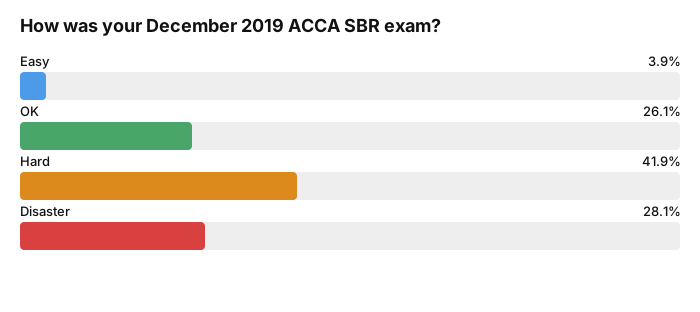
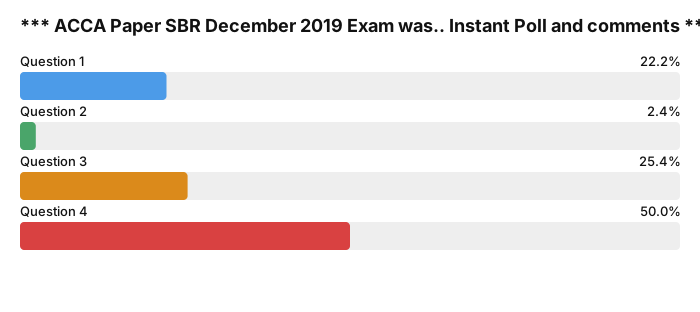
December 2019 ACCA SBR exam — historical results
*** ACCA Paper SBR December 2019 Exam was.. Instant Poll and comments *** poll results
Xxanpech6y ago#61
@js12 said: Q1 I got positive goodwill but i didn't FV the inventories, so i reckon that's why i got positive. But if you left it out and carried it forward, so that mean you would get a penalty just for those mark(s) but no more penalties if you carry it forward? Also, it appeared a joint venture just from the seperate entity however, on the next question it mentioned something about the £10m share issue for the 51% being included as debt rather than NCI? I wonder if it's something to do with the other entity having a contract to makes them having to get a % of the gross receipts might be why it's being designated as debt as they get contractual cash flows. And very time pressurised, didn't manage to finish the exam ;(
I also got positive goodwill after not fair valuing the inventories. I think the own figure rule will mean we will still get marks for the goodwill calculation. I also didn't finish, I ran out of time before 4C, I wonder how many ppl actually did 4c? lol.
Xxanpech6y ago#62
Does anyone know for the deferred tax increase on the fv adjustment if we were meant to use the current tax? I have a bad feeling I used the deferred tax rate. But then I can't remember, was the deferred tax rate 30 percent and current was 20 percent? Am also wondering which the principal and which was the agent...
JJames6y ago#63
@xanpech said: I also got positive goodwill after not fair valuing the inventories. I think the own figure rule will mean we will still get marks for the goodwill calculation. I also didn't finish, I ran out of time before 4C, I wonder how many ppl actually did 4c? lol.
Fingers Crossed
JJessica6y ago#64
Nicely found Nadia weldone
Jjean6y ago#65
Q1- Step-acquisition It is first an associate recognised at cost in 2002 at 100 mil We add back the share of post-acq profit, this was possible as the question gave the NA at acq and asked to calculate the NA in 2006 at second aqui.We also add the secon aqui at 66. NA 2006: 100 + 27 (adj for step-aquisition) + FV of the contingent consideration + NCI at proportionate share - NA For the NA, the question gives the CV at 348, if I remember correctly, including also the deferred tax. The only adjustment needed was for land of 10 and also current assets of 47 both not depreciable. On this 57, there is a deferred tax of 57*20% = 11.4 So I came to a NA of 348+57-11.4 = 393.6 The last part about the digital list, I did not include, there was an article about the digitale accounting in the ACCA website. The weird part in this question was the control at 48%, but as substance has priority over form, the actual value is 60% and 40%, I also used the 40% to calculate NCI. I also got a bargain purchase. I think the exam was average, let's see in a few weeks
MMarek6y ago#66
Why would you use 40% if NCI were holding 52%? Share and control are two separate things. The company can have less than 50% but still having control. That was the case here. At this point option wasn't exercised therefore NCI was 52%.
IIram6y ago#67
From what I can remember.... Q1. Spoke about definition of an associate, recognition of associate Aii) About the equity method and how should be accounted Aiii) The classification of an associate(didn’t have a clue) Bi) to work out the financial and non financial assets and what can be recognised with reference to rev reserve Iii) calculate Gw/bargain purchase(gain) 2). Ethics-related parties, single segments, ias 8 accounting policy, ias 16 B) what is the validity of the ships(not sure conceptual framework) 3) contracts Ii) reference to ias 38 intangible asset Iii) to do with inputs and outputs business combination B) to recognise why it is debt and not a non controlling interest 4) Revenue-principal and agent Ii) question on KPI with reverence to business combination and asset acquisition of figures shown in depreciation, amortisation, impairment, therefore ratios B) what impact has on investors Asset acq Business combination
Xxanpech6y ago#68
I think q.3ii was something like "does it have control over the investment?" which I took as a IFRS 10 type question about power over the investee to influence returns etc. And then Q.3b was something like "should the other party be seen as having a debt interest rather than NCI" which was an indirect way of asking is it an asset or a business?
DDaniel6y ago#69
@geologist81 said: Q1- Step-acquisition It is first an associate recognised at cost in 2002 at 100 mil We add back the share of post-acq profit, this was possible as the question gave the NA at acq and asked to calculate the NA in 2006 at second aqui.We also add the secon aqui at 66. NA 2006: 100 + 27 (adj for step-aquisition) + FV of the contingent consideration + NCI at proportionate share - NA For the NA, the question gives the CV at 348, if I remember correctly, including also the deferred tax. The only adjustment needed was for land of 10 and also current assets of 47 both not depreciable. On this 57, there is a deferred tax of 57*20% = 11.4 So I came to a NA of 348+57-11.4 = 393.6 The last part about the digital list, I did not include, there was an article about the digitale accounting in the ACCA website. The weird part in this question was the control at 48%, but as substance has priority over form, the actual value is 60% and 40%, I also used the 40% to calculate NCI. I also got a bargain purchase. I think the exam was average, let's see in a few weeks
I appreciate the conceptual framework wants substance over form but the share options were not exercised. Therefore, you would use the NCI at 52%. You can still have control of an entity with less than 50% share holding but you must relate the workings to the shareholdings once control has been identified. The question advised assume control has been obtained. I believe the share options that were not yet exercised related to the part of the question where we had to discuss whether they had control of the entity. Furthermore, the internal customer list that was rightly not recognised in their own individual financial statements as it is internally generated should have been included in the goodwill working at fair value as it could have reasonably have been expected to be relevant when working out fair consideration for the entity. Intangible assets are assumed to be able to provide economic benefit when purchased as part of a business combination or in a seperate transactions and therefore would meet the criteria to be recognised in the group financial statements.
MMarek6y ago#70
Exactly this :)
HHayley6y ago#71
Did anyone else find this exam extremely complex and unlike any of the previous SBR exams? Questions 1, 3 & 4 completely through me due to the volume of information to consume and what it was actually asking of me. Extremely complex paper! Worst exam by far and definitely will be resitting.
AAnnette6y ago#72
I think the NCI was to be measured at the proportionate share in Q1, but I got negative goodwill too.
AAlex6y ago#73
I agree with one of the posts that said that negative goodwill is very rare and therefore unlikely to be the answer. Indeed IFRS requires that management recalculate their workings if negative goodwill is found because it more likely due to an error rather than it being a bargain purchase. I did not get negative goodwill but it threw me off when they mentioned it in the exam because it seemed to suggest that it would be. I think they do that on purpose to trigger your biases when answering questions, you assume that because they mention it and that is unusual they are hinting at the answer. Cheeky but definitively getting the response they want which is to test how much you really know the information and are able to apply it objectively. I found goodwill in my calculation, not negative goodwill. The first adjustments that I made were to the fair values of the assets. I think it was land that was originally 65 but by the date of consolidation it was 60. Then current assets had increased by around 57m. Therefore you needed to adjust the net assets of the subsidiary by adding 57m and removing 5m. While also reducing this with the corresponding tax liability from the fair value increase so 57m * 0.2 = 11.4m and then a reversal of a tax liability based on the reduction of fair value of 5m*0.2 = 1m. You have the original net assets of ~348 and you add 57m - 11.4m - 5m + 1m = 389.6. Remember that consolidate must always happen at fair value. The next part is to work out the NCI and that is the proportionate method so you take 52% of 389.6 = ~203. Then you have the consideration paid for the 18% which was 66m and then the fair value of existing interest which was 127 I believe. Therefore your goodwill calc should be 127+66+203 - ~390 = 6m These are the numbers that I remember and by no means if you don't have the same numbers you are going to fail. You can still pass this exam if you don't get this part exactly right so I wouldn't worry too much as it is Christmas ? I just wanted to provide a different narrative to the one on negative goodwill which seems to be the main theme in this forum. Q2 think this is straight forward. I left it till the end because it was the easiest. It was rushed and not my best piece of work but it will have to do. Regarding Q3 and joint venture. I think they asked whether Ibex had control or not, not whether they had joint control. For joint control to occur unanimous decisions have to be made and it doesn't appear to be the case from the case study so I don't think a joint venture is the correct way of looking at it. It was again looking at control but from FRS's perspective which is slightly different to IFRS's. I can't be sure about this but that is how I read it. I'd say that generally Q3 was my weakest part because I just didn't have time to write everything and my mind blanked a bit on the application of impairment to the scenario but I look back on it and realise it wasn't too bad, just need to state the standard principles and apply to the scenario! The question on why Ibex should account for Pomex as debt baffled me at first and I settled on the answer that they don't have a proportion of net assets and so can't be considered an equity holder. Q4 this was messy for me as I didn't plan the answer properly. I don't think I did terribly here but didn't do as well as I could have. The first question regarding whether the distributor should be agent or principle threw me because the materials I was using didn't cover this in much detail so I just used instinct here and went agent, explanation was weak but it was there. I noted that the license should be recognised as an asset for the distributor because it meets the definition can't remember if I said it should be intangible asset or not. Regarding the difference in effect on the KPIs of whether it was as an asset purchase or business combination. Unfortunately my answer was messy and could have been better. Overall I thought the exam was fair. It was tough given the time constraints but that is what differentiates most of us normal people from those that score really highly. That additional bit of discipline to maintain composure in the exam to not go hell for leather and write like a mad person when you get into a flow. I always say to myself I won't do next time but I always do!
AAlex6y ago#74
I should add that a joint venture is when there is unanimous decision making and both have a share of net assets. I don't think the relationship describe in Q3 met this criteria
AAlex6y ago#75
I should add as well that the intangible asset of 5m should be added. Forgot about that :-) I did add that. So goodwill will be a bit higher.
TToni6y ago#76
Q1. I can't really remember the contents of. From what I remember, I calculated negative Goodwill, and I did not normal 'FV adj' working for consolidation to calculate my deferred tax. I tried to explain more about what I was doing and the relevant standard than spend too long on the numbers. I did a stepped acquisition and presented discussion on why the the buying company had control - because all the other shareholders had less than 10% holding and none of them had previously voted together. They also shared key management personnel within the company. Q2. Firstly I said that it was no acceptable for Mr Topper to leave accounting issues because he is too busy, and that delegation of the quarterly reports is necessary. Secondly, I said that he and his wife had self-interest threats caused by intimidation which should be ignored and they should remain objective, and not engage in any illegal activity. Thirdly, I said that Mr Topper should under no circumstances use the insider information to gain an advantage. Again, a self-interest threat that Mr Topper should look in to. I went on to say that if he did so he would threaten accountancy as a profession and that his membership would be stripped and he would be likely to get a prison sentence. I concluded that Mr Topper should go on some CPD training courses and then regurgitated the standard "both Mr Topper and Ms Tiger are representatives of the association. They must approach the COO, whilst keeping a record of communications, and explain the appropriate actions needed to be taken. If the COO refuses, they must seek professional advice from ACCA. Furthermore, they must consider resigning from their position if the COO does not accept their changes". I obviously said it in a lot more words. Q3 was my UK GAAP question. I had absolutely no idea of the differences bet UK GAAP and IFRS 13, so I stated the normal CV exceeds FV and mentioned the markets for which FV could be obtained. Furthermore, I said that an impairment indicator would be that the validity of the facts in the 'climate change' programme had be question effecting its validity. As the company was adopting FRS 102, I defined an asset under FRS 102 which still include the 'probable economic inflow' element, and said that as the popularity had decreased it should be considered whether the cost will be recovered. For the dinosaur programme, I said that the fair value should be reviewed and the impairment reversed before further capitalisation of costs. On the Joint Arrangement question, I said that under FRS 102 there a 3 (asset, entity and operation) to consider. I can't really remember what else the question was asking for, but I wrote a fair bit. On the debt vs Equity I said (Ibex, Barber & Pompex); Normally, shares purchased would be considered as equity, however, there were a few things for us to consider; - Barber could appoint 3 out of 5 of the directors HOWEVER, all decisions had already made and all future decisions would be made by Ibex. - They were locked in for 3 years, at which point Ibex would fully own Pompex. - Ibex had the rights to all but 50% of the revenue generated from the sales. This is a prime example of substance over form. They have no control, Ibex have an obligation to pay Barber (unlike equity instruments where dividends are paid out of choice). etc etc. Q4 - I seemed to have a complete breakdown at this point and put together some extremely rough workings but very little discussion. I think my workings were correct, though. I did a quick discussion on the impacts to the EPS and the adjusted EPS but I only had 5 minutes left. UK GAAP people - which framework did you recommend? I recommended FRS 102 but didn't really have any reasons for it other than the threshold limited.
AAlex6y ago#77
I said they could potentially use the micro entity if they qualify, which I noted they likely don't given the size of their assets and the need for substance over form. Therefore I recommend FRS 102 because it is based on IFRS SMEs so it seems like a good stepping stone to full IFRS.
Xxanpech6y ago#78
I am still slighty confused about the last 2 questions in question 3. I thought the second last question was something like "should they consolidate"? and the last was "should it be OCI or debt" I took this last question to be a question on whether it was a business or asset, thinking business would mean OCI and asset it meant like a debt interest. So I did my discussion of business or asset and definition of a business etc in this question. However now am thinking this last question was just a standard debt versus equity discussion? And that I should have done the business/asset discussion in the consolidate question. (in the consolidate question I just wrote about control and influencing variable returns etc). So I'm now wondering do you think I could get marks for the business/asset discussion when that answer might have actually only been relevent to the consolidate question before it? (assuming obv there were free marks left to get in the previous question). Or would it be more likely the examiner would be strict on this?
OOlga6y ago#79
I found this exam unfair with 3 qurstions out of 4 concentrated on the business combinations and acquisitions of any shape and forrm. This doesn't give any credit to the effort put towards obtaining comprehensive knowledge across all syllubas and as a result significantly reduced chances to pass. I would encourage all students who feel the same to complete the ACCA survey (following the link that you should have received via email)and give your feedback. This was my 11th paper and only 2nd time that I feel the exam was not a fair test of knowledge. I think that completing the ACCA survey last time (for one of F papers) triggered the examination team to review the marking requirements.
SSteph01056y ago#80
Agree. I didn't think it was a fair paper either. Most of the topics weren't tested and we give ourselves so much pressure to learn, apply and confirm our knowledge on the bulky materials and topics. I just completed the ACCA survey and urge others to file your complaints on the ACCA survey email sent to you. Closing date is 12/12/19 , UK noon time.
IIram6y ago#81
Can you post the survey on this website
SSteph01056y ago#82
They sent it to your email after the exams. The email address that you normally receive updates from ACCA.
JJessica6y ago#83
I personally agree and provided feedback to that survey. I prepared very well but unfortunately I don't fell it was good enough. Did alot of timed questions, summarised articles.. Went through the whole kaplan revision kit properly.. I somehow see where I may have gone wrong e.g not using the SBR syllabus and study guide to cross check that you actually covered it all in the depth in which the guide states. However, in my feedback, I stated that tutors from the big learning providers are failing to teach application skills properly for real world scenarios and perhaps it should really be the key focus now. This should be the case especially now, looking at the direction in which this paper is now going..
UUsman6y ago#84
I also got negative goodwill attempted it 3 times and my goodwill was all negative at a point I got tired hehe wasted too many time on Q1
Topic lockedNew replies are closed.