ACCA Forums
SBR*** ACCA Paper SBR December 2019 Exam was.. Instant Poll and comments ***
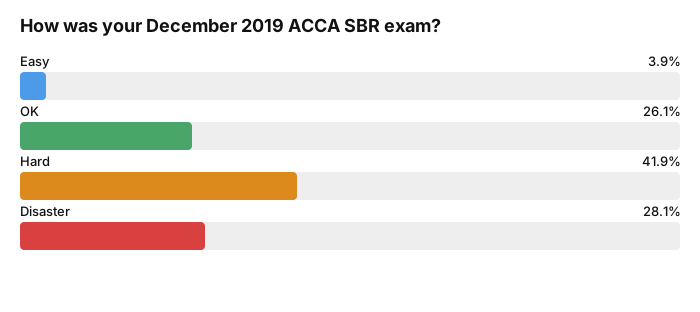
Paper was good and average. I couldn't do well due to time constraints. Q1 was slightly confusing and took majority of the time. Ready to sit in Mar again
Paper was ok, but I overran my time on the first question, had to leave the goodwill calculation
and it was a uphill battle from there on,
relatively simple way standards were examined, nothing complicated which was surprising
I attempted most of the paper, I had a really good time on the Ethics question (20marks!),
I imagine they’ll be a bit strict with marking,
Q 3, had a range of standards applying to its requirements and for little mark allocation each so wasn’t quite sure what level of detail were the examiners looking for
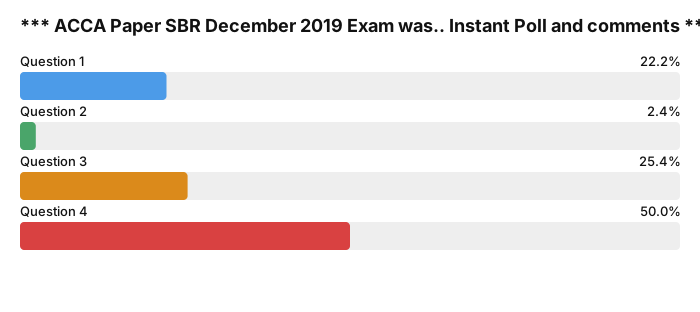
Q 4 looked confusing but once I got going it got easier, although still not sure if I answered it correctly as it was very unfamiliar, was more common sense than technical
All in all expecting a pass fingers crossed
Disaster .. only did 80% of the paper .. retry in March...
Can anyone tell me what ethical issues they addressed on Mr Toppers Profit warning?
Yes it was confusing. Who remembers the questions? I just don't remember.
Weird exam. I expected it more balanced and 3/4 of the study text wasn’t examined. Didn’t understand the marking. Weird
I've tried to remember what I can here, along with some answers/thoughts I had during the exam:
Q1 on a step acquisition from associate to subsidiary. Talked about the differences between significant influence and control and how equity accounting to be used up to the point of control assumed. Relatively simple goodwill calculation if you remembered to bring in the FV of the existing investment held. Talked about how associate was to be accounted for and then moved onto NCI being at proportionate value in GW calc. There were also some FV adjustments to make in respect of revaluation (including the arising of deferred tax as a result). I think from what I remember, good will was around $1.4m in my answer (though may be way out!)
Q2 was really quite straight forward in my opinion. There was a whole host of ethical issues and dilemmas being faced of which I addressed using PIPCO. I then talked about the chain of command when it comes to resolving these issues (i.e. not just resigning in the first instance without speaking to person themselves, another key member of management personnel, the audit committee and finally, the ACCA).
I also talked about what the principles and threats were not in relation to the scenario to try and obtain close to the full 11 marks (however, this caused me issue with timing in hindsight).
The treatment of the accounting for ships and containers was wrong on several levels (aggregating separate material items on the balance sheet), depreciating all as one and changing the depreciation policy without the end result being more relevant/reliable measurement. Finally, IAS 16 specifies that if you are to hold the assets under the revaluation model, you must hold the entire class of these assets in the same way (and not cherrypick), which is not what the accountant was doing.
Q3 & 4 is where I really struggled. 4 in particular seemed particularly tricky and I found it difficult to pinpoint exactly what the examiners were after. I made some scarce remarks about the business combination hitting the P&L through goodwill impairment and in turn, hitting the EPS figure. I also mentioned that in an asset acquisition, dep'n and amortisation would hurt the profit in the first year.
I also talked briefly about the contingent consideration, which would need to be allocated across the assets obtained and so if the significantly higher figure was used, we would give rise to an inflated balance sheet and skewing any ROCE calculations, putting us in a position whereby impairment may be significant in a future period. I also recall stating the revenue recognition criteria somewhere in Q4 for the non refundable fee paid. I just said that it should be held as a contract asset and the transaction price written down accordingly upon full recognition.
Finally, question 3 again seemed quite a tough question to deal with (related to the Joint Venture). It asked us whether the JV should have been classified as a sub by one of the JV participants, which really messed with my head. For another of the sub-requirements, I just threw a load of standards based on impairment somewhere here via bullet points as time was of the essence. I stated the definitions of an asset under the conceptual framework and then went onto IAS 38's PIRATE criteria for recognising internally generated intangible assets for the production costs being capitalised or not. Not sure if this was the right approach but was really clutching at straws!!
All in all, think i'll come out with between 40-50% and will be resitting in March due to Q3 & Q4 and the missing out of 8 marks in Q1 (related to assets) due to bad timing planning!
@inverter said: Can anyone tell me what ethical issues they addressed on Mr Toppers Profit warning?Well, I wrote Mr Topper was abusing his position as accountants are privy to sensitive information due to nature of their work, and him seeking to capitalise on private info is a breach of ACCA code of conduct.
When answering Q2 ethics. Part b) ship depreciaton did we have address ethics part within part a)?
Q4 - did we have to calculate treatment under BOTH a) asset acquisition and b) business acquistion? Or simply state which one is relevant den apply this to calculate EPS. I got negative earnings under business combination so couldnt work out EPS?
Q4 was the revenue as an agent or principle ..although i discussed couldnt decide so went with my gut as principle
Q3 UK version there was discuss of correct to consolidate...what did others decide..i said yes....
Did anyone get negative goodwill in q1?
Thanks BG.. I just remembered I put a contract liability istead of asset. Lol. Its obviously I contrant asset as the fee was paid..
@bg12321 said: I've tried to remember what I can here, along with some answers/thoughts I had during the exam: Q1 on a step acquisition from associate to subsidiary. Talked about the differences between significant influence and control and how equity accounting to be used up to the point of control assumed. Relatively simple goodwill calculation if you remembered to bring in the FV of the existing investment held. Talked about how associate was to be accounted for and then moved onto NCI being at proportionate value in GW calc. There were also some FV adjustments to make in respect of revaluation (including the arising of deferred tax as a result). I think from what I remember, good will was around $1.4m in my answer (though may be way out!) Q2 was really quite straight forward in my opinion. There was a whole host of ethical issues and dilemmas being faced of which I addressed using PIPCO. I then talked about the chain of command when it comes to resolving these issues (i.e. not just resigning in the first instance without speaking to person themselves, another key member of management personnel, the audit committee and finally, the ACCA). I also talked about what the principles and threats were not in relation to the scenario to try and obtain close to the full 11 marks (however, this caused me issue with timing in hindsight). The treatment of the accounting for ships and containers was wrong on several levels (aggregating separate material items on the balance sheet), depreciating all as one and changing the depreciation policy without the end result being more relevant/reliable measurement. Finally, IAS 16 specifies that if you are to hold the assets under the revaluation model, you must hold the entire class of these assets in the same way (and not cherrypick), which is not what the accountant was doing. Q3 & 4 is where I really struggled. 4 in particular seemed particularly tricky and I found it difficult to pinpoint exactly what the examiners were after. I made some scarce remarks about the business combination hitting the P&L through goodwill impairment and in turn, hitting the EPS figure. I also mentioned that in an asset acquisition, dep'n and amortisation would hurt the profit in the first year. I also talked briefly about the contingent consideration, which would need to be allocated across the assets obtained and so if the significantly higher figure was used, we would give rise to an inflated balance sheet and skewing any ROCE calculations, putting us in a position whereby impairment may be significant in a future period. I also recall stating the revenue recognition criteria somewhere in Q4 for the non refundable fee paid. I just said that it should be held as a contract asset and the transaction price written down accordingly upon full recognition. Finally, question 3 again seemed quite a tough question to deal with (related to the Joint Venture). It asked us whether the JV should have been classified as a sub by one of the JV participants, which really messed with my head. For another of the sub-requirements, I just threw a load of standards based on impairment somewhere here via bullet points as time was of the essence. I stated the definitions of an asset under the conceptual framework and then went onto IAS 38's PIRATE criteria for recognising internally generated intangible assets for the production costs being capitalised or not. Not sure if this was the right approach but was really clutching at straws!! All in all, think i'll come out with between 40-50% and will be resitting in March due to Q3 & Q4 and the missing out of 8 marks in Q1 (related to assets) due to bad timing planning!Well, if that constitutes a 40-50 i don’t know what I should be expecting! I applied IFRS 15 to recognise the costs as contract asset if there was a performance obligation satisfied over a period of time? Along with probability criterion of IAS 37 Did I go wrong? Question 4 I said due to goodwill being impaired and the subsequent effect on net assets meant the entity is less likely to acquire source of finance due its inability to offer assets as security and this might cast doubt for future investments? Is this reasonable?
I forgot to bring in nci in calculating goodwill....i m ruined
Hello, anyone that took the SBR UK paper,
please
What UK topics came up in question3????
Many thanks for your reply.
Did you not use full goodwill method in Q1??
I got negative goodwill..
Also stripped out deffered tax from NA calculation, didn’t think you included this.
@micksymooresy16 said: Did you not use full goodwill method in Q1?? I got negative goodwill..The question said proportionate method so that means partial method yes? I got negative goodwill too
I think I said I was doing full goodwill calc but actually did the proportionate method :D :D
And stripped out deferred tax for no reason :D :D
100% repeat, awful exam
I think there was a hint in the question of q1 it said about goodwill/bargain purchase. And this only happens in negative qoodwill. Looks like we on the right path
Did everyone say that a business combination occurred on April X6? As a result of the 18% acquisition and the option to take the other 12% shares?
What about q4 part a? I said they where the principal as they where responsible for operation of the game and all other matters and received payments?
pm
Q2 ethics part A. Situation 3. I talked about ethics as in professional behaviour - computing with relevant laws and regulations and avoid action that discredits the profession . Because clearly he was not following the standards.
And then in part B I talked specifically which standards were done incorrectly. I mentioned segment reporting since their ships were material items (not sure if correct though haha ), then said about it you use revaluation model then it should be applied to all class of assets in scope of that standard (PPE IAS 16). I also said gain and losses are charged through OCI. And disclosures should be made review of depreciation methods, etc.
Then also said that provision that was created before for overhaul was incorrect and it is an acc error. Should be corrected retrospectively. Said what provision is , that it is obligation from past events not future. Although now I am thinking did he have to have a provision for overhaul costs or not?
Q4 – I am not sure too! But I said it is business combination , and then started caccluatlions so I didn’t calculate if it was asset acquisition . sugar there was KPI and I forgot to that part, but just talked about contingent asset, then calculated goodwill, then said that direct costs are expensed.. Showed transactions
Q4 haha not principle ! principal
Q3 it was a joint venture , yes in consolidation It is accounting in Equity accounting . there should be asset investment in joint venture and corresponding share will be included in group retained earnings.
pm
Sorry I forgot to say I was answering bilalkhalifa’s question
bilalkhalifa
Participant
When answering Q2 ethics. Part b) ship depreciaton did we have address ethics part within part a)?
Q4 – did we have to calculate treatment under BOTH a) asset acquisition and b) business acquistion? Or simply state which one is relevant den apply this to calculate EPS. I got negative earnings under business combination so couldnt work out EPS?
Q4 was the revenue as an agent or principle ..although i discussed couldnt decide so went with my gut as principle
Q3 UK version there was discuss of correct to consolidate…what did others decide..i said yes….
I said IBEX (q 3) where in control as they controlled most of the big considerations for the film - the cast and distribution. And they had to use their subsidiaries for all contract work. And that the board of directors couldn’t change this. But I could defo be wrong ??
I got control too as ibex had power to direct the use of Pompex‘s resources and affect the return on them through its level of involvement?
Ye I said similar
I also got negative goodwil in Q1!
But Q1 was hard for me I spent so much time on it! I think 1 h. Then spent too much time on Q2 instead of 40 min max that I allocated to it I spent an hour because I wrote too much. My negative goodwill was -1.8m but I’m sure it is not correct, can someone tell me what their goodwill was In q1?
Q3 was a disaster to me because I didn’t have time to remember properly GAAP! I was confused with questions regarding difference in impairment between FRS2 and IAS16! Can someone tell me rules for impairment reviews in FRS2 I couldn’t even find it in my book!
Then obviously I couldn’t do the calculation for impairment in part 2 of Q3!
I was glad not the whole question was on GAAP. I managed to answer question about Joint venture.
Q4 it was a prepayment asset for a licence and then charged to profit and loss on straight line basis for 12 months.
I said it was a principal because agent usually takes a fee . Not amazing explanation to be honest I can’t remember what else I wrote to convince it was principal.
Also I forgot to calculate kpi stuff.. but I did manage to calculate goodwill, then contingent consideration discount was unwound and charged to p&l. I think it was 1.5m fin cost which increased contingent consideration liability by 1.5 m which resulted in 6.5 m of contingent consideration liability at year end
Beyond disaster!
Honestly speaking, this was NOT a 3 hour 15 min exam. It was at least a 4 hour exam.
You need time to first look into the scenario, which was next level complex today, then try to understand what the requirement is and then plan and start writing your answer. The scenarios alone were so damn complex that it took hours to just understand them, how the heck could one fully attempt the exam?
I don't think most candidates could attempt full exam. How many of you were lucky enough to do so?
I’m so annoyed!! I had 1.4m negative goodwill for my answer, then went back and changed it for some stupid reason taking out the deffered tax liability of 16m!!
I still got negative goodwill of around 8 so will pick up marks for describing how to treat it.
If you cross something out but it’s still visible do you get marks for it? :)
@f6ali said: Beyond disaster! Honestly speaking, this was NOT a 3 hour 15 min exam. It was at least a 4 hour exam. You need time to first look into the scenario, which was next level complex today, then try to understand what the requirement is and then plan and start writing your answer. The scenarios alone were so damn complex that it took hours to just understand them, how the heck could one fully attempt the exam? I don't think most candidates could attempt full exam. How many of you were lucky enough to do so?Yeah true, i spent an hour on Q1 but defo didn’t get 30 out of 30! Maybe 10? I did attempt all questions but if I didn’t know the answer as all(for example with GAAP) I just skipped it and came back in the end to write a non sense ;)))
Q1
A (ii) How do we calculate 'investment in associate' after acquiring a further 30% equity share?
Topic lockedNew replies are closed.