
Skip to content

ACCA Forums

APM*** ACCA Paper APM December 2019 Exam was.. Instant Poll and comments ***

Oopentuition_teamAdmin6y ago

How was your APM exam? Please post your comments below, and vote in the Instant Poll
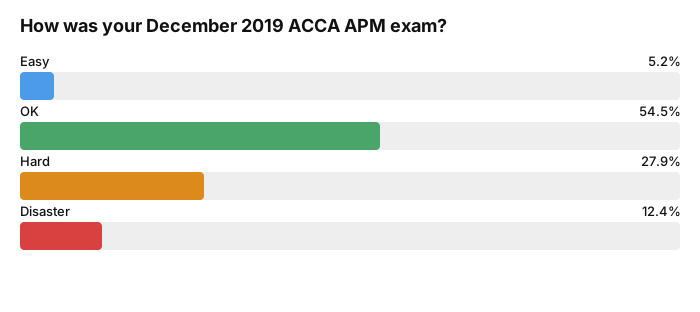
December 2019 ACCA APM exam — historical results
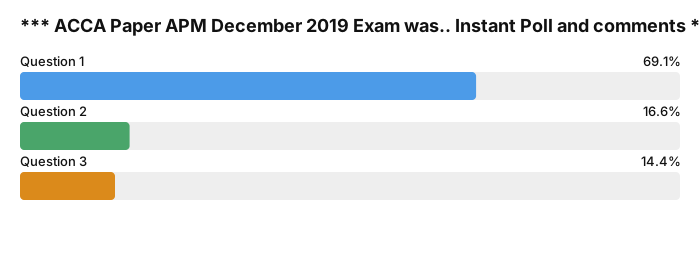
*** ACCA Paper APM December 2019 Exam was.. Instant Poll and comments *** poll results
Nnicky2476y ago#1
What topics came in this sitting? I'm sitting in march and I'm so nervous.
OOluseun6y ago#2
I wish everyone success
KKK6y ago#3
Q1 (i). Performance & Performance Measurements Evaluation based on ROI, RI and the case Q1(ii) BGC Matrix as a Performance Management tool in general and case specifically Q1(iii) Management Information System generally but may link to case were applicable Q2 Calculation and Evaluation of appropriate Performance Measures (The Case) Q3 Predicting Corporate failure using the Agenti A Score and the problems with such a toll in predicting corporate failure in respect to the case Performance measurement Evaluation
SSanjana6y ago#4
1a- Evaluation of ROI, RI and analysis 1b- BCG analysis 1c- Qualities of good information and MIS. It's uses in different levels of management 2a- Benchmarking 2b- Benchmarking 2c- BPR (JIT/Value chain integration) 3a- Qualitative Argentine A score model 3b- discuss that qualitative corporate failure model Overall, the paper was quite manageable and good enough.
NNick6y ago#5
"Evaluate the method of benchmarking?" What did people do? Evaluate choice of company etc or evaluate the numbers? Questions seemed to want the first but appendix had additional information that seemed to support the latter
YYando6y ago#6
I assessed the method which Selite** (whatever the name) used against the Benchmarking Process.. My conclusion was that the process was fine except that the KPIs identified did not respond to the CSFs except for one..
MMatt6y ago#7
I thought that was a bit of a trick question there as the question was to advise on the appropriateness and sufficiency of the measures in terms of the industry (not the company). I debated what to write for a while as it listed the company objectives and CSF's but then later it went on to say what was valued in the industry at the moment - Ie. customer satisfaction, employee knowledge etc. so I focused on these points. To be fair these items overlapped quite a bit though.
MMaciej6y ago#8
Wasn’t part A to evaluate the benchmarked position and suggest additional measures? Part b I focused on benefits and disadvantages of the benchmarked method chosen and how it wasn’t inline with objectives and CSFs of the organisation.. paper was definitely manageable but think paper should be 4 hours same as SBL.
MMatt6y ago#9
I'm sure the question was 'the sufficiency and appropriateness for the industry' - ie. Not the company
SSanjana6y ago#10
1a- I calculated and commented on the ROI as well as the RI. In both cases, I calculated it without taking the head office costs, taking the brand building and R&D cost as well as the restructuring cost. Then I also calculated and analysed the both ratios by not taking the head office costs and restructuring costs and considering the R&D and Brand building costs. Gave a short note as to why restructuring costs was not considered as the company's senior management would give approval for shifting the business place to a prestigious place and divisional managers aren't quite responsible for that cost. Wrote the disadvantages of ROI too. Some advantages of ROI and RI too. 1b- BCG analysis was pretty straightforward..gave two financial KPI for cash cow, star and problem child. 1C- Idk how far I'm correct but I wrote the qualities of good information, good MIS report, what information/data is required by functional managers of different levels. 2a- Wrote a short note on benchmark, compared monlich or whatever company that was with the competitor sheil. Also, analysed those ratios and wrote what monlich company should focus on to achieve the ratios like sheil. Gave some 3-4 extra ratios that could be calculated in the benchmark process. 2b- Wrote specifically the advantages and disadvantages of Benchmarking against a competitor. Idk if we should write something extra than this or no. 2c- Wrote a short summary of BPR. Wrote about how to change the process of material handling/order processing to Just in time. Wrote about how to keep close relationships with 1-2 suppliers only. All of that. 3a- Described Argentine's A score model and compared it with the given scenario sletille company or whatever that company name was. Defects, mistakes....all of that! 3b- I didn't do, because no time. I am just hoping to pass please! This is my last paper and I studied too much for it.
MMatt6y ago#11
@sanjanapaul1234 said: 1a- Then I also calculated and analysed the both ratios by not taking the head office costs and restructuring costs and considering the R&D and Brand building costs. Gave a short note as to why restructuring costs was not considered as the company's senior management would give approval for shifting the business place to a prestigious place and divisional managers aren't quite responsible for that cost. Wrote the disadvantages of ROI too. Some advantages of ROI and RI too.
I might be completely wrong but I felt with the R&D costs and marketing/brand costs, it was eluding to potential use of EVA which being essentially an extended RI calc. these costs wouldnt be charged against expenses as they would be considered long term enhancement/value add. The wording was very specific - it lead me to believe this. Yes it didnt ask specifically but for me its too much of a coincidence.
MMatt6y ago#12
@yando said: I assessed the method which Selite** (whatever the name) used against the Benchmarking Process.. My conclusion was that the process was fine except that the KPIs identified did not respond to the CSFs except for one..
I thought that was a bit of a trick question there as the question was to advise on the appropriateness and sufficiency of the measures in terms of the industry (not the company). I debated what to write for a while as it listed the company objectives and CSF’s but then later it went on to say what was valued in the industry at the moment – Ie. customer satisfaction, employee knowledge etc. so I focused on these points. To be fair these items overlapped quite a bit though.
NNoshma6y ago#13
It was a bit tricky...wasn't too prepared for it so will take the paper in upcoming sittings. Good luck everyone
SSpiroSupporter6y ago#14
Could someone clearly list which of the costs in Q1 (i) are treated as non-controllable? I treated as non-controllable the Head office, R&D and building marketing brand. What about the restructuring costs of one of the divisions (moving to new office)? Who takes the decision/responsibility for it? Probably I missed something when reading the question.
YYando6y ago#15
I feel odd that I calculated EVA in question 1. Did anyone calculate it too? I think the only way R&D costs, etc could be considered was by calculating EVA which is a modified RI. So I evaluated using ROI (all divisions were above industry average), I evaluated using the RI and also using EVA (which included lots of calculations as I had to adjust the NOPAT and the CE). My calculations were full of errors but I hope my reasoning can attract marks.
Former userFormer user6y ago#16
How may marks were allocated for q1(I) ..can you remember..was it 16 or 12?
MMatt6y ago#17
Q1 a) was 18 marks I think. Think it went 18, 16, 12 and 4 professional
SSanjana6y ago#18
To everyone who's confused about question 1a regarding the Brand building costs and R&D costs- Yes, it was leading to a long term benefit. It was mentioned in the question Appendix 1. However, the question asked to stick specifically to ROI and RI. It didn't ask to comment about EVA. EVA is the best method to find out the shareholders wealth because it makes adjustments to the profit and brings it closer to the cash flow which can't be manipulated. Hence, in EVA we have to add back such expenditures leading to long term benefits to the operating profit. However, in ROI and RI, they are a performance measurement ratio which considers the operating profit. Operating profits can be manipulated to get a better ratio (creative accounting) Hence, in ROI and RI those divisional managers will minus those expenditures leading to long term benefits and calculate the ratio of ROI and RI. For restructuring, since it was a questionable figure, I once considered restructuring costs and then I didn't consider restructuring costs while calculating the ratio. And I wrote the explained that in this place restructuring costs aren't considered because maybe the company's senior management decides which place the business should be shifted to or located in and that divisional managers have a little say in making that decision...so... I showed both the calculations of that restructuring costs to be on the safer side. I am just praying that I pass this time pleaseeeee.
NNoshma6y ago#19
How did you calculate EVA without WACC? Because looking at question requirements I thought EVA but there was no mention for Ve and Vd... Or equity debt ratio... And then saw TOI and RI while reading the case scenario...
NNoshma6y ago#20
@yando said: I feel odd that I calculated EVA in question 1. Did anyone calculate it too? I think the only way R&D costs, etc could be considered was by calculating EVA which is a modified RI. So I evaluated using ROI (all divisions were above industry average), I evaluated using the RI and also using EVA (which included lots of calculations as I had to adjust the NOPAT and the CE). My calculations were full of errors but I hope my reasoning can attract marks.
How did you calculate EVA without WACC? Because looking at question requirements I thought EVA but there was no mention for Ve and Vd… Or equity debt ratio… And then saw ROI and RI while reading the case scenario…
SSanjana6y ago#21
We didn't have to calculate EVA anywhere in the question paper. That question mentioned specifically that we have to stick with ROI and RI. Nothing else is expected from the management accountant for now. It was specifically mentioned in that question only.
Ggagandeep6y ago#22
It was clearly mentioned in question 1 not to calculate any other performance measure except ROI/RI we only have to check its sufficiency and appropriateness I think 1st question was tricky And in 3rd question All mistakes, symptoms and defects were mentioned in question itself If I am not wrong
Former userFormer user6y ago#23
18 marks were allocated for BCG for sure ..not for (I) whether it was 16 or 12
SSanjana6y ago#24
Uhmm....I would disagree with the explanation of not considering R&D and Brand building expenses while calculating ROI and RI as ROI and RI are ratios in which manipulations can be done to the operating profit through creative accounting. However, EVA is a method that doesn't allow such manipulations and adjusts the profits nearer to a proxy cash flow. Hence, according to me, if a divisional manager is measuring performance via ROI or RI, he will consider R&D and Brand building costs. Restructuring costs are arguable and so I toh showed calculations for both (with considering restructuring costs and without considering restructuring costs) (I had seen this type of an answer in the exam kit) That logic of long term benefits add back applies to EVA only. 1b- I described the whole BCG matrix and related it to the given case study. Financial KPIs like Sales revenue and profit margins for Essan (Differentiation strategy one) KPIs like Cost per unit and cost variances for Doilet (Cost leader strategy) and KPIs like Sales revenue, ROI, RI, EVA for Fada as it was a problem child and we have to either apply the invest or divest strategy to it. For investment, we have to check the ROI/RI with that logic I wrote ROI and RI. But to play safe, I mentioned Sales revenue in fada again because I felt that to decide upon a decision of divestment or investment, managers have to check the sales revenue trend from that particular division na so! I hope they consider and give me marks for Fada :p
SSanjana6y ago#25
The thing that you're trying to say would've been correct if they had asked to describe EVA. What you're trying to say is absolutely right in terms of EVA. However, they had asked ROI and RI. Both of these are flawed performance measurements as compared to EVA. As ROI and RI is a manipulative performance measure, EVA was introduced. If you remember studying adding back R&D expenses to the operating profit and deducting the amortization for the year only from operating profit to arrive at NOPAT. No, I didn't do 3b. I had attempted everything else except Q3b. I didn't get time for it.
SSanjana6y ago#26
Also, in ROI and RI, we consider Operating profits as per the statutory reports. In operating profit, R&D, BBM will be considered if an expenditure is made. To make your point valid, a simple note of "considering R&D, BBM as capital expenses as per IFRS" would suffice I suppose. If you've written it, you're safe. The examiner can't reduce your marks I guess if this note is mentioned. However, I am not sure if the examiner considers such notes or not.
Mmisbahkiran6y ago#27
i am also sitting in march..any tips...
JJennie_fierz6y ago#28
Problems with Qualitative models 1) Internal focus, use PEST to overcome problem 2) Subjective in nature, difficult to quantify but use trend analysis 3) Grey area results in inconclusive results 4) Very limited financial focus, has to be a balanced view 5) Historical in nature based on single point in time, rather than considering periodic anaysis I hope it helps!
TTasbiha6y ago#29
I am planning on attempting APM for March 2020, any tips and advise??
SSpiroSupporter6y ago#30
December 2019 APM examiner's report is available on ACCA site https://www.accaglobal.com/content/dam/acca/global/PDF-students/acca/p5/examinersreports/apm-examreport-d19.pdf
Topic lockedNew replies are closed.