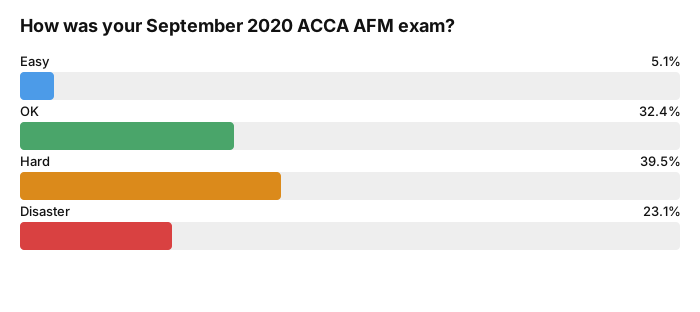
AFMACCA Paper AFM September 2020 Exam was.. Instant Poll and comments
Oopentuition_teamAdmin6y ago
How was your ACCA Paper AFM September 2020 exam?
Please post your comments below, and vote in the Instant Poll
RRohan6y ago#61
Transfer price was 10 Euro and Manufacturing Cost was 2 Euro.
So, the Pre-tax contribution for us is 8 Euro.
So, Sales volume * 8 * inflation in euro for each year.
Then you need to deduct tax from the contribution. i.e. 20% tax
Ffrafiq81Supporter6y ago#62
The exam was okay but too time pressured. I think if i would fail then it would be due to not being able to write due to time constraints.
The bond question is a bit similar to requirement b(i) of Conejo question (Q 48 BPP kit). What should be Kd when calculating WACC after the issue of new bond as both the bonds had different yield to maturity/returns required by bond holders?
I did not even have a chance to look at the other requirement of this question and thought someone at opentuition would comment on that. I assume the requirement related to difference between forex and currency swap was worth 12 marks? I wish I had 10 more minutes to complete that part of the question.
Forex swap actually 'locks' the rate at the start of the transaction and then the same rate applies at the end of the transaction so you are not exposed to currency rate fluctuations. Specially when you are dealing with a weak currency or investing/doing a project in a country whose currency is weaker or not easily available on foreign exchange markets. For e.g you invest money at To in a project at the spot rate at To then you would receive the profits at T4 for example at the same rate.
With currency swaps there are two parties involved. You borrow an amount in your currency from the bank in your country for the counter party and pay their interest. The counter party borrows an amount in their currency from the bank in their country and pays your interest. The principals amount and interest payments are exchanged between the counter parties. The objective is to save interest payments because it would be cheaper to get a loan in your currency in your country.
Question 40 Buryecs (part b) in bpp addresses both these areas.
I think there should also be a poll in here for the ACCA CBE platform. I think 80% + plus will choose hard or disaster but i hope ACCA are willing to improve the software based on our feed back. Just submitted my suggestions via the survey. I think ACCA should give students an option to either sit for the exam via CBE or paper based exam.
CCnris6y ago#63
I think for the bond the market value was already calculated using the relevant spot yield curve for the year + Credit spread
For example
Time 1 - Interest - $7.5 * (1+Spot yield curve for 1 year bond + credit spread for that year)^-1
Time 2 - Interest - $7.5 * (1+Spot yield curve for 2 year bond + credit spread for that year)^-2
Etc etc. That gave market value or issue value of bond.
Then using you can repeat the same cashflows including the initial purchase of the bond at market value (thinking about things from the investors perspective.
But for the DCF do one at say 5% and one at say 10%, then plugging that IRR, I think gives you the YTM.
CCnris6y ago#64
Agree completely with the time and hassle of CBE. Frustrating as I really liked the CBE function on the foundation level exams as my handwriting is poor. Especially as they aren't as time pressured than AFM.
You save 30 seconds using an auto sum ON EXCEL, then spend 1 minute shuffling round the exhibits and word processor and spreadsheet because the screen is too small to show all relevant data.
Why they can't either give you two screens or a copy of the questions on paper to help time pressure is beyond me.
CCnris6y ago#65
I think the idea about the FOREX swaps and currency swaps is more to do with what type of question you are trying to hedge/what benefit you are trying to achieve.
I think the idea of the Forex swap is to hedge relatively short term (a year or less). Which could to hedge a future reciept or payment and involves swapping a principle with a counter party.
The currency swap still involves the principle swap with a counter party but is mainly set up to lower the cost of borrowing (using the estimation that a company co is likely to be able to borrow at a lower rate domestically than an overseas company will and vice versa.
These kind if swaps are usually used when financing a significant overseas project that might last years. Theyll essentially benefit financially from the swap due to paying lower interest.
So the currency swap is no use use to hedge a receipt in a few months. At least I think that's the idea. That's the sort of stuff I wrote about anyway, and recommended that a Forex swap would be much more beneficial and the currency swap would be a better fit to the expected expansion projects - not the future rupees receipt.
CCnris6y ago#66
I dont think you needed to do any currency conversion to calculate the number of contracts needed. We were hedging a receipt of 202mR and the contract currency was in Rupees.
If i recall correctly, the premium on the option may have needed converting.
CCnris6y ago#67
I think thats the point. Its fine on a 27 inch monitor, you don't get a 27 inch monitor in the real exam at the Pearson Vue UK locations anyway.
Ddharyn6y ago#68
To obtain the contract, all to do was divide 202m by 5m. Then we had to find the gain or loss on futures but the currency was denominated in Indian Rs per 1 euro, after finding the gain, I think I should have converted the loss in US dollar using the predicted spot rate (which is the current futures price) then multiply by no of contracts and contract size, another way of doing this is multiplying the loss in indian rupees x no of contract x contract size then divide the amount obtained by futures price or predicted spot rate (which are the same). I had no clue how to work out the amound underhedged.
CCnris6y ago#69
202mR/5m was 40.4 contracts, rounded down to 40 contracts.
40 x 5m contracts was 200m.
Therefore amount unhedged was 2mR which was hedged using FRA.
MMagdalena6y ago#70
If I'm not wrong, there was a short note in OT notes (or maybe in BPP) where they explained that forex swaps are for very short term, like one week. So basing on this I recommended to use currency swaps.
Ddharyn6y ago#71
Thank you, make sense now. I've never seen a question examined in that fashion before, thats why I got confused, I've learnt futures in a methodical way without understanding the underlying logic that well. I did well on theory, hope I secure a pass.
Cchan6y ago#72
I guess the cost of debt should be weighted average of total interest /total market value ?
difference between forex and currency swap was 6 marks,another one asking benefit of seperate treasury department , 6 marks
Ffrafiq81Supporter6y ago#73
@accboy729 thank you
CCnris6y ago#74
Hopefully mate.
Ffrafiq81Supporter6y ago#75
@accboy729 yes i calculated based on weighted average and the proportion which i used was related to non currency assets however i hardly mentioned any assumptions in my answer because of lack of time...
JJude6y ago#76
The marks were actually there for the taking, but a little twist in Q1 (the second bond and all those stuff with it) did a lot of havoc.
Ssoshilata6y ago#77
hi, may i know how much of proportion of MVe and MVd in question 1? because i feel like i calculate wrongly for the MVe and MVd. it make the Wacc no much different
AAlessandro6y ago#78
Acca is not cheap. For the amount of money we spend I think we deserve a better spreadsheet software.
It totally sucks - you can't even cut and paste without losing formulae and references.
It slows me down
KKhalood6y ago#79
.
KKhalood6y ago#80
Same i am confused about this too :/
SSaksham6y ago#81
Was it even possible to complete the AFM paper in CBE mode? I did not attempt 29 marks, which was the second best attempt in terms of marks in my practice of 4 papers and the final exam.
Although I feel confident about the part I wrote and hopefully will pass but I would like to know from others if it was possible to complete CBE exam for AFM?