
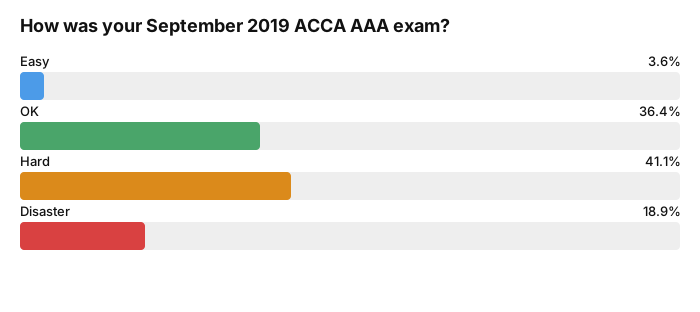
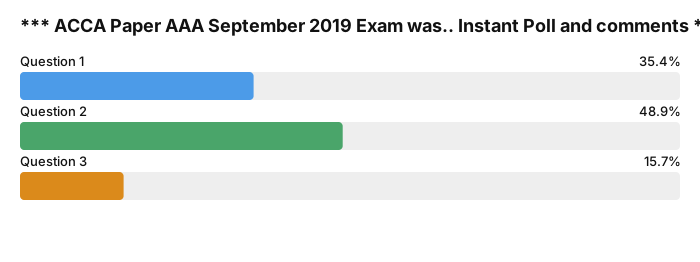
How was your AAA exam? Please post your comments below, and vote in the Instant Poll
ACCA Forums
@navjot23 said: Hey everyone. Just a breakdown of things that may have been worth mentioning which I wrote about in my answers Q1) audit risks: - Complex group structure - Listed entity - management bias to manipulate results - Potential Impairment of the Burger chain as they mentioned in the wording revenues had fallen - operating segment disclosure - disclosures for the joint venture - the disposal of the burger chain is an event after the reporting period as they have not found a buyer at year end disclosure necessary? - held for sale treatment for the burger chain - the PPE capitalised $45m has intangibles in it which need to be sepreated and amortised - within the PPE whatever related to the PPE items such as Fixtures and fittings, plant and machinery and the building should all have different depreciation terms and should be separated - dont know if anyone noticed but there was a reconciling difference between The operating segment note which stated total assets were i think $450m but just below it "other information" stated that total assets were $475m there was a reconciling difference of $25m of assets. I talked about how the auditor doesnt audit the "other information" section and doesnt express and opinion but there is a risk that this is mistated and we must ask management to correct. - government grant risk that the full amount has been recognised in the P&L but according to IAS standards should only recognise the income when the associated costs are alongside and as nothing has been spend the f/s are misstated. Also worth noticing that Profit after tax was $20m and the government grant was $20m so if we remove the grant profit after tax becomes $0? Further information about the disposal i mentioned all the criteria needed for a held for sale such as actively marketed, sale highly probable, sell in currrent condition, fair value, sale in one year etc. The ethical threats i mentioned self interest due to the fee the auditor may receive, intimiation as juniors may fail to challenge the senior auditor, self review , management responsibilities, as well as familiary as the audior may become too trusting of the staff if he joins them for a short while. Q2) FYI for those uncertain about the shopping mall impairment treatment. If you have done P2 theres one page which mentions impairment reversals and an entity cannot recognise an impairment reversal greater that what they had originally impaired the inital asset at. The sale and leaseback was correctly recorded so it was just things to talk about such as has a sale occured and has the entity satisfied its performance obligations and if the transaction didnt meet the requirements of a sale then the treatment of the sale and leaseback would be different. As the building had a 50year life and the leaseback was only 10years the substantial rights to the asset move to entity buying the building (they have the remaning 40years of use on it) therefore it can be treated as a sale. All in all a qualified opinion would be issued with an "except for" wording and a "basis for qualifed opinion below it" Q3) forensic audit acceptance was: Advocacy Confidentiality Self review Professional competence Self interest I could keep going on the other parts let me know if you want good luck to everyone.Looks like you really hit the nail on the head with q1. Q3 it mentioned the company wasn't currently a client so not sure if you'd get marks for stuff like self-review, advocacy threats etc. I based the acceptance on having resources, trained staff who have personal skills to interview witnesses, helpful to have some further information on claim to help understand extent of task. The procedures I put on looking into fictitious customer account, cancelled orders with stock missing etc. I hope I've done a good enough job on Q3 to make up for 1&2. I really went to town with the overstated revenue for the coffee shops and the separate system. And ultimately just gotten 1 or 2 marks.
@opentuition_team said: <h3>How was your AAA exam? Please post your comments below, and vote in the Instant Poll</h3>
 Former user7y ago#35
@raoul7370 said: It always concerns me when the comments on here regarding the exam are so focussed on accounting rules. And also complexities and details of the scenarios. This is missing the point in such a major way if you want to pass. I have not seen the exam paper. But based on several posts which detail the requirements, I would tell you the following: Q1 3 easy Prof Marks 2 for calculating materiality of any 2 things you put as risks RISKS Assuming no calcs were requested, probably aiming for 11 audit risks Qn asks for audit work on 50% acqn and a grant, so that means both have risks: - recognise grant in P or L too early - might need prov for grant repayment if not meeting t+c - new 50% thing needs disclosure (IFRS 12) and they might under-disclose - mis-classification of new 50% thing as could be JV, Sub, associate and "control" is subjective concept - new 50% acqn could be a new Op Seg = disclosure needed - gain or loss on disposal wrong - potential wrong classification of disposal as HFS or Discont Op(I do not know when it was sold so cannot tell which would be right) the above looks like enough risks to pass given the marks, and is based purely on seeing another part of the question asking for audit tests on those 2 things. It does not need reading of the story. Even if you only score an average of 1 mark per risk above, that is 7 marks, add to the 3 Prof Marks and 2 materiality and we are up to 12. EXTRA INFO RE DISPOSAL since I have not seen the story, I do not know what info HAS been given, but common sense says I would want the following, so if any of these are not in the story they go in the answer: - WHEN sold - to WHOM (could be RPT) - for HOW MUCH (to calc gain, and also could be deferred / contingent) - WHY (to help GC assessment of remaining company/group) - tax situation (if a gain, tax likely) - if sold post y/e, WHEN did the advertising for sale start (to check if HFS at y/e) If at least 2 of the above are not in story, that should be a pass (it was out of 4, right?) TESTS Grants have come up so often, if you cannot do 4 tests on a grant you might as well give up: - CB and BS - Grant agreement - board minutes to verify commitment to use grant within the t+c - recalc of whatever portion to P or L this year (if any) - corresp with grant authority for signs of failure to meet t+c The 50% thing … there was a JV question in Sep/Dec 2016 Q1. Sounds like it could be the same? Anyway, if tests are re classification then need to see involvement of your client in management and decisions at this new acqn: - BM of client to understand intention of acqn, is it to jointly manage? - BM of the thing acquired, to see if client's directors are attending BM and voting - Co House info to verify make up of board at acquired entity - Shareholder reg to confirm 50% owned, and who owns the other 50% ETHICS Cannot comment without seeing the story for this bit. The point is that there are at least 20 marks of content above for Q1, and that assumes poor explanations of the audit risks, no attempt at the ethics at all, and not reading the scenario at all. Almost a pass. A lot of auditing is about doing core things on every client, and then adding specific extras. The core stuff still gets marks, whatever the scenario says (within reason of course!). Q2 SALE and LEASEBACK The IFRS 16 accounting for these is nasty. I suggest you ignore it. Evidence - sale document confirming transfer of legal ownership to other party and date - leaseback document to confirm lease length, payment terms and any other t+c - BS and CB to verify any cash received from sale and date received - BM to confirm understanding of why sale and leaseback done (could be cashflow issues and a GC problem) - proposed disclosure note and SFP to verify asset now described as leased not owned Matters - calc materiality of a number in the story above is more than 4 out of 8 = pass. As I said, ignore the accounting rules. They are hard (judging by the amount of discussion on this thread!!) INV PROP having not read the question, I do not know whether this was bought in the year, or revalued in the year, or whatever. So it is hard for me to say what I would test, other than: - copy of most recent valuation to verify value, and how recent - quals, exp and indep of valuer to assess reliability - if not recent, auditor expert to do valuation - BMs to confirm intention re asset is investment not use - recalc of gain on revaluation - Land Reg docs to confirm still owned by client - physical inspection to verify not in use by client Calc materiality (of the reval gain, if there is one) and that's that bit passed. I will stop now, because no doubt this is annoying some of you, but the point here is that a decent approach, combined with having practised recent past questions (and therefore nailing the grant and JV tests because you did both in revision within past few days), gets a pass every time. Anyone who is worrying about the specifics of the scenario ahead of what I did above is in deep trouble. So follow my advice, and stop getting angry at difficult accounting stuff in the stories. Good luck to all for results :)
Former user7y ago#43@achilleasp said:if a newly listed company yes, because they would never have had to do it before so might forget or not know how. if they have been listed for years then they should know how to do it and no reason to get it wrong.
Former user7y ago#44@mukayani said: Generaly to me the exam seems ok and was a bit heavy on technical accounting standards. Q1 seemed ok though it ate most of my time. Eish quite a lot of risks in there considering the 24 marks - i included among mgt pressure on results(bias), operating segment,gvt grant recognition criteria, need for provisions as it seems the group might not meet the requirements,intangibles understatement, ppe overstatement, depr and amortisation over/ understatement, failure to disclose held for sale assets correctly in both P&L& and B/S cant remember others. Q2 was just technical and neede knowledge of IAS. Had 1hr left and - sale and lease back thought the client was wrong and was no need to derecognise the assets and there was need to record a lease liability on money received on sale, write off profit/ loss on disposal. Q3 Only managed to answer the first bit and boom time was gone. Feel sad as i forgot the calculator and had to use mental - lost 3 materiality marks.the loss of materiality marks is indeed unfortunate! Regarding your comments above re having to know accounting rules for Q2, I suggest you read my post above as this simply isn't true. You can pass M+E questions knowing absolutely zero accounting rules.
Former user7y ago#45@acca3336 said: Very disappointed with my self. I prepared technically better this time but the time pressure most probably failed me. How can the examiner ask for evidences and I write procedures? December again!Procedure: "Inspect grant agreement to verify t+c, purpose of grant, amount and date" Evidence: "Copy of grant agreement to verify t+c, purpose....." They are so similar the markers do not get bothered. Q1 has to say "procedures" as you are being asked for the tests you are going to do in the future to collect the evidence. Q2 has to say evidence because it is the finalisation stage and the test have already been done, so you are describing the evidence that those tests should have collected. It amounts to writing pretty much the same thing, so relax.
Former user7y ago#46@raoul7370 said: if a newly listed company yes, because they would never have had to do it before so might forget or not know how. if they have been listed for years then they should know how to do it and no reason to get it wrong.
Former user7y ago#48@achilleasp said: could you argue that 50% is a subsidiary instead of joint venture? it didnt mentioned anywhere ' joint ventures' but just the 2 companies formed a new 1. could you argue it was subsidiary if Group had control? could you get points further on consolidation risks of the said subsidiary?I have not seen the question, but if 2 companies form a new one together and each has 50% of the votes my starting presumption is a JV. However, control is achieved in more ways than one, and the key of joint control is that both parties must be involved in decisions - one cannot unilaterally decide anything. If the board comprises directors in equal numbers from each of the 2 joint venturers, and they have an agreement to decide things together, I doubt it would be a subsidiary. So if the question points heavily at a JV, the risks would in my opinion be wrongly accounting for it as a sub, or not applying the equity method of a JV correctly. As well as the risks of under-disclosure of interests in other entities (IFRS 12).
@raoul7370 said: I have not seen the question, but if 2 companies form a new one together and each has 50% of the votes my starting presumption is a JV. However, control is achieved in more ways than one, and the key of joint control is that both parties must be involved in decisions - one cannot unilaterally decide anything. If the board comprises directors in equal numbers from each of the 2 joint venturers, and they have an agreement to decide things together, I doubt it would be a subsidiary. So if the question points heavily at a JV, the risks would in my opinion be wrongly accounting for it as a sub, or not applying the equity method of a JV correctly. As well as the risks of under-disclosure of interests in other entities (IFRS 12).
Former user7y ago#50@achilleasp said: The question didnt hint about voting nor board structure. as this was ambiguous i focused to say that if the board has more group members then control would be exercised and hence could be classified a subsidiary. the standard says it could be less than 50% and still be a subsidiary. oh well, food for thought. i believe a lot things are open to judgment in this module.the ambiguity of the scenario is excellent news. It means that in the audit procedures requirement you currently know nothing and are therefore allowed to test everything. Checking the make up of the board of the new entity, the shareholding structure, whether there is an agreement between the two owners to share control, whether any board meetings have already happened and if so reading minutes to see if both sides are co-controlling … 4 procedures :). It also means that almost any risk that properly demonstrates knowledge of JV v Sub (and perhaps even v Associate) will score you marks, so be happy as I suspect your initial question 's answer is a yes!
@raoul7370 said: the ambiguity of the scenario is excellent news. It means that in the audit procedures requirement you currently know nothing and are therefore allowed to test everything. Checking the make up of the board of the new entity, the shareholding structure, whether there is an agreement between the two owners to share control, whether any board meetings have already happened and if so reading minutes to see if both sides are co-controlling … 4 procedures :). It also means that almost any risk that properly demonstrates knowledge of JV v Sub (and perhaps even v Associate) will score you marks, so be happy as I suspect your initial question 's answer is a yes!
Former user7y ago#56@achilleasp said: excellent news my friend indeed. the ambiquity of the scenario could also justify the 24 marks just for audit risk. lets not forget its audit risk meaning including detection risk.We have had plenty of audit risk questions that have had 24 marks (or thereabouts), even before we had a 50 marker as Q1, so the marks do not feel strange to me. Detection risk is indeed part of audit risk, but from my experience an audit risk answer is usually close to 100% risk of material misstatement, and typically almost entirely inherent risk. As such I am looking to explain, for 24 marks, around 11 reasons why they might have got their FS wrong in some respect, aiming for 2 marks per risk (the other 2 marks can usually be earned by doing 2 materiality calcs on any 2 risk items). As you will note from one of my earlier posts, simply knowing there is a grant, a disposal, and an acquisition is enough for me to be able to suggest 6-7 risks, and if the Intro says the client is listed then I reckon I have at least another 2. If question stated individual and consolidated FS are in play, then I probably can get enough risks now before ever reading the scenario (in which there will no doubt another 10 risks if you need them).