ACCA Forums
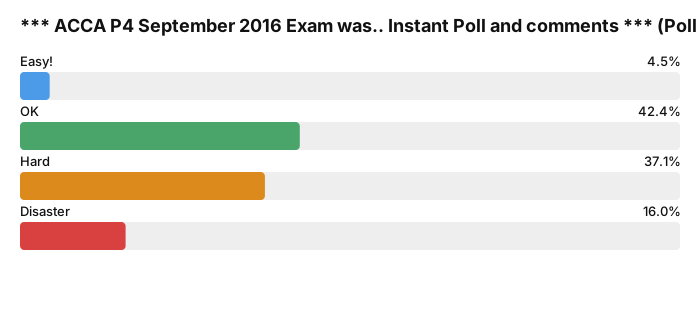
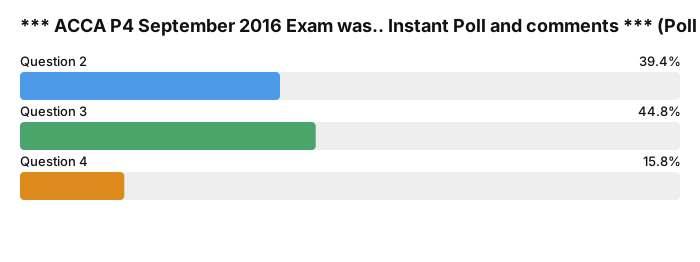
AFM*** ACCA P4 September 2016 Exam was.. Instant Poll and comments ***
Retention rate is PAT-dividend/PAT? PAT is total earning. Hope I am right
In Q2... one could've used CAGR to estimate the Growth Rates for the 3 Companies i.e., Compound Annual Growth Rate (CAGR) = [(Do / D n years old)^(1/n)] - 1.
Yes, DVM values were less than the Market Cap values for all the 3 companies... The main reason is that the drivers behind these two concepts are different. DVM assumes that a company's value is based on the PV of all future dividends, whereas the Share Price is determined by the Market Demand / Supply forces based on the publicly available information, this is what a company's Market Cap is based on.
Q3 - was my favt area restructuring just nailed it..
a) Define MBI, benefits and drawbacks..
bi) Revised financial position after restructuring which in my calculation footing was 184m. and value of company post restructuring used FCFF as there was not bank loan will be left after restructuring value was around 168m.
bii) Funds needed to MBI that was 199m, and value if sold to MBI which was around 368m.
c) benefits and drawbacks of co if sold to MBI..
Attempted complete question with planned time as it was not first choice to attempt..
Q1 a) real options implication on conventional NPV 4 marks. these marks were easy if you read the latest articles on real options
b) Requires fair calculations for conventional NPV with little bit tricks of tax and inflation and option value to expand BSOP application trick was there in determining Pa which was equal to Pe if I m not wrong.. and at the end discussion of assumptions in both calculations and recommendation for phase 1.
c) was on comments for a american company having financial difficulties in EU and impact on american co if it shifts production facility to America..
Overall Q1 was fair and easy as compared to previous attempt.
I have completed it with planned time but didnt attempt last requirement as in depth for 7 marks just written few points about currency fluctuation risk, etc.
Q2 - all about dividend policies and DVM ( Didnt attempt it)
Q4 - Interest rate swap calculation - This question was a cash ready marks if you have read the past article of Determining the interest rate swap value.. whole question was based on that article..in addition you were just given the fixed rate..
I have attempted it but forget to calculate forward rates..
Overall paper was not time pressured..
I just attempted q1 and q3 in part. If i could get 3+10+9+8+5+3 (for q1) and 4+6+5 (for q3) =53 (in a race with Fail this would be a photo finish)...
The PV for second phase was zero. So the Discounting had already been done upto that stage.
But me thinks that this papers requires alot of assumptions and the examiner shall consider all one makes.
There is more than one answer to some questions.
@amon84mwash said: The PV for second phase was zero. So the Discounting had already been done upto that stage. But me thinks that this papers requires alot of assumptions and the examiner shall consider all one makes. There is more than one answer to some questions.Agreed!
For the investment appraisal? keeping the selling price at 30k throughout was making the project unprofitable, as other costs inflated?
Also the only bit that trumped me was the way it worded working capital, usually year 0 onwards and inflate, but the wording was so specific to it wanting it at a year one figure? So I placed it in year one then inflated probs wrong, my phase one was about 3m ish out.
BSM model tried two methods pa=pe, then some other mad method where I tried to extrapolate something around WC, probs wrong again.
Q2 Restructuring had cash left over after sell off and redundancy fees. Used fcf method for both based on the assumed growth and cost of capitals given. Reworked depreciation into the calculations based on the change which was 25% reducing balance, then reinvestments were equal to depreciation so netted off in terms of adding back phase.
Q3 only had time to do 6 marker and 9 marker, worked out FRAs but applied the companies spread on the gilts, then deducted the banks basis points, a lot of errors as time pressure was mad.
Probably failed. Bad time management, don't even know where I stand, as everyone has a different answer.
I agree. I think it was taking the production to Europe and the implications of doing so too.
Q1) I used Pa = Pe ($140m). I've seen various answers here. It was tough
Q3) I got $199m but thought that was too easy. So i deducted the cash balance $5m they would receive from buying the company. making it $ 194m. I also think the additional funds $20m required to upgrade the facility is not required for the company purchase but an optional expense after the MBI. Although i didn't deduct it, i believe this should be deducted as well.
Q2) Absolutely no time
How many marks were allocated to question 1c? Who remembers? Just discovered I skipped it.
@eadinnu said: How many marks were allocated to question 1c? Who remembers? Just discovered I skipped it.Hmm.. Q1. (a) Real Options explanation bit..........................was 4 marks Q1. (b) NPV of Phase 1..............................................was 14 marks and Q1. (c) Phase 2 Option value.....................................was 10 marks + 4 Professional Marks Q1. (d) Discussion on moving ops back to America............? Marks Not sure though... getting confused now too.
@jd01 said: Hmm.. Q1. (a) Real Options explanation bit..........................was 4 marks Q1. (b) NPV of Phase 1..............................................was 14 marks and Q1. (c) Phase 2 Option value.....................................was 10 marks + 4 Professional Marks Q1. (d) Discussion on moving ops back to America............? Marks Not sure though... getting confused now too.Q1 4,14,9,12,4,7
@eadinnu said: How many marks were allocated to question 1c? Who remembers? Just discovered I skipped it.7
Thank you all for the responses. My body temperature has normalised. Let us hope for the best.
I honestly can't remember.
same Here
Comments:
Question 1.
a. Real option explanation- Option to expand (Call Option) benefits over conventional NPV approach.
b. Investment Appraisal Phase 1- Arrive at negative NPV though could not recollect the figure.
c. Phase 2. Call option (Option to expand after the phase 1 result). The confusion will be on figure for Pa as Pe is given as $140m. Now Pa= 140m/1.12^4. Whoever is doubting this figure should consult text and past questions on real option approach. Saying Pa=Pe is nothing but false.
Question 2. It bases on Dividend policy and one needs to be careful not to waste much time.
Question 3. Organisation restructuring. No ambiguity on this as larger percentage of the students that answered this question would get pass mark.
Topic lockedNew replies are closed.