ACCA Forums
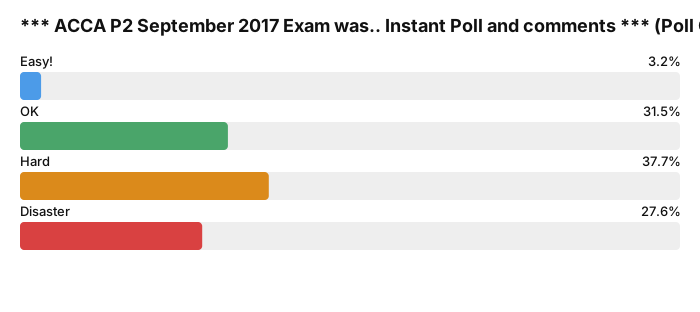
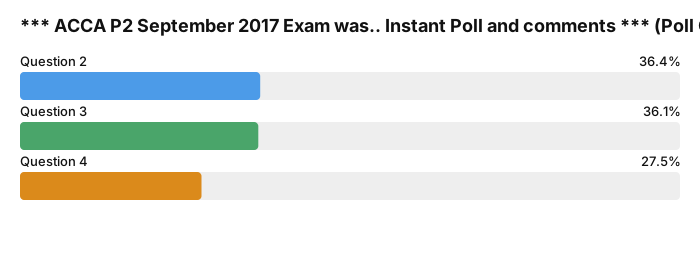
SBR*** ACCA P2 September 2017 Exam was.. Instant Poll and comments ***
What were the topics assessed?
anyone did question 4? what was the treatment for last part of IFRS 16 questions? bicycles and cars?
How did everyone find that exam?
I thought it was very hard compared to previous sittings. The cash flow question blew away even though I practices it and watched the tutor revision video where he goes through the cash flow.
I had my final net cash flow figure as 33 (I included the 2 cash from the net asset at acquisition however I think it was (31)?
I attempted question 2 and 3
Question 2 SBP was bit tough too but the impairment one on IAS 38 was fairly straight forward.
Any other comments? What did people do with the cash flow? I really struggled.
Bicycles were low-value leased assets and could therefore be expensed directly to P&L (no lease asset recorded).
With cars I said that the company could have a policy for the same class of leased assets and treat them the same eventhough their contract terms and conditions might slightly differ - but not sure about it.
hi zuzanaa, yeah i also replied on same lines. did u attempt q 3?
Despite being well prepared for the exam I struggled with the cash flow question. Seemed much harder than previous CSOCF sittings.....
I did Q4 but ran out of time to do the last Q properly. Managed to say the cars are a lease and bicycle not because of low value and short term.
I really struggled with CFS. I skipped to q2 and q4. Then ended with q1 with very little time left. I pray it will be enough. Was much more prepared for an SFP.
Anyone remember the questions ?
I thought the exam was hard, but I knew a little about a lot, and sometimes that's a problem when choosing which questions I know more about, considering the spread of the standards I knew over the questions.
I practised SFP last night, when my gut feel was saying cash flow, but luckily, I watched the revision video of Chris for more than once two days ago, and I remembered the techniques and also T accounts, very helpful indeed. I am just hoping I did enough to pass.
Q2 was average for me in terms of difficulty, although I understood the standards, the time I had left and the bit of knowledge, trying to generate ideas was a bit of a struggle. Again, I hope I did enough.
Q3 I know the revenue from contracts with customers very well but for the rest of the question, I rushed through b and didn't even manage to do c. probably get about 1/3 of the marks, if I'm lucky.
Now time to focus on P3 for Thursday :)
@sahil1234 said: I have never said this before but this exam was a nightmare. Although Q2 and Q3 were relatively easy but Q1 SCF was definitely not. Or maybe I didn't practice it enough as I really didn't expect it to show up. Was hoping for a consolidation question. I just hope I pass.Very time pressured for question 1 I watched Chris cashflow last night but when I opened the question today I was baffled and though I expected cashflow my T accounts were all over the place :(
Yes, I attempted Q3.
a) The revenue was an easy one, I think. Just illustrated the five step approach with the example and unbundled the sale of turbine and maintenance, calculated SSP and then revenue.
b) the steel derivative bought in euro - I did not write much. I think that they need to charge the change in FV to PL because the FV changed due to the change of forex and not the underlying hedged asset.
c) testing for new turbines and how to record income from sale of energy. I was not sure... what did you write?
Q1 b What did you write about the decommissioning and restoration costs?
If I understood correctly, Mirror accounted for the restoration costs against the PPE at the initial recognition - that was really weird. I think they should have booked a separate provision as the item satisfies the definition of liability and not asset.
Yes please does anyone remember q2 (a) SBP requirements?
Tough enough exam.
Read a article which suggested doing the exam in reverse (start with Q4 and go backward) glad I took that advice it helped me attempt the full 100 marks.
I was not expecting Cash flow however I practised Weston 2 weeks ago and practice Jocatt question a lot last night. Glad now I did as I was able to least give it a fair attempt. There was one or two similarities with the Jocatt question.
Q4 I was happy leases came up. I had read so many articles on it it made me blue in the face. I was hoping for that provisions or goodwill as a current issue question.
I thought it wasn't too difficult to think of why simply improving disclosure requirements would not be enough for leases. Because the big problem was how they were accounted for it was an accounting problem and 'off balance' financing that was causing a fuss not any disclosures.
I knew the implication for the SOFP (such as the effect on the gearing ratio) and SOCI but less so the SOCF.
I knew that for companies like big airline companies who leases a lot of parts it could have very significant impact on their profit and balance sheet ratios if they were using operating leases.
The cars then I didn't fully know but gave a fair judgement on whether they should be treated individually. Said they should as different terms will mean different lease life therefore different depreciation, etc.
The bikes was too easy. If you knew the excemptions available under IFRS 16 this was very obvious. They were low value/immaterial for instance.
Then I done Q3 a fair question on revenue recognition in part a, difficult dereritive question in part b and a question on land and research and development under IFRS 15. IIRC it wasn't legally permissible. Said to treat the energy as a sale and any remaining use as inventory. Q3 wasn't too good but gave it my best shot. Hopefully I passed it.
Then Q 1 (c) was integrated reporting and benifits and ethical issues with the environmental disclosures in it.
Among benifits I said it highlights their valuable CSR efforts to stakeholders and ethical issues I mentioned how thy can 'cherry pick' what they want to report and deceive stakeholders potentially and their CSR may be strategic only and only be doing it because it brings them value only. Mention how if they don't live up to what they've promised it will have big implications for their reputation.
Part B I waffled about why the decommissions cost is direct, necessary and part of the cost of the asset. Not my best attempt but hopefully I passed. Mentioned they have a constructive liability and so must account for it.
The Cash flow well I gave it my best. I done the obvious like Depreciation, amortisation, goodwill impairment, tax paid, etc.
It is boardline for me I feel. A marginal pass or a marginal fail coming my way. Not going to give a second thought until October though there is no point. What will be will be. Enjoy discussing it post exam though nevertheless.
Staying calm and not panicking is so important in this exam glad I was able to keep my cool even if not everything I wanted came up. If I do get a pass it would be becomes I didn't cry when the SOFP or SOCI question I wanted didn't come up. I said right let's just deal with this we move on and we fight to pick up as many marks as possible. I knew I had done a CF last thing last night to have it fresh in my mind so I knew I had enough to at least pick up a few marks here and there.
Yes,
Bicycles expensed directly to spl - low value and short term
Cars are service contract not lease contract as the leased asset is not identified
That was my answer
What did people get as net cash flow equivalent figure? (33)
and good will was this full good will method? NCI was given.
Was a disaster. Time to prepare for the Dec resit!
I didn't have time to revise all the standards - my own fault for being complacent ??
Was a disaster. Time to prepare for the Dec resit!
I didn't have time to revise all the standards - my own fault for being complacent ??
Wowee, that was tough. I'm still hanging on to a bit of faith that I will do ok, but geez that exam was a gut punch for me. I always had zero intention of doing Q4, whatever it would turn out to be, but lo and behold, after browsing through the paper and seeing the terror inside, Q4 ended up being the first thing I attempted! Didn't want to spend too long on questions though, so ended up hopping around. Never got back to discussing the cars for employees in the last part of Q4.
Ran away from Q3, fought with Q2. Knew the standards but it was tough applying them to question. Kinda expected Cash flows in Q1 but still didn't want it lol. Tried my best for that and part c and made-up stuff for part b :P
Praying that I made it though. Super tough, but I must say I tried my hardest. :)
This is officially my toughest ACCA exam.
To many regrets. Starting the exam with the cashflows question; and wasting time to the detriment of other questions.
Not reading the question well enough to understand what the requirements are. After the cashflows, i was already pressed for time, so i just started answering questions. 3a - IFRS15 looked easy; so i jumped at it..... by the time i got to the b part I didn't know what the question was about; and i didnt have time to cancel and answer number 2.
The only bright side of the exam was IFRS 16Leases.
I can only hope for a pass.
My approach was similar to rogman228.
Started with question 4, then 3, then ethical discussions in q-1 and then cash flow. didn't panic when cash flow showed up on the exam. I kept my calm until last minute. but after reading this discussion I think I made some mistakes:
1) I thought they were leasing 100 bicycles for 600 each, so it became 60k and I said they should use finance leasing, so that's 3,4 marks down the drain.
2) about car leases, I mentioned that they can only bundle if car specs and t&c are same but since employees have the choice to choose vehicles it is very unlikely that two contracts will be same. then there are official ranks as well e.g. CEO and accounting clerks will differ in brand and value etc.
3) about revenue question, I deducted 0.8 from 3.6 million to recognize using "at" and 0.8 over a period of 10 years because warranty and service contract cannot be further unbundled. and service contract length was 10 years.
4) IFRS 9 question, I think they were not hedging for currency, so I said they take re-state at year end. and steel should be measured using fair value hedge because it is FVTPL because they were intending to take the delivery. Only the ineffective part will go to OCI.
Question 1 b, part, de-commissioning rational, on similar lines as rogman228 and IR question was easy I think, there was a lot to talk about.
Q3-(c) part I have forgotten now? anyone remembers?
After re-thinking about the exam, I think I have 30-70 for pass-fail now i.e. only 30% of chance of a pass.
Only positive point is that i didn't panic and tried to give my best shot at everything.
@ muhammad Well done you gave everything your best attempt and didn't give up any part of the questions. I think because we gave everything our best and didn't panic or give up we've a 50/50 chance of passing.
Q3 (C) was IFRS 13 fair value measurement and more specifically the part of the standard that talks about land and research and development projects. That was my take. A difficult enough question as was the part B of Q3.
I thought the car leases was very tricky in part b of Q4 but the bikes were easy if you came across the exemption for leases under IFRS 16. The fact you still attempted it is important as if you leave any parts blank you lose the professional marks. So not attempting it would not just sacrifice 7 marks but possibly 9.
It was a difficult exam but let's hope for the best in October.
@olliebalboa said: I notice some people saying that the bicycles qualified for an exemption under IFRS 16 and should be expensed to the P/L as they are of low value? Low value is $5k or less from most readings I have found... My logic was 100 bicycles at $600 each = $60,000 and this would qualify as a lease if the 12 month lease period was extended Did anyone else come to the same conclusion? I hope I haven't thrown marks away :/Having read the technical article the examiner uploaded on the 2nd of August about IFRS 16 I am confident I judged the bikes correctly given their term was 12 months or less and they are typically a low value item like tablets and telephones would be. The fact they were unlikely to extend the lease term was important. Don't stress over it though you only lost 3 marks max if you got that part wrong I bet. Plenty of other areas you could have made up for it.
@rogman228 said: @ muhammad Well done you gave everything your best attempt and didn't give up any part of the questions. I think because we gave everything our best and didn't panic or give up we've a 50/50 chance of passing. Thanks.
Q3 (C) was IFRS 13 fair value measurement and more specifically the part of the standard that talks about land and research and development projects. That was my take. A difficult enough question as was the part B of Q3.You are making me scared now, Q3 (C) was IFRS 13? I don't remember attempting IFRS 13 at all during the whole exam, can you provide little more detail about this? I'm too nervous now, it was 7 marks I believe.
@tayyabom said: You are making me scared now, Q3 (C) was IFRS 13? I don't remember attempting IFRS 13 at all during the whole exam, can you provide little more detail about this? I'm too nervous now, it was 7 marks I believe.Ha! Don't worry. Even if you attempted and said anything reasonable you may still score a mark or two. I wouldn't stress over it. However IFRS 13 does mention the measurement of non-finanicial assets and the examples given in my Kaplan book were Land and Research and Development projects. That's why that stood out to me in the question as they bought land and were using it to test their project of developing more energy efficient wind turbines. There was other issues to score marks on other than it, such as the sale of renewable energy, or even if you mention that any development cost for developing their new prototype can be capitalized as part the cost of the wind turbine asset if/when completed that could even be valid point possibly. Or who knows maybe I am completely off trail altogether and misjudged the question.
oh Ok, I remember now. Thanks.
There were two issues here:
1) Capitalization of research costs, they had just got permission from regulatory authority to test/prototype the turbines and they had a dead end with some development. Commercial production had not been started yet.
I mentioned the criteria of IAS 38, and mentioned something that since the testing under harsh conditions is not completed yet and they have doubts about the commercial production they shouldn't capitalize the testing expenses.
2) They were supplying the energy back to govt and this part was about recognition of revenue, the question was whether to recognize it?
I mentioned that, if a contract exists as per IFRS 15 and company expects receipt of payment then they should recognize the revenue immediately at the time of delivery. Because when energy is transmitted to the national grid, risks and rewards are immediately transferred.
@tayyabom said: oh Ok, I remember now. Thanks. There were two issues here: 1) Capitalization of research costs, they had just got permission from regulatory authority to test/prototype the turbines and they had a dead end with some development. Commercial production had not been started yet. I mentioned the criteria of IAS 38, and mentioned something that since the testing under harsh conditions is not completed yet and they have doubts about the commercial production they shouldn't capitalize the testing expenses. 2) They were supplying the energy back to govt and this part was about recognition of revenue, the question was whether to recognize it? I mentioned that, if a contract exists as per IFRS 15 and company expects receipt of payment then they should recognize the revenue immediately at the time of delivery. Because when energy is transmitted to the national grid, risks and rewards are immediately transferred.Yeah what you said makes sense, too. I personalty judged it as IFRS 13 and talked about the highest and best use and it being legally permissible, financially feasible, etc. Who knows. We both gave it our best judgement and attempt anyway that's all we can do. Here's hoping we both pass that and every other part of the exam we attempted anyway. I also said to recognize the sale as revenue and any remaining energy left at the year end to treat as inventory.
If you guys are wondering about Q4 - IFRS 16 effect on FS, here is an excerpt from pwc article on IFRS 16:
The new standard will affect virtually all commonly used financial ratios and performance metrics such as gearing, current
ratio, asset turnover, interest cover, EBITDA, EBIT, operating profit, net income, EPS, ROCE, ROE and operating cash flows.
These changes may affect loan covenants, credit ratings and borrowing costs, and could result in other behavioural
changes. These impacts may compel many organisations to reassess certain ‘lease versus buy’ decisions.
Balance sheets will grow, gearing ratios will increase, and capital ratios will decrease. There will also be a change to
both the expense character (rent expenses replaced with depreciation and interest expense) and recognition pattern
(acceleration of lease expense relative to the recognition pattern for operating leases today).
Topic lockedNew replies are closed.