
Please vote in our Instant Polls about the ACCA F7 June 2017 Exam
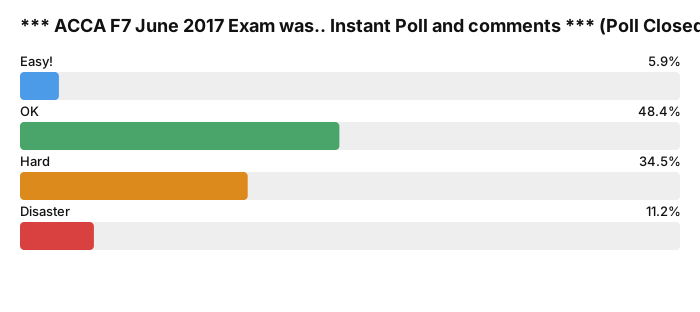 Post your comments about the ACCA F7 exam below
ACCA Forums
Post your comments about the ACCA F7 exam below@feroz1234 said: Which option did you guys pick for inventory valuation or something. Was it A which ended along the lines of bringing it to its present location and condition. or option C bring inventory to its saleable condition?I selected cost plus to complete and selling cost was smth like 166 per 100 unit, I guess finally gave 14300 some like that as answer.
@feroz1234 said: Which option did you guys pick for inventory valuation or something. Was it A which ended along the lines of bringing it to its present location and condition. or option C bring inventory to its saleable condition?The question is very tricky but I was able to figure it out.....to present condition and location doesn't mean the inventory is in working condition for intendended use........Salelable condition is the correct answer as it indicates that the asset is ready for its intended purpose.
@surajnair said: A. Bringing inventory to present location. Not saleable.yes to present condition but doesn't me the asset IS ready for intended use or sale.....According to the standard....purchase cost, duties and all other cost incurred in bringing the asset to "condition for intended use or intended sale" key word present condition n location could be sea port and additional cost may still need to b incurred in transporting them to the warehouse....hope this helps
@feroz1234 said: In relation to if dep'n should be capitalised as part of cost of constructing a new asset, what did you guys choose? Also i picked all 3 goodwill patent and licence one had infinite life - The option being all 3 should be tested for impairment yearly. With regards to the mcq on enhancing characteristics of Financial statements what did you guys pick?For enhancing selected understandability, comparability, timeliness verifiability Related Impairments, I have selected goodwill, indefinite life Also value of patent post allocation of impairments loss, I have apportioned only patent and license after adjusting for goodwill as property had same value
@23123fd said: Inventory shouldn't include selling costs so saleable condition means that it would be includedTo saleable condition may include for example primary packiging of an item they are not saleable until they have been properly packaged....selling cost may include advertising cost, sales commission, etc
@hayor said: To saleable condition may include for example primary packiging of an item they are not saleable until they have been properly packaged....selling cost may include advertising cost, sales commission, etcno.selling costs means "costs to sell" do we include it?No.
@laughingcoffin said: Multiple choice Ps questions not in order 1. FV of Investment $300,000 FV of NCI $80,000 Net Assets Stated Capital $150,000 Retained Earning $150,000 Answer - Goodwill $80,000 2. What would be reviewed for impairment Answer - Goodwill and Patent with indefinite life 3. Which qualitative characteristic is linked to IAS 8 changes in accounting policy, estimates and errors Answer - Comparability 4. Which one of the following is correct according to IAS 8 Answer - Changes in depreciation and changes in inventory valuation (FIFO) would be treated prospectivly 5. What is the definition of Inventory according to IAS 2 Answer - purchase cost, conversion cost and costs incurred to bring the asset to its present condition and location The other option is wrong i believe purchase cost, conversion cost and costs incurred to bring the asset to a saleable condition 6. Which of the following would be treated as discountinued under IFRS 5 A. Plant which stops buying and selling car parts B. They only have one plant the produces rims. They buy another plant to produce rims Answer - A only 7. State the Enhancing Characteristics of Financial Information A. Substance B. Prudence C. Materiality D. Timely, verifiable, comparable & understandable Answer - D 8. Basic eps 9mil ÷ 10 mil = .90 Diluted earnings 5mil × % × 70 % If anyone knows this % pls tell me Diluted Shares 5mil ÷ 500 × 250 shares = 2,500,000 Answer = .74 Thats all the MCQ i can remember sorry guysChange in inventory valuation is a change in accounting policy and should be done retrospectively an example is Q32 (a) Cost of sale 19200 and changed from FIFO to AVCO and due to the change in policy opening inventory increased by 300 and closing increased by 450 which will make adjusted cost of sales to be 19050 (19200 + 300 - 450).....others u totally concur....Goodluck to us all!
@aaradhya33 said: no.selling costs means "costs to sell" do we include it?No.There is difference between saleable condition and selling cost or cost to sell......saleable is an example of intended purpose.......intended purpose could be to sell an item or to keep an asset for production or for hiring to others....all cost incurred in bringing the asset to such condition for their intended purpose will always form part of the cost......but it's okay I agree with you.....it changes nothing.....let's just hope for the best!
@hayor said: yes to present condition but doesn't me the asset IS ready for intended use or sale.....According to the standard....purchase cost, duties and all other cost incurred in bringing the asset to "condition for intended use or intended sale" key word present condition n location could be sea port and additional cost may still need to b incurred in transporting them to the warehouse....hope this helpsHayor, wish i could share the picture here. I just referred back to bpp text.page number 235(june2017 edition). It clearly says cost of inventories consists of all costs of: Purchase Cost of conversion Other cost incurred in bringing the inventories to their present 'location and condition'.
@surajnair said: Hayor, wish i could share the picture here. I just referred back to bpp text.page number 235(june2017 edition). It clearly says cost of inventories consists of all costs of: Purchase Cost of conversion Other cost incurred in bringing the inventories to their present 'location and condition'.and where is the last part? "For intended use" i remember that definition even in my sleep...all these are carry forward knowledge from F3.....the definition in F7 are a bit fast forwarded cause they expect us to have known some prior to studying for F7.......that's why i don't advice people to take exemptions it's better to start from the scratch.....anyways thanks man......success to us all....after all it changes nothing!
@yijiayap said: 20x7 b/f 30 Sep 20x7: 1400 Compare to this year 20x8: 4680 (assume)×26%= 1217 Overprovision: 1400-1217=183 PBT: 4680 (my answer) Income tax expense: 1400-183+390=1607 Profit for the year: 3073 Other comprehensive income: Gain on revaluation of property: 3500 Fair value adjustment-equity instrument: 200 Total comprehensive income: 6773 Not sure about it, revaluation is at the end of the year right? Do we need to charge extra depreciation to COS? I didn't charge.yes I think you must. becayse only depreciation charged was for the historic cost. and for the extra increase in cost of $3.5m ,it should be depreciated over 20 years.Thus,175k of extra depn should be charged to COS because it has not been included in the calculation.
@surajnair said: I dont think you have to proportionate it aaradhya. It was a sale from subsidiary to parent.you have to deduct the entire unrealised profit from retained earnings. Which would be 6k. Im prettyy sure about itIts 3600 coz the question stated what will we remove from the parents RE so due to sub's selling to parent PURP goes to both parent and NCI so from parents we remove 60% of 6000 which gives 3600
@feroz1234 said: Did anyone choose any Answer A's for the MCQ'S on revenue recognition question 25-30?When retained earnings increase we credit them and when they decrease we debit them In 20x2 they decreased And 20x3 they increased So answer is c
@laughingcoffin said: How did u guys calculate the ratios in question 31</blockquote I got GP margin of 22% for both year and some different operating margin, but didn't know how to calculate adjusted ratios as sub was sold in Jan itself so i assumed no number related sub was there in consol number. Made some adjustments for excluding profit on sale from admin expenses. Then wrote something on that line.
@surajnair said: I cant recollect Goodwill question. Asset one if you're referring to the section A mcq question,the right option is C(which says future benefits should be measured reliably) - not in the asset definition.Ya, that's the one. But is it cost which need to be measured reliably and future benefit should flow into Entity. I selected that option I guess. MCQs will always create some problems, I really don't know to tackle those well.
@topakin2002 said: I did the same, but for the excess depreciation calculation, what did you do? I didn't see any information on previous depreciation so was difficult to establish what the new depreciation and excess would be.excess depn would be the increase in value i.e. 3.5m divided by 20. you do not require any extra info for that,because the depn has alreafy been charged on cost and so when the cost value increases,depn is only charged on that.