
MA1
Process costing
CAT MA1 Course Notes Contents Page
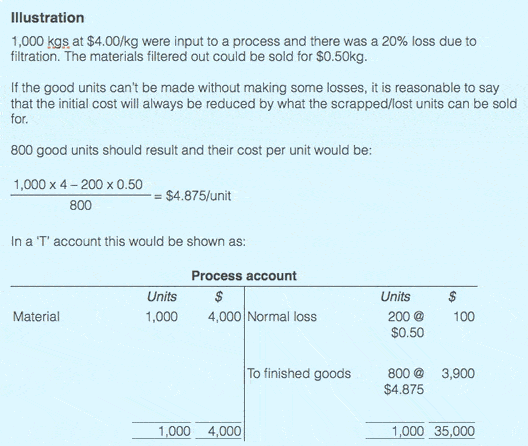
 Sometimes the ‘lost’ material can be sold as scrap. For example, in a saw-mill, sawdust can be sold for various uses.
 Example 3
In August 2000 kgs of a material were introduced to a process at a cost of $5/kg, and 200 hours labour were spent at a cost of $12/hour. Overheads are absorbed at the rate of $3/labour hour.
Normal losses are incurred at the rate of 5% of input and lost units can be sold for $0.8 per kilogram
1,900 units were produced
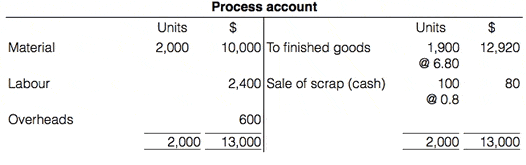
Calculate the total absorption cost of the good output and also show the process account.
Answer to example 3
Input costs less sale of normal loss =
2,000 x $5 + 200 x $12 + 200 x 3 – 100 x 0.8 = 12,920
Expected output = 2,000 x 0.95 = 1,900
Cost per unit = $6.80
Example 3
In August 2000 kgs of a material were introduced to a process at a cost of $5/kg, and 200 hours labour were spent at a cost of $12/hour. Overheads are absorbed at the rate of $3/labour hour.
Normal losses are incurred at the rate of 5% of input and lost units can be sold for $0.8 per kilogram
1,900 units were produced
Calculate the total absorption cost of the good output and also show the process account.
Answer to example 3
Input costs less sale of normal loss =
2,000 x $5 + 200 x $12 + 200 x 3 – 100 x 0.8 = 12,920
Expected output = 2,000 x 0.95 = 1,900
Cost per unit = $6.80
 Example 4
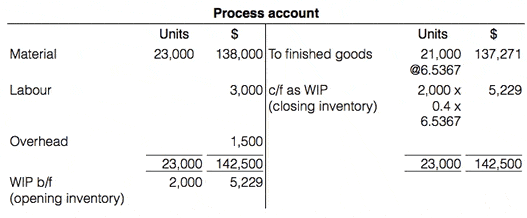
In December 23,000 kgs of a material were introduced to a process at a cost of $6/kg, and 300 hours labour were spent at a cost of $10/hour. Overheads are absorbed at the rate of $5/labour hour.
21,000 units were completed and 2,000 units were in closing inventory 40% complete.
Calculate the total absorption cost of the completed output and the work-in-progress and also show the process account.
Answer to Example 4
Equivalent units produced = 21,000 + 2,000 x 40% = 21,800
Cost per equivalent unit = (23,000 x 6 + 300 x $10 + 300 x 5) = $6.5367
Cost of completed output = 21,000 x $6.5367 = 137,271
Value of work-in-progress = 2,000 x 40% x 6.5367 = 5,229
142,500
Example 4
In December 23,000 kgs of a material were introduced to a process at a cost of $6/kg, and 300 hours labour were spent at a cost of $10/hour. Overheads are absorbed at the rate of $5/labour hour.
21,000 units were completed and 2,000 units were in closing inventory 40% complete.
Calculate the total absorption cost of the completed output and the work-in-progress and also show the process account.
Answer to Example 4
Equivalent units produced = 21,000 + 2,000 x 40% = 21,800
Cost per equivalent unit = (23,000 x 6 + 300 x $10 + 300 x 5) = $6.5367
Cost of completed output = 21,000 x $6.5367 = 137,271
Value of work-in-progress = 2,000 x 40% x 6.5367 = 5,229
142,500

Process costing - introduction
Process costing deals with manufacturing that takes place as a continuous process. Examples of industries using process costing are:- Oil refining
- Chemical works
Process costing – with losses
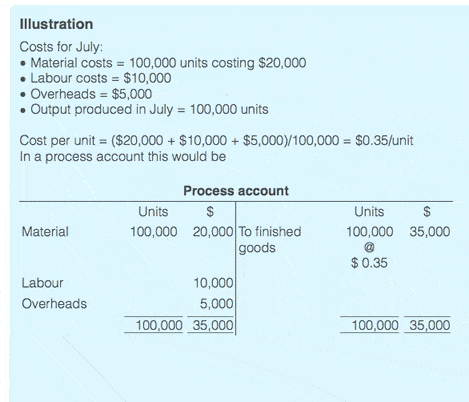
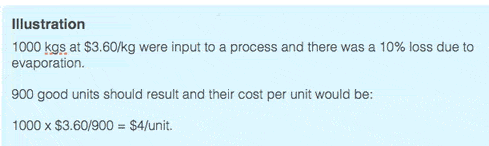
Many processes incur losses which are inevitable. For example, liquids evaporate or solids are filtered out. Therefore, the units of good output are often not the same as the units input. this exam deals only with normal or expected losses. If you can’t make units without some losses, then the cost of that loss is spread over (or absorbed) into the good units produced. The loss is just another cost on the way to good production. Cost/unit = costs for the period/expected good output for the period
Sometimes the ‘lost’ material can be sold as scrap. For example, in a saw-mill, sawdust can be sold for various uses.
Example 3
In August 2000 kgs of a material were introduced to a process at a cost of $5/kg, and 200 hours labour were spent at a cost of $12/hour. Overheads are absorbed at the rate of $3/labour hour.
Normal losses are incurred at the rate of 5% of input and lost units can be sold for $0.8 per kilogram
1,900 units were produced
Calculate the total absorption cost of the good output and also show the process account.
Answer to example 3
Input costs less sale of normal loss =
2,000 x $5 + 200 x $12 + 200 x 3 – 100 x 0.8 = 12,920
Expected output = 2,000 x 0.95 = 1,900
Cost per unit = $6.80
Process costing – with closing work-in-progress
As explained above, in process costing discrete batches are not produced and instead costs and output are measured for periods. This can mean that at the end of the period some items are not completed and remain partially finished in work-in-progress. Costs will have gone into both completed units and the work-in-progress and therefore have to be averaged over all of those units. To account for partially completed units, the concept of equivalent units is used.
Example 4
In December 23,000 kgs of a material were introduced to a process at a cost of $6/kg, and 300 hours labour were spent at a cost of $10/hour. Overheads are absorbed at the rate of $5/labour hour.
21,000 units were completed and 2,000 units were in closing inventory 40% complete.
Calculate the total absorption cost of the completed output and the work-in-progress and also show the process account.
Answer to Example 4
Equivalent units produced = 21,000 + 2,000 x 40% = 21,800
Cost per equivalent unit = (23,000 x 6 + 300 x $10 + 300 x 5) = $6.5367
Cost of completed output = 21,000 x $6.5367 = 137,271
Value of work-in-progress = 2,000 x 40% x 6.5367 = 5,229
142,500
Comments
Be the first to leave a comment.
Leave a comment