
FA1
Double Entry Bookkeeping - Starting a business and its initial transactions

CAT FA1 Course Notes Contents Page
Transaction 1
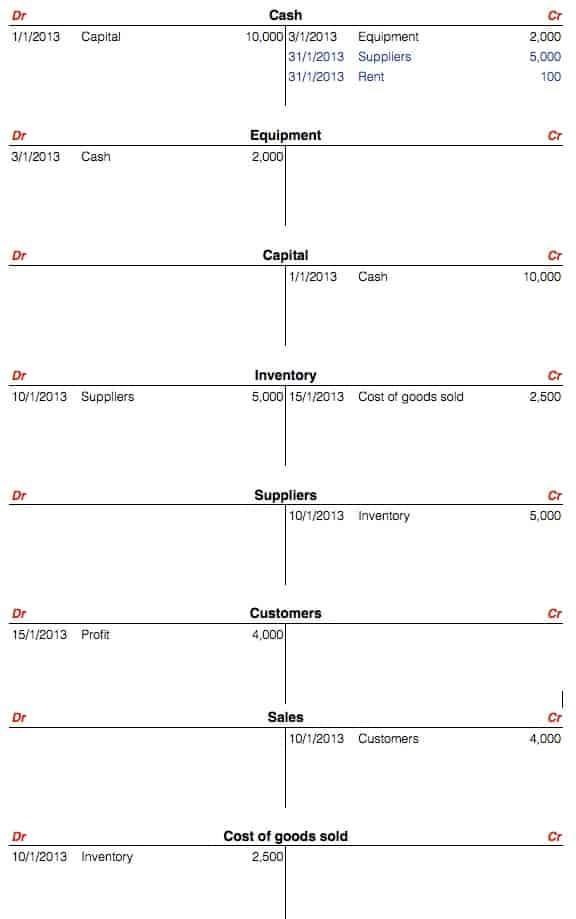
The owner starts up the business in 1/1/2013 by putting $10,000 of cash in as capital. From the business’s point of view, its cash has increased by $10,000 and its capital has increased by $10,000. Cash is an asset (something owned) and the capital is the amount owed by the business back to its owner. The double entry would be: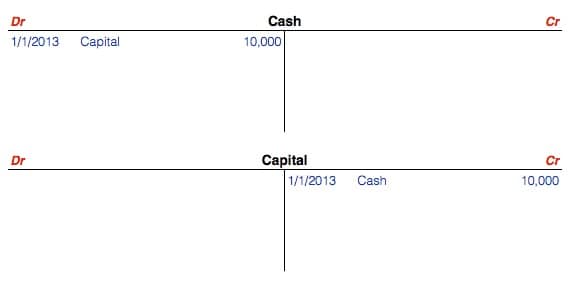 Notice the cross-referencing between the accounts. The entry in the Cash account is described as ‘Capital’, which is where the cash came from; the entry in the Capital account is described as ‘Cash’, the nature of the capital injected.
Accounting equation:
Things owned, cash $10,000 = Things owed, capital 10,000Transaction 2
The business buys some equipment for $2,000 cash on 3/1/2013. Cash has decreased $2,000 and the cost of equipment has increased by $2,000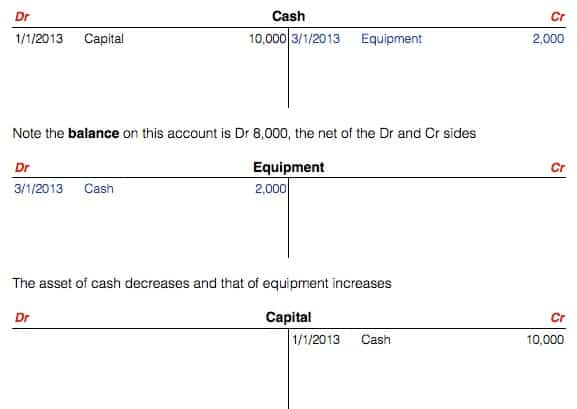 Note the balance on this account is Dr 8,000, the net of the Dr and Cr sides
Accounting equation:
Things owned, cash $8,000 + equipment $2,000 = Things owed, capital $10,000
Note the balance on this account is Dr 8,000, the net of the Dr and Cr sides
Accounting equation:
Things owned, cash $8,000 + equipment $2,000 = Things owed, capital $10,000
Transaction 3
On 10/1/2013, the business purchases goods for resale for $5,000 on credit.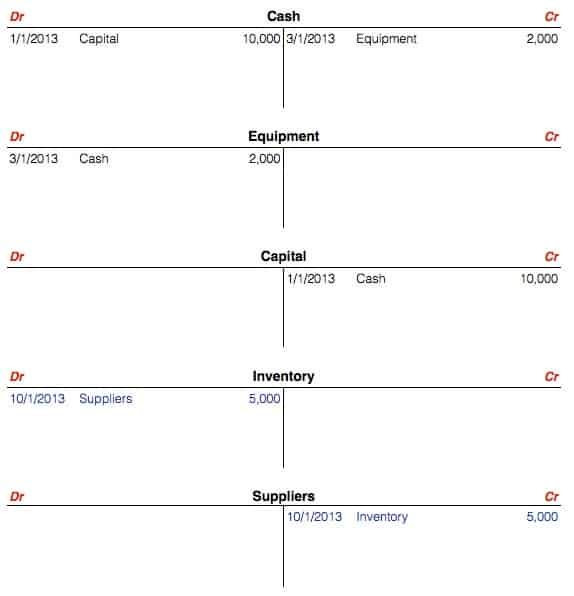 The asset of inventory increases and the liability to suppliers increases
Accounting equation:
Things owned, cash $8,000 + equipment $2,000 + inventory $5,000
= Things owed, capital $10,000 + suppliers $5,000
Transaction 4
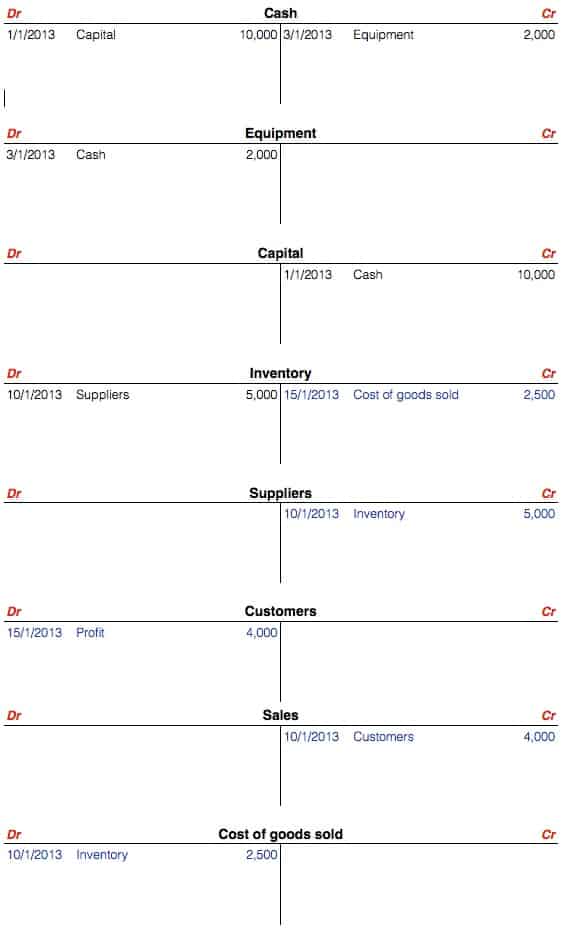
On 15/1/2013, sells half the goods for $4,000 credit.
This will create a profit of 4,000 – 5,000/2 = $1,500. The profit is owed to the owners and is a liability of the business to its owners.
We can look at the sale in two parts: earning $4,000 for a cost of 5,000/2 = 2,500.
The asset of inventory increases and the liability to suppliers increases
Accounting equation:
Things owned, cash $8,000 + equipment $2,000 + inventory $5,000
= Things owed, capital $10,000 + suppliers $5,000
Transaction 4
On 15/1/2013, sells half the goods for $4,000 credit.
This will create a profit of 4,000 – 5,000/2 = $1,500. The profit is owed to the owners and is a liability of the business to its owners.
We can look at the sale in two parts: earning $4,000 for a cost of 5,000/2 = 2,500.
 Accounting equation:
Things owned, cash $8,000 +equipment $2,000+inventory $2,500 + due from customers $4,000 = $16,500
= Things owed, suppliers $5,000 capital $10,000 + profit [4,000 – 2,500] = $16,500
Transaction 5
On 31/1/2013, the suppliers are paid what they are owed and $100 is paid for rent.
The rent is an expense and decreases the profit. Paying suppliers what is owed to them has no effect on profits.
Accounting equation:
Things owned, cash $8,000 +equipment $2,000+inventory $2,500 + due from customers $4,000 = $16,500
= Things owed, suppliers $5,000 capital $10,000 + profit [4,000 – 2,500] = $16,500
Transaction 5
On 31/1/2013, the suppliers are paid what they are owed and $100 is paid for rent.
The rent is an expense and decreases the profit. Paying suppliers what is owed to them has no effect on profits.
 Accounting equation:
Things owned, cash $2,900+equipment $2,000+inventory $2,500 + due from customers $4,000 = $11,400
= Things owed, capital $10,000 + profit [4,000- 2,500 – 100 (rent)] = $11,400
Accounting equation:
Things owned, cash $2,900+equipment $2,000+inventory $2,500 + due from customers $4,000 = $11,400
= Things owed, capital $10,000 + profit [4,000- 2,500 – 100 (rent)] = $11,400
Comments
Be the first to leave a comment.
Leave a comment