Borrowing costs - specific borrowings example - ACCA Financial Reporting (FR)
YouTube video
33 Comments
C
carolloo·
I like it so muuch!
Excellent blog!
You did amazing job.
It was interesting to read so thanks for sharing it!
V
victoriousdoylt·
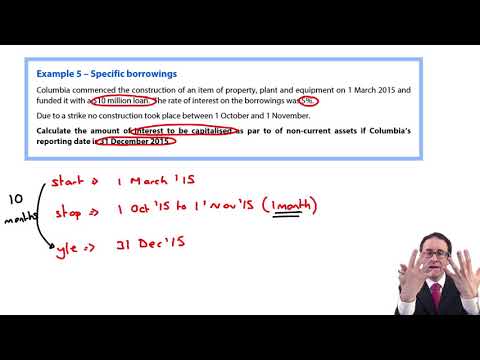
Hi, if both the construction and the drift hunters loan commenced on 1 March, shouldn’t the interest be calculated based on 9/10 and 1/10 rather than 9/12 and 1/12? The interest charged would not have covered a full 12 months within the financial period.
L
Leo·
Hi
It's Colombiaaa.
L
Leo·
Hi
It's Colombia.
D
daniyal·
why do we expense out the cost for the month in which their is no activity?
I
Irfan·
You still incur interest on the loan even when there is no construction taking place so that interest will need to be accounted for.
K
Kartik·
How is the 10million loan taken treated in the financial statements?
C
Claudia·
Loan is a liability.
S
sara·
Hi All,
Did someone manage to know why we use 9/10 and 1/10 instead of 9/12 and 1/12. I have all the above questions, but cant seem to find the answer? Can someone please very kindly reply ?
R
Raj kumar singh·
because out of 10 months, there was no construction during 1 month. so when we are capitalising we don't include that month. 1/12 is used to know how much of expenditure is incurring for a month in a year.
A
Adam·
Hi Chris, what are the corresponding credit entries for both scenarios
i.e
Dr Asset
Cr?
Dr SPL Finance Costs
Cr?
Thanks
G
Gerda·
Could you please explain this for me?
So based on the rules... i agree that 9/12 * 500 = 375 should be capitalised.
But within those 9 months, 1 month does not qualify to be capitalised due to the ceased operations.
So should the 1 month interest not be deducted from the 375 to give you capitalised interest of 333?
M
manoj·
1st March to December are 10 months and out of 10 months one month was on strike. So in nutshell we have 9 months to capitalize and 1 month to expenditure.
A
Ambuj·
Thanks
I
igor1989·
Hi Chris
Could you please explain me why did you count month instead of days?
As I remember interests should always been calculated on a daily basis.
And 1 month can consist of different days: October - 31, Septebmer - 30, February - 28/29
Thanks,
Igor
T
tejusmanoj·
Bro igor why do you want to take complicated path see 5% is the depreciation charged per year so as we stopped the work for just 1 month we just need to look at months where the work is going on and charge depreciation for those months so if you cal “interest per day” or “interest per month” it doesn’t make much difference
M
Mohamed Ismail·
Hello sir,
Thank you very much for these lecture videos. My question is, why did we use 9/12 months to calculate amount to be capitalised and 1/12 months for amount to be expensed, instead of 9/10 and 1/10 respectively?
K
kasiamat·
9 months out of 12
1 out of 12 months
E
ebimere·
why 12 month when the loan was from march 2015 and not January 2015
L
lithuania·
Hi Ebimere,
The rate of interest on the borrowing is based on 12 months' period, also called an annual percentage rate.
Regards,
L
Lucas·
I have the same question. We are capitalizing 9 months and charging another as an expense. What happens with the other 2 months?
M
Mohamed Ismail·
Hello sir,
Thank you very much for these lecture videos. My question is, why did we use 9/12 months to calculate amount to be capitalised and 1/12 months for amounts to be expensed, instead of 9/10 and 1/10 respectively?
H
hammad·
Why 9/12 or 1/12 why it's should be 1/10 , 9/10
S
Shane·
Hi, if both the construction and the loan commenced on the 1st march, should the interest not be based on 9/10 and 1/10 rather than 9/12 and 1/12 as the interest charged would not have been for a full 12 months in the financial period.
Thanks
E
ekhoza·
Hi Sir,
Why are we using 9/12 and 1/12 when construction started in March till December?
shouldn't it be 9/10 and 1/10?
V
viethuynguyen·
If there is no additional information, u often understand the interest rate is annual rate.
So 5% per year, 12 months.
P
Petronella·
Easy to follow lecture . Thank you sir.
K
kaadence·
So Sir, is that one month expense the month when there was no construction i.e. 1 Oct to 1 Nov? and if so, that's what we do? Expense whenever there is no construction?
P
P2-D2Tutor·
Yes, that's correct. Always keep an eye out for it in any exam question.
N
nokthu·
I have noticed that you calculated two answers one for sfop and I/S, is there supposed to be a double entry always?
M
mk·
Sir why we use 10 months instead of 12 months?
P
P2-D2Tutor·
Hi,
The assumption is that the loan and construction both commenced on 1 March.
Thanks
Z
ZulmaSupporter·
Thanks Chris.
Just one thing. Colombia in South America is written Colombia, not Columbia. I say that because it's my country of birth. ;)
Thank you SO much for your lectures. You all guys are amazing.


Excellent blog!
You did amazing job.
It was interesting to read so thanks for sharing it!
It's Colombiaaa.
It's Colombia.
Did someone manage to know why we use 9/10 and 1/10 instead of 9/12 and 1/12. I have all the above questions, but cant seem to find the answer? Can someone please very kindly reply ?
i.e
Dr Asset
Cr?
Dr SPL Finance Costs
Cr?
Thanks
So based on the rules... i agree that 9/12 * 500 = 375 should be capitalised.
But within those 9 months, 1 month does not qualify to be capitalised due to the ceased operations.
So should the 1 month interest not be deducted from the 375 to give you capitalised interest of 333?
Could you please explain me why did you count month instead of days?
As I remember interests should always been calculated on a daily basis.
And 1 month can consist of different days: October - 31, Septebmer - 30, February - 28/29
Thanks,
Igor
Thank you very much for these lecture videos. My question is, why did we use 9/12 months to calculate amount to be capitalised and 1/12 months for amount to be expensed, instead of 9/10 and 1/10 respectively?
1 out of 12 months
The rate of interest on the borrowing is based on 12 months' period, also called an annual percentage rate.
Regards,
Thank you very much for these lecture videos. My question is, why did we use 9/12 months to calculate amount to be capitalised and 1/12 months for amounts to be expensed, instead of 9/10 and 1/10 respectively?
Thanks
Why are we using 9/12 and 1/12 when construction started in March till December?
shouldn't it be 9/10 and 1/10?
So 5% per year, 12 months.
The assumption is that the loan and construction both commenced on 1 March.
Thanks
Just one thing. Colombia in South America is written Colombia, not Columbia. I say that because it's my country of birth. ;)
Thank you SO much for your lectures. You all guys are amazing.