It's just a way of spreading out the cost of the loan over its life.
I actually think it's needlessly complex as well and also means (in the case of receivables) that you're paying tax on money you haven't even received yet, but such is accruals.
In any case it's not our job to question if something's a good idea, we just have to learn the mechanics of it for the exam.
F
fahim231·
Hello,
What are the journal entries for the initial incurred issue costs of 100,000?
G
Gifty·
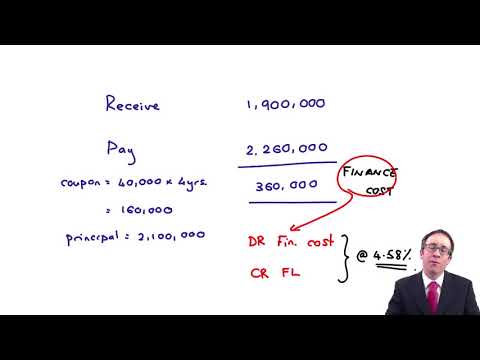
Please,how did we get the principal of 2,100,000
D
David·
You don't need to make an entry. The issue costs are simply netted against the proceeds. Hence the initial net proceeds of $1.9m rather than $2m.
E
Emil·
You don't put 20000 * 100 in brackets prior to - sign. This is like grammatical error in maths.
E
Ehsan·
A thousand thanks from Afghanistan to OpenTuition and Mr. Chris.
Ps. Sir, say that the chapter is easy so we could fool ourselves and think it is easy. Then we can learn better. :)
Q
Qilian·
Hi,
I have a quick question on the example 2 from Chapter 11 lectures in relating to financial liabilities. What confuses me is that at 13:23 we can see B/F+ Financial Cost - Coupon =C/F. I am not quite sure why the financial cost needs to be added onto the money that we received from issuing shares. Who is liable to the financial costs here? Thanks.
V
Vaibhav·
This chapter (Financial Instruments) also contain a topic called Factoring of Receivables. May I know why haven't you posted a lecture on that? Thanks.
A
Abdul·
why we need effective rate of Interest? What is the use in reality?
J
James·
Hi these videos are great, thanks a lot!
I know we don’t need this but can you please explain how to calculate the IRR in the example given in this video?
I have tried the following: total inflows divided by outflows (2,260,000/1,900,000), raise that to the power of (1/4) ie 0.25 because there are 4 time periods, then subtract 1.
That all gives me an incorrect rate of 4.43%.
What am I doing wrong?
Thanks
S
Sholape·
really you are the best- I was excepted from F7 and going through SBR, I thought no I am done for on this one. then I went back to ur lectures on F7 and life came back to earth. would have just give up on SBR without ur superb lectures. you the best. now I can go back studying SBR knowing all the terminologies.
THANK YOU
A
ahmed58·
best teacher ever
U
Udeshya·
Excellence!!
M
mohsin17222·
Why we take redeemable rate 1.05 instead of 0.05?
P
P2-D2Tutor·
Hi,
Is it not because it is redeemable at 5% above the par value, so we are adding 5% to the original amount and hence 1 plus 0.05?
Thanks
A
arpansaha12·
Really superb.
P
P2-D2Tutor·
Thanks, glad you're enjoying the videos.
D
David·
Really Chris, you are imo the best OpenTuition tutor. Your videos are the most concise and clear.


I actually think it's needlessly complex as well and also means (in the case of receivables) that you're paying tax on money you haven't even received yet, but such is accruals.
In any case it's not our job to question if something's a good idea, we just have to learn the mechanics of it for the exam.
What are the journal entries for the initial incurred issue costs of 100,000?
Ps. Sir, say that the chapter is easy so we could fool ourselves and think it is easy. Then we can learn better. :)
I have a quick question on the example 2 from Chapter 11 lectures in relating to financial liabilities. What confuses me is that at 13:23 we can see B/F+ Financial Cost - Coupon =C/F. I am not quite sure why the financial cost needs to be added onto the money that we received from issuing shares. Who is liable to the financial costs here? Thanks.
I know we don’t need this but can you please explain how to calculate the IRR in the example given in this video?
I have tried the following: total inflows divided by outflows (2,260,000/1,900,000), raise that to the power of (1/4) ie 0.25 because there are 4 time periods, then subtract 1.
That all gives me an incorrect rate of 4.43%.
What am I doing wrong?
Thanks
THANK YOU
Is it not because it is redeemable at 5% above the par value, so we are adding 5% to the original amount and hence 1 plus 0.05?
Thanks