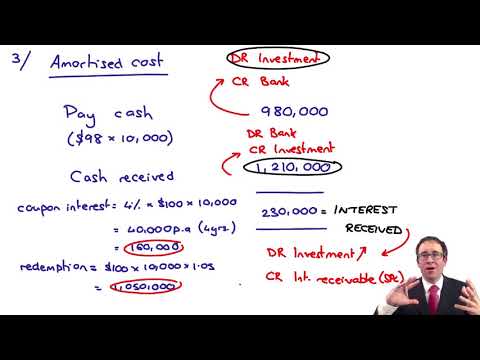
Redemption is at 5% [5% of 100= 5], apart from the nominal value [10,000 * 100] we are gaining an interest of 5% on redemption [10,000 * 105] which totals to 1,050,000. In the video, sir has calculated the interest as 105/100 = 1.05
S
Shanoya·
redeemable at a premium to me means "at an extra of"
so its redeemable at par + premium
1% +0.05%
so all in all you will get back your full amount and an additional 5% more
S
Shanoya·
redeemable at a premium to me means "at an extra of"
so all in all you will get back the full amount and an additional 5% more
full amount = 100x10,000= 1,000,000.00
add 5% = 5/100 x 1,000,000.00= 50,000.00
Total = 1,050,000.00
A
Aasif·
Hi Chris,
I have watched your lecture a couple of times and there is a lot of confusion with regards to principles of amortization...and shall appreciate your support to understand below matters
1) Technically Interest receivable is Current Asset (SFP) and Interest received is Income (SPL). So shouldnt we be crediting interest income with 40000, and increase investment only by differential amount between Interest receivable and Interest received on yearly basis
2) If continuing with point 1 above, than the accumulated interest receivable (after each year difference between interest received and interest receivable) shall be debited only at the end of 4th year when full and final payments are received..
I shall deeply value your support in making me understand this important concept. A detailed journal entry and any recommended additional videos or notes shall be highly appreciated.
M
Mohamed·
I had the same doubt did you clarify it kindly help?
J
Jeslin·
I think i got it, so hear me out. Before reading this i hope you are clear with the cost of debenture calculation (980,000) and the cash flows through out the year calculation (40k + 40k + 40k + 40k + 1050k). Now what i want you to know is that coupon rate is a fixed interest rate on investment that we the debenture holder receive annually, and effective rate of interest is calculated by the business on the total interest receivable (coupon), capital gains, and premium on redemption. After calculating the total amount, they convert it to a percentage in order to spread it over the years ( in this case 4yrs). Now after having a clear foundation on theory, we move onto the calculation of the value of investment.
First up the cost (980,000 duh?) then we calculate the effective rate of interest (980,000*5.73%=56,154 [interest receivable]) - 56,154 includes the 40,000 and premium. We add them both to get the total value of investment. The cash receipts of $40,000 from the coupon interest are used to reduce the value of the investment. This reduction in the value of the investment reflects the cash received as income from the debentures. The calculation goes like this 980,000 + 56,154 - 40,000= 996,154. So, the statement of financial position would show the remaining value of the investment after accounting for the cash received from coupon interest, which helps provide an accurate representation of the asset's value at a specific point in time. This process goes on and at the end, the effective rate of interest nullifies with the cashflows received.
This took a while to understand, hope this clears some doubts. All the best!
S
Sakshi·
1.05 came multiplied while redeeming
S
Sakshi·
I got it
S
Sakshi·
how did 1.05 came multiplied while redeeming
E
Emil·
Why the interest in the table is called interest receivable? This is interest received (SPL), I guess?
A
Ashikh·
It was 980,000 at the start of Year 1, but as you know, SFP shows the snapshot at Year-End. From the start of the year till the end, the followings events took place:
A) We accrued for interest receivable as below:
980,000*5.73% = 56,154
B) We received a 4% coupon in the 1st year. (DR Cash, CR Investment)
(40,000)
And all together, it looks like this at the end of Year 1.
980,000 + 56154 - 40,000 = $996,154
T
Tanya·
Hi Chris, Can you please explain why the 4% coupon interest of £40,000 per year is deducted from the b/f value, also why it gets credited to investments and not debited?
A
Andrzej·
Hi Chris,
Effective rate of interest (amortised cost example) should in fact be 5,72% and not 5,73%. Otherwise magic works wonderfully, thanks for great lectures :)
A
Ashikh·
It's actually 5.72042540067849%, if we want to get exact $230,000 over 4 years, but it will be impractical to use it so they rounded up.
A
Abdul·
can you please tell me how'd you get that figure, I've been trying all the methods I know and can't seem to arrive anywhere near 5.72%
I
igor1989·
Hi Chris,
Don`t you think that it could be easier just simply calculate PV of all the cash payments at effective int rate?
Regards,
Igor
B
bankimolly·
Hi Chris, thanks so much for the lecture. While studying with BPPstudy txt, the premium rate of 5% was applied to the total cash to be received at the end of the term, in this case5% on 1,210,000 making annual int. To be received equal to 60500.....please help clarify?
P
P2-D2Tutor·
Hi,
Where exactly is the question in the study text?
Thanks
V
vijay·
HI Chris,
Thanks, can you please confirm below will be the summary of the entry.
In your video you are showing the last leg as credit interest receivable but P&L. In short, this should go to income , correct. thanks for confirming my understanding.
Dr Investment 980,000
Cr Bank 980,000
Dr Bank 1,210,000
Cr Investment 980,000
Cr P&L Interest income 230,000
Thanks
Vijay Menon
V
vijay·
sorry, chris. I overlooked your further explanation on JE.
Got it and as below.
Initial cash
dr Invest (SFP) 980,000
cr Bank 980,000
each year to pass - Total to pass as below
dr Invest (SFP) 230,000
cr Intrest received (SPL) 230,000
each year to pass- Total to pass as below
dr Bank 160,000
cr Invest (SFP) 160,000
Final cash Received
dr Bank 1,050,000
cr Invest (SFP) 1,050,000
H
haider·
Hi
Excellent lecture as usual, however, I thought we record the £200,000 incentive 2% in the following journals
DR Investment £1,000,000
Cr Bank £980,000
Cr Discount £200,000
is it possible to confirm it? thanks
P
P2-D2Tutor·
Hi,
The 2% you are referring to is the coupon rate of interest, which is what must be legally paid each year on the debenture. The payment of 2% is applied to the par value of the debenture and so $200,000 is paid each year. The adjustment will CR Bank and DR Financial liability.
Thanks
V
Venarsious·
Could it be because it is effective interest so we are discounting?
V
Venarsious·
How like to know why 1.05 and not 0.05 on redemption.
H
haider·
Because it is an incentive, You will have an extra 5% on redemption and hence 1.05 not 0.05.
P
P2-D2Tutor·
Hi,
It's hotel/motel with regards to the interest received/receivable, i.e. the same thing wbut with a slightly different name.
Remember that we are accounting for the substance of the transaction, so even though legally the cash received is interest in substance it is just a repayment of the cash advanced and the interest accrued on the debt is based upon the effective rate. To account for the cash received we will therefor DR Bank CR Financial asset.
Thanks
D
David·
Hi Chris, so you're saying that Interest Receivable is actually an SPL Income account?
I think other commenters are confused in the same way that I was initially, thinking that "receivable" indicated an asset account, with the receivable interest being all recognized upfront and then the journal entry moving the amount between two asset accounts each year.
This now makes a lot more sense.
X
Xiiao·
I would like to know why the interest received 230,000 spread over 4 years will be credited to interest RECEIVABLE rather than interest RECEIVED? Is it because we haven't receive ths interest yet? We will receive it only when we redempt the investment in debt? Is that so?
How about the coupon interest 4% for each year which are 40,000 per year. Why it will directly go to reduce the investment rather than go through to interest received section?
Can u let me know about this.
Thanks Sir


Dt: Investment 980,000
Kt: Bank 980,000
At the end of the year
Dt: Investment 56,154
Kt: Interest income 56,154
Dt: Bank 40,000
Kt: Investment 40,000
so its redeemable at par + premium
1% +0.05%
so all in all you will get back your full amount and an additional 5% more
so all in all you will get back the full amount and an additional 5% more
full amount = 100x10,000= 1,000,000.00
add 5% = 5/100 x 1,000,000.00= 50,000.00
Total = 1,050,000.00
I have watched your lecture a couple of times and there is a lot of confusion with regards to principles of amortization...and shall appreciate your support to understand below matters
1) Technically Interest receivable is Current Asset (SFP) and Interest received is Income (SPL). So shouldnt we be crediting interest income with 40000, and increase investment only by differential amount between Interest receivable and Interest received on yearly basis
2) If continuing with point 1 above, than the accumulated interest receivable (after each year difference between interest received and interest receivable) shall be debited only at the end of 4th year when full and final payments are received..
I shall deeply value your support in making me understand this important concept. A detailed journal entry and any recommended additional videos or notes shall be highly appreciated.
First up the cost (980,000 duh?) then we calculate the effective rate of interest (980,000*5.73%=56,154 [interest receivable]) - 56,154 includes the 40,000 and premium. We add them both to get the total value of investment. The cash receipts of $40,000 from the coupon interest are used to reduce the value of the investment. This reduction in the value of the investment reflects the cash received as income from the debentures. The calculation goes like this 980,000 + 56,154 - 40,000= 996,154. So, the statement of financial position would show the remaining value of the investment after accounting for the cash received from coupon interest, which helps provide an accurate representation of the asset's value at a specific point in time. This process goes on and at the end, the effective rate of interest nullifies with the cashflows received.
This took a while to understand, hope this clears some doubts. All the best!
A) We accrued for interest receivable as below:
980,000*5.73% = 56,154
B) We received a 4% coupon in the 1st year. (DR Cash, CR Investment)
(40,000)
And all together, it looks like this at the end of Year 1.
980,000 + 56154 - 40,000 = $996,154
Effective rate of interest (amortised cost example) should in fact be 5,72% and not 5,73%. Otherwise magic works wonderfully, thanks for great lectures :)
Don`t you think that it could be easier just simply calculate PV of all the cash payments at effective int rate?
Regards,
Igor
Where exactly is the question in the study text?
Thanks
Thanks, can you please confirm below will be the summary of the entry.
In your video you are showing the last leg as credit interest receivable but P&L. In short, this should go to income , correct. thanks for confirming my understanding.
Dr Investment 980,000
Cr Bank 980,000
Dr Bank 1,210,000
Cr Investment 980,000
Cr P&L Interest income 230,000
Thanks
Vijay Menon
Got it and as below.
Initial cash
dr Invest (SFP) 980,000
cr Bank 980,000
each year to pass - Total to pass as below
dr Invest (SFP) 230,000
cr Intrest received (SPL) 230,000
each year to pass- Total to pass as below
dr Bank 160,000
cr Invest (SFP) 160,000
Final cash Received
dr Bank 1,050,000
cr Invest (SFP) 1,050,000
Excellent lecture as usual, however, I thought we record the £200,000 incentive 2% in the following journals
DR Investment £1,000,000
Cr Bank £980,000
Cr Discount £200,000
is it possible to confirm it? thanks
The 2% you are referring to is the coupon rate of interest, which is what must be legally paid each year on the debenture. The payment of 2% is applied to the par value of the debenture and so $200,000 is paid each year. The adjustment will CR Bank and DR Financial liability.
Thanks
It's hotel/motel with regards to the interest received/receivable, i.e. the same thing wbut with a slightly different name.
Remember that we are accounting for the substance of the transaction, so even though legally the cash received is interest in substance it is just a repayment of the cash advanced and the interest accrued on the debt is based upon the effective rate. To account for the cash received we will therefor DR Bank CR Financial asset.
Thanks
I think other commenters are confused in the same way that I was initially, thinking that "receivable" indicated an asset account, with the receivable interest being all recognized upfront and then the journal entry moving the amount between two asset accounts each year.
This now makes a lot more sense.
How about the coupon interest 4% for each year which are 40,000 per year. Why it will directly go to reduce the investment rather than go through to interest received section?
Can u let me know about this.
Thanks Sir