Basic group structures - SFP workings and adjustments - ACCA (SBR) lectures
YouTube video
22 Comments
T
Tolu·
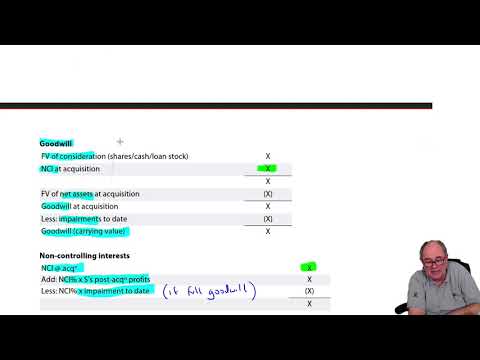
Could you please clarify why the NCI at acquisition is added to the FV of consideration (as against adding it to what is being acquired) as though the investor is the one bringing the NCI as part of the purchase consideration?
P
Pooja·
My understanding says, NCI is added, because you are deducting the net assets value of 100% of subsidiary. When you purchase a subsidiary you buy 50% or more , through consideration. the other 50% is NCI = total 100% of Subsidiary cost (consideration) less FV of Net Assets, will provide goodwill for the entire subsidiary. I hope I am able to explain properly.
A
AadhithytaSupporter·
did u clear pooja
S
strx·
Goodwill is the value of a company (market valuation) in excess of the company's net assets.
i.e. Goodwill = Value of company - Net assets
Remember NCI is what the acquirer did not buy. So for example, if acquirer buys 51% of the company, we assume:
Value of company (100%) = FV of consideration (51%) + NCI at acquisition (49% balancing figure)
Therefore:
Goodwill = (FV of consideration + NCI at acquisition) - Net Assets
^ which is basically the proforma
Related topic if you like to overlearn is 'business valuation' (recall from FR: net book value if the company is about to liquidate, market capitalization, etc.).
How come we deduct all of the impairment in the associate for the Group Retained Earnings and Investment in Associate Calculations, instead of just the parent's % ownership like we do with a subsidiary?
P
prka89·
3:12 impairment goodwill every day? - i suppose it should be once a year
J
Jeby·
Impairment test on goodwill have to be done every year. (IAS-36)
S
strx·
Or when there is an indication of impairment (also IAS 36).
P
penelope·
Hi - who is the NCI?
A
Alex Lim·
hi sir, may I know what does that means non-cotermious YE? I not really understand about this part.
P
patkev·
Non-conterminous year end from my understanding means both parent and subsidiary have different year ends, meaning they are not consistent
O
Olabisi·
Pls what does PUP mean or represent?
M
MikeLittleTutor·
Provision for Unrealised Profit
O
Olabisi·
Thank you
W
wisecrack·
Profit on unrealised profit
W
wisecrack·
Sorry provision for unrealised profit
Z
Zura·
The explanations and illustrations is great, thank you tutor.
M
misbahkiran·
fantastic lecture...you are an amazing teacher..
K
kemkemm·
Based on PUP, if associate sells to parent, why do we debit w5 when parent and associate aren't consolidated? If associate is selling to parent, the profit sits with the associate isn't it? And if that's the case then the parents retained figures aren't affected.
Is this right?
Thanks for your help.
Sarah
P
P2-D2Tutor·
Hi,
It is a bit odd but regardless of the direction of the transaction, the entry is to debit the share of profit of associate (SPL) and credit the investment in associate (SFP) with the investor's share of the profit.
Thanks
L
laylluli·
hi sir, i am a little bit confused about that at the end of lecture, referring to adjust unrealised profits P to A, why need to Cr. Investment in A?
P
P2-D2Tutor·
Hi,
We would normally take the entry to the inventory but as the inventory is in A's books we cannot take it there as A's inventory is not included within the group accounts. We therefore have to take the entry to the only element of the associate that is included within the group accounts, and that is the investment in associate.


i.e. Goodwill = Value of company - Net assets
Remember NCI is what the acquirer did not buy. So for example, if acquirer buys 51% of the company, we assume:
Value of company (100%) = FV of consideration (51%) + NCI at acquisition (49% balancing figure)
Therefore:
Goodwill = (FV of consideration + NCI at acquisition) - Net Assets
^ which is basically the proforma
Related topic if you like to overlearn is 'business valuation' (recall from FR: net book value if the company is about to liquidate, market capitalization, etc.).
https://www.investopedia.com/terms/b/business-valuation.asp
Is this right?
Thanks for your help.
Sarah
It is a bit odd but regardless of the direction of the transaction, the entry is to debit the share of profit of associate (SPL) and credit the investment in associate (SFP) with the investor's share of the profit.
Thanks
We would normally take the entry to the inventory but as the inventory is in A's books we cannot take it there as A's inventory is not included within the group accounts. We therefore have to take the entry to the only element of the associate that is included within the group accounts, and that is the investment in associate.
Thanks