In this lecture, we had tax savings more than the tax, so that would mean that in the CT600 we would report a taxable loss after the capital allowances.
However, as per my understanding we will not get that extra tax saving back as cash?
So, could you please advise why we added the tax saving into the total cash flow?
S
Sabi·
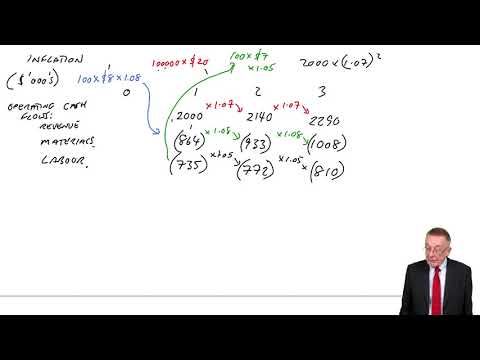
Thank you for another great lesson! Would inflation not be applied in time 1, given that time 0 is now? This is the methodology I see in BPP materials. Thanks in advance.
S
Sabi·
Sorry, disregard the question. The costs are indeed inflated, but not the selling price. This is due to the wording in the question. Note to self: Read the question properly!
A
Abbas·
Dear Sir John Moffat,
when we do project appraisal through Money term approach, we inflate the cash flow according to the relevant inflation rate & use Monetary wacc to discount those cash flow...
but there could be another scenario that our annual cash flows are fixed (eg. paying annual insurance premiums) meaning that these cash flows would'nt inflate as inflation rises irrespective of the inflation rate in the country, so in this kind of scenario whether we are to use Monetary Wacc or Real Wacc for discounting?
let me give an example of such case: assume that we are to pay fixed 50,000 annual premium for 20 years and at the end of 20th year we will get 4Million inflow (like happens in Insurance policy), we assume that inflation rate in country would be 10% YoY and we require just 2% Real Return; How should we do its appraisal? What would be the discount rate i.e money rate or real rate?
J
John MoffatTutor·
You must ask this sort of question in the Ask the Tutor Forum and not as a comment on a lecture.
A
Abbas·
Sir i had asked there as well but haven't got the reply yet..!
S
Sohaibb·
Dear Sir, As we read comments won't it be better to reply here as we will learn from it as well?
J
John MoffatTutor·
No, because most students use the search box to look for previous replies specific to their queries. That is not possible in comments.
Also tutors are only ever able to view a limited number of recent comments.
N
noob·
Sir one more question
Why havent we used after tax cost of capital here
What i mean is here we have tax deductions like in the next example
So why havent we used after tax cost of capital here ?
J
John MoffatTutor·
The cost of capital is always after tax, and so 10% is already after tax. (See later my lectures on the calculation of the cost of capital).
N
noob·
As you said sir
That because of tax payment in 1 year arrears we calculated 4th year cash flows and therefore when calculating npv we added 4th year PV
Firstly I wanted to clarify that if the tax payment was 2 year in arrears then the years would have gone to 5 ?
Secondly if there was no tax payment and allowances we would have stayed at year 3 only right ?
J
John MoffatTutor·
What you have written is correct.
S
samrap23·
helo Sir, Pleas why didnt you include the Fixed Overhead in the calculations
J
John MoffatTutor·
Unless told otherwise we always assume that the total fixed overheads are not changing. So there is no extra cost.
A
Asher·
Thank you for this lecture. Indeed example 5 is a full standard section C question. So far you have been using reducing balance method for capital allowances but what if the question say capital allowances 25% straight line. What's then is the approach.
J
John MoffatTutor·
Well then you use the straight line method as in Paper FA - i.e. an equal amount each year. Strictly the amount should be the initial cost spread over the life of the project, but the examiner does also allow you to take the cost less the scrap value spread over the life of the asset.
J
John MoffatTutor·
Please do not type out full questions like this as a comment on a lecture. You should ask questions in the Ask the Tutor Forum (although do not expect to be provided with a full answer - you will obviously have an answer in the same book in which. you found the question so ask about whatever it is in the answer that you are not clear about.
This is a question on capital rationing and so I suggest that you watch the lecture on capital rationing.
J
Jeffery·
Hi John, I am little bit confused about which year to start applying the inflation rates on the selling price and variable cost.
1st Scenario: The current selling price is $30 per unit and is expected to increase by 5% a year. The suggested answer started applying the inflation in year 2.
2nd Scenario: The selling price of product SEP (in current price terms) will be GH¢20 per unit and inflation is expected to be 4% per year. The suggested answer started applying the inflation in year 1.
Please can someone help me on why the different treatment.
Thank you.
J
John MoffatTutor·
I do explain this point in my lectures.
It depends on the precise wording in the question. If a flow is given at 'current prices' then it automatically inflated in the first year. If, on the other hand, you are told what the initial selling price will be in the first year then it doesn't inflate until the second year.
J
Jeffery·
Thank you Sir. I get it
J
John MoffatTutor·
That's great :-)
G
gree·
Can someone please explain me why cost scrap is considered as 2800 and not 1000?
G
gree·
Sorry for the question.
I got it
Cost is (2800) and scrap is 1000 in year 0 and year 3 respectively.
J
John MoffatTutor·
Correct :-)
P
Priyanka·
Hello Sir,
For year 3, I'm having a little confusi9n about the total of 1694. Can you ex0lain me how did we got this number?
And why did we add 200 in year 3.
Thank you
J
John MoffatTutor·
1694 is the total of the cash inflows less the cash outflows.
200 is added as the recovery of the working capital as explained in the earlier lecture on working capital.
J
John MoffatTutor·
Because (as I explain in the lecture) there are no extra fixed overheads to the company - it i s simply a reapportionment of existing fixed overheads.
S
sheen00·
Why didnt you minus the fixed overhead and then calculate the tax of 25%??
C
Catalin·
Dear sir,
Thank you for the lectures, I enjoy them very much. I have a question regarding the tax allowance in the question. The tax allowance is higher than the actual tax payable, which generates additional cash inflow. Shouldn’t the maximum tax allowance be the actual tax payable?
Kind regards,
Gabriel
J
John MoffatTutor·
No. It is because we always assume that the company is already making profits and is therefore already paying tax. Doing an extra project means they pay more tax because of the extra profits, but save tax on the extra capital allowances.
C
Catalin·
Thank you for the clarification, my mistake as I didn’t put the whole picture of the company.


In this lecture, we had tax savings more than the tax, so that would mean that in the CT600 we would report a taxable loss after the capital allowances.
However, as per my understanding we will not get that extra tax saving back as cash?
So, could you please advise why we added the tax saving into the total cash flow?
when we do project appraisal through Money term approach, we inflate the cash flow according to the relevant inflation rate & use Monetary wacc to discount those cash flow...
but there could be another scenario that our annual cash flows are fixed (eg. paying annual insurance premiums) meaning that these cash flows would'nt inflate as inflation rises irrespective of the inflation rate in the country, so in this kind of scenario whether we are to use Monetary Wacc or Real Wacc for discounting?
let me give an example of such case: assume that we are to pay fixed 50,000 annual premium for 20 years and at the end of 20th year we will get 4Million inflow (like happens in Insurance policy), we assume that inflation rate in country would be 10% YoY and we require just 2% Real Return; How should we do its appraisal? What would be the discount rate i.e money rate or real rate?
Also tutors are only ever able to view a limited number of recent comments.
Why havent we used after tax cost of capital here
What i mean is here we have tax deductions like in the next example
So why havent we used after tax cost of capital here ?
That because of tax payment in 1 year arrears we calculated 4th year cash flows and therefore when calculating npv we added 4th year PV
Firstly I wanted to clarify that if the tax payment was 2 year in arrears then the years would have gone to 5 ?
Secondly if there was no tax payment and allowances we would have stayed at year 3 only right ?
This is a question on capital rationing and so I suggest that you watch the lecture on capital rationing.
1st Scenario: The current selling price is $30 per unit and is expected to increase by 5% a year. The suggested answer started applying the inflation in year 2.
2nd Scenario: The selling price of product SEP (in current price terms) will be GH¢20 per unit and inflation is expected to be 4% per year. The suggested answer started applying the inflation in year 1.
Please can someone help me on why the different treatment.
Thank you.
It depends on the precise wording in the question. If a flow is given at 'current prices' then it automatically inflated in the first year. If, on the other hand, you are told what the initial selling price will be in the first year then it doesn't inflate until the second year.
I got it
Cost is (2800) and scrap is 1000 in year 0 and year 3 respectively.
For year 3, I'm having a little confusi9n about the total of 1694. Can you ex0lain me how did we got this number?
And why did we add 200 in year 3.
Thank you
200 is added as the recovery of the working capital as explained in the earlier lecture on working capital.
Thank you for the lectures, I enjoy them very much. I have a question regarding the tax allowance in the question. The tax allowance is higher than the actual tax payable, which generates additional cash inflow. Shouldn’t the maximum tax allowance be the actual tax payable?
Kind regards,
Gabriel