Discounted Cash Flow Further Aspects, Lease versus Buy - ACCA Financial Management (FM)
YouTube video
101 Comments
R
Roldan·
Hi John, thanks very much for all these videos, I'd rather use them than any other resources even if my employer pays for my studies as your method is far superior than the others I've seen.
Just a question about the savings on the lease as I thought it would just be the Lease depreciation and Finance cost that would be expensed thus being deducted from the profit and not the whole annual payment although technically at the end of the lease would be the same? Don't we need to do the IFRS 16 when doing Lease vs Buy questions on FM?
Thank you.
J
John MoffatTutor·
Thank you for your comment.
For Paper FM we treat the whole payment in the same way as we would rent, and assume the whole of the payment is tax allowable (unless, of course, the question specifically said to do differently, but it never has in the exam :-) )
D
David·
I find this with a lot of ACCA questions: the calculations and the concepts themselves are not difficult, so in order to ensure that not everyone passes the examiners have to deliberately make dates and time periods confusing and the language intentionally vague. I suppose though as unfair as it may seem is it representative of the situations accountants find themselves in in the real world.
M
Mohammed·
Sir, I understand the calculation of capital allowances and balancing allowance, but I couldn’t figure out why in the lease vs buy example the scrap value and balancing allowance are shown in a separate year 5 instead of in year 4, even though the machine’s life is 4 years. Is this treatment only applicable to lease vs buy questions, or does it apply in other cases as well?
J
John MoffatTutor·
It depends on what is told in the question about the tax timing. Here the tax is one year in arrears (i.e. after the relevant flow).
S
Sabi·
Brilliant lessons these three, thank you. Made it much clearer, quite easy really. Now I feel a lot more confident in my ability tackling these questions!
J
John MoffatTutor·
Great :-)
J
John MoffatTutor·
The profits are taxed before the payment of dividends. However as you write, it would make no difference to the calculation because we use the dividends in the calculation.
F
Farhaan·
Hi sir, hope you are fine. I have doubt regarding the after tax cost of capital, say If we were to assume that the money for this project was entirely raised from equity, we then not make any interest savings and thus there would be no difference if we were to take either before or after tax cost of capital right?
S
Satya·
From ACCAwebsite, FM, chapter -6 and activity -6, “Lease vs Buy”, option A’operational benefit” , could you please guide me in arriving the annuity factor, it’s 1.578 vs 2.487 (@10% 3 yr) per annuity table.please advise
J
John MoffatTutor·
Please ask this in the Paper FM Ask the Tutor Forum.
E
Eldor·
Hi John, shouldn't we take into account tax savings from depreciation of Right of use asset under this section?
J
John MoffatTutor·
No. For Paper FM the lessee just gets tax relief on the lease payments.
A
afraz ali·
sir you said tax is payable one year later , outflow of 35000 at 1.1.2017 at T 0 we calculate tax at 31122017 a year later ? how is that a year later and into the next accounting period , we are still in the same accounting period that is T 0 a year later would be T 1 31 12 2018, to my understanding , thankyou soo much ?
J
John MoffatTutor·
Between 1 January and 31 December is 1 year (we are not bothered about 1 day) and therefore a cash flow on 31 December 2017 needs discounting for 1 years interest. If the tax is payable 1 year later then it is payable on 31 December of the following year and therefore needs discounting for 2 years.
E
ewurefua·
sir, why didnt we calculate capital allowance when we were computing the lease's PV
J
John MoffatTutor·
There are no capital allowances for the lessor. It is just the lease payment that is tax allowable.
M
MoegiSupporter·
Hi John, Thank you for the lecture.
I got one question "how can we know the lease contract is capital leasing or operating leasing"??
Or, unless the question specifies, do we assume the lease is operating lease??
Thank you.
J
John MoffatTutor·
The question will make it clear what the flows are.
M
MoegiSupporter·
thank you for the response.
Okay. If this will be clear in the real question. I' fine with this. thank you.
(I asked this because in Example 4, type of lease contract wasn't clarified.)
S
Sanjar·
Hello sir,
Thank you for your lectures.
Why are you putting (100k) under 0, aren't you spending it at the year end of current year?
Thank you
J
John MoffatTutor·
Time 0 is the date of the first flow (which in this case happens to be the end of the current year).
C
Curtis·
I am not understanding. Time 0 is the start of the 1st year ie now. The machine would purchased at the end of the first year ie time 1 so wouldn’t the discount rate be 0.935? Isn’t the decision in this case, “lease now or buy later?”
C
Curtis·
Similarly if the machine is really bought at T1 then full depreciation is charged at T2 and tax benefit from this is from this is realized in T3?
J
John MoffatTutor·
Again, time 0 is the date of the first flow. This is the end of the current year and start of the first year.
A
alawi sayed·
Hi Mr John ,
Thanks for the lecture ,
My question is ,isn't it and supposed to be that year 0 and year 1 they are the same year ,
i.e they are one year
the only difference is that Time 0 is the beginning of the year 1 and Time-1 is till the end of the first year
is my understanding correct ?
Thanks
J
John MoffatTutor·
Time 0 is the start of the first year.
Time 1 is the end of the first year/start of the second year.
Time 2 is the end of the second year/start of the third year.
and so on.
It matters because we are discounting always for 12 month periods and a flow at the end of the first year needs discounting for one year to get back to present value.
Have you watched the earlier lectures on investment appraisal?
A
alawi sayed·
Hi Sir,
I understood now why the tax allowances were for five years because we bought on 31-dec-2016 and time 0 will start 1.1-2017 .
But my question is it possible that the no of allowances will be more the life time of the assets which is here 4 years in this example and the allowances are for 5 years.
Thanks
J
John MoffatTutor·
There is an allowance for each accounting period during which the asset was owned (even if only owned for one day).
A
Arjun·
Sir,
Chapter 9 example 3 says," Buying it will involve borrowing money at an after-tax interest cost of 7% p.a." So why did you tax 7 % when leasing? Don't we assume that there is capital for leasing?
J
John MoffatTutor·
We discounted at 7% in order to see whether the effective cost of leasing is more or less than 7%.
J
John MoffatTutor·
There are two ways that you can set up the flows.
One is to set out the lease flows and the buy flows (with the associated tax savings for both) separately (as I do in the lecture) and then choose the one with the lowest PV.
Alternatively set out the differences between the two flows and calculate the PV of these differences. The decision will be the same.
To do the first option but show tax savings etc as well would be effectively double counting and would be wrong.
A
Anshika·
Sorry for the wrong questions above,
My question is as per 3rd video of chapter 8 which is in relation with the tax (DCF) , we were not having any capital allowance in the last year of the machine except for balancing charge and balancing allowance whereas, in this video in case of buying we are having a capital allowance in 4th year and balancing allowance in 5th year?
Please explain ?
J
John MoffatTutor·
In this question tax is payable one year in arrears.
A
Anshika·
Thankyou! for solving it.
A
Anshika·
Why are we having a tax saving in 4th year in case of buying , we don't charge tax in the last year when the machine is to be sold. ?
A
Anshika·
Why are we having a tax saving in 4th year in case of buying the machine there is no tax in the last year.
K
King·
Mr. John Sir,
Please what if there is No one year delay? I know I could use my common sense but please is there a rule you can give for that too?
K
King·
Concerning the tax issue…
J
John MoffatTutor·
Have you not watched the earlier lectures on investment appraisal with tax? The calculations are the same but the tax effect is in the same year rather than the following year.
B
Benhur·
Dear Sir John,
Thanks for the lectures.
My question is in year 5 why did we not Deduct the cost from the Scrap value and take the tax % age to get the balancing figure to use as a capital allowance like we did when calculating the NPV questions.
J
John MoffatTutor·
I assume that you are referring to example 3, in which case we did calculate the balancing allowance as normal.
D
Daria·
Hi John,
the question name is Ufnit Co (Dec 2014, amended). Please let me know if you could find the question.
Thank you! :)
Daria
J
John MoffatTutor·
I have found the question, but I am puzzled by your question because it is not a lease and buy question. When calculating the NPV of a project we always discount at the cost of capital, and the cost of capital is always already after tax.
D
Daria·
Hi John,
I wrote my question in the lease & buy lecture because that where you explain after-tax interest rate. I am confused when we should deduct the tax from the discount rate and when we should not.
In many question it is explicitly written after-tax discount rate is xx% (e.g. question Degnis Co). But in question Ufnit Co it is written weighted average cost of capital is 12%. So I thought we should deduct the taxes from the discount rate. But no, in the answer the 12% discount rate is applied for the NPV calculation.
Or are you saying that regardless the wording in the NPV question we should always assume that the discount rate is already without the tax?
Thank you,
Daria
J
John MoffatTutor·
The weighted average cost of capital is always after tax unless the question specifically says that it is given pre-tax. (Just as I wrote in my previous reply). Have you not watched my lectures on the cost of capital?
D
Daria·
Dear John,
could you please clarify when and when Not to remove the taxes from the interest rate? For example in question 163 on page 60 BPP "Practice & revision Kit, FM" for the exams Sep 22-Jun 23 they dont remove the tax from the interest rate and apply full 12% for the NPV calculation.
Thanks a lot in advance!
Daria
J
John MoffatTutor·
I have a different edition of the kit - please tell me the name of the question (or if no name then the first like of it) and then I will be able to explain :-)
T
Tim·
Dear Sir,
You can ignore my last question. I looked at the way the answer is structured in the lecture notes and I seem to have understood now.
On the other hand, just to confirm the logic, is it correct if I say that there is an additional year of capital allowance due to Taxation rules, yet in terms of depreciation it is still 4 years which is based on the actual usage of the new machine?
Thanks again.
Regards,
Tim
T
Tim·
Dear Sir,
Thank you again for another great lecture.
I understand that there is a 5th year (or Time 5) of capital allowance/depreciation due to the actual usage of the new machine. However, why would we already account for the Scrappage at Time 4? The scrapping is done only at end of usage which should be in Time 5?
Much appreciated for your guidance in advance.
Regards,
Tim
J
John MoffatTutor·
It wasn't done till year 5.
There is depreciation in the year in which the asset is bought and for each of the years it is used.
Usually, assets are bought on the first day of an accounting period, and if it is lasting 4 years then there are 4 years of allowances.
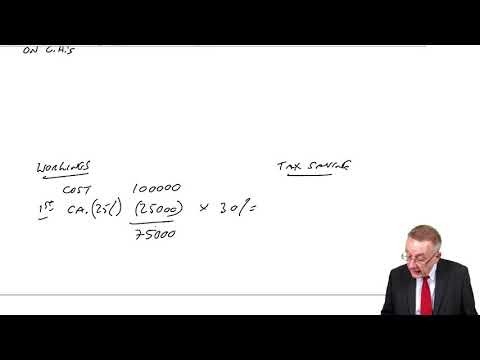
If the asset is bought on the last day of an accounting period (as is the case in this example) then there is depreciation for that year and then also for the 4 years it is used (so 5 years in total).
B
Benny·
Dear Sir John,
Noted. Thanks for the explanation. :)
J
John MoffatTutor·
You are welcome :-)
B
Benny·
Dear Sir John,
Can I conclude if the payment of the equipment was made on last day of the month, the depreciation of the equipment will have to be done till Year 5 even the sales proceed was in Year 4. Where-else if the payment was made on 1st day of the month, the depreciation will have to be done only till Year 4, assuming the sales proceed was on Year 4
Thanks
J
John MoffatTutor·
Months are not relevant. If the machine is purchased on the last day of an accounting period then there will be tax allowable depreciation calculated at time 0 and for each of the following 4 years.
If it is purchased on the first day of an accounting period then there will be tax allowable depreciation just in each of the 4 years in which it is used.
When the benefit of the TAD is received depends on whether tax is payable immediately or with a one year delay.
Have you watched the free lectures on investment appraisal with taxation where the tax rules are all explained?
B
Benny·
Dear Sir John,
Yep. I did. I was doing a comparison between the topic - “dcf-taxation” and “lease versus buy”. I realised that the depreciation done for the years of sales proceed was different.
For example in dcf-taxation, the depreciation was done till the year where the machine was sold. Sales proceed was in year 4. We do the depreciation till year 4
But for lease vs buy, it was done till the year 5, even the sales proceed was in year 4.
I am trying to find the similarity between this 2 topic.
E
Ehsan·
Dear Sir Johan
These calculations are based on which IFRS?
Thanks
J
John MoffatTutor·
Ben: The tax effect at time 5 is because there is a one year delay in the tax (as per the question and as is usual in the exam).
J
John MoffatTutor·
Ehsan: IFRS's are of no relevance to the financial manager (or to Paper FM as a result). They are the 'rules' for Financial Reporting and therefore relevant only for the Financial Reporting exams.
D
Dennis·
Sir why is the first lease payment not taken as 1st of 2016(current year) rather 1st 2017. do we always assume the cash flow to be future if then one year?
J
John MoffatTutor·
The question says that the lease payment are payable at the start of each year. Therefore the first payment is at the start of the first year, which is time 0.
(If bought, then the cost is payable on the last day of the current year, which is also time 0.)
J
JojoBeat·
Hi Sir, do we take account of opportunity cost such as saved initial outlay and lost capital allowances when doing lease vs buy or replacement questions?
J
John MoffatTutor·
You can, but it is better and safer to look at the lease flows and the buy flows separately as I do in my free lectures.
J
JojoBeat·
Hi Sir,
When do we use before tax cost of capital and after tax cost of capital?
J
John MoffatTutor·
I assume that you are referring specifically to lease and buy calculations given that you have posted this as a comment on a lecture on lease and buy.
We always use the after tax cost of debt (not the cost of capital) when deciding between leasing and buying (unless obviously the question specifically says to ignore tax!).
J
JojoBeat·
No Sir, I was also referring to normal NPV. How do we know when to use pre or post tax discount rate?
M
Muhammad·
Sir why are you using Interest cost after tax (7%) in this question, although you did calculate interest cost of 10%? Previously, you never told us to discount cashflows at interest rate after tax. I have understood the relationship between interest cost after and before tax, but discounting at 7% worries me.
J
John MoffatTutor·
We are comparing the cost of leasing with the cost of borrowing and buying. If they borrow then the interest as always is allowable for tax and therefore the net cost to the company is the after-tax interest.
Later lectures look in more detail at the cost of capital and the impact of tax.
F
Fahed·
Dear John,
Many thanks for the lectures.
I understand the reasoning behind why the capital allowance is calculated over 5 years in this case, but what I don't understand is what distinguishes it from the capital allowance in Chapter 9, Ex. 4? - where the machine has a 3 year operating cycle and the purchase is performed at Time 0, but we only recognized 3 years of allowance. Shouldn't the allowance have been recognized 4 times in that example?
Thanks!
J
John MoffatTutor·
No.
Usually we assume that machines are bought on the first day of a financial year and therefore it gets capital allowances first in that year.
In the lease buy example it says that the machine is bought on the last day of a financial year and so it first gets allowances in that year and then in each of the years during which it is used.
F
Fahed·
Understood, thanks John!
J
John MoffatTutor·
You are welcome :-)
Z
ZHU·
Dear John,
Many thanks for your time and effort for preparing the lectures. May I ask you why the buying cost is in Time 0 as the question says it will be bought on the last day of the current financial year. why it is not in Time 1 which is the last day of first year and first day of the second year?
Kind regards,
Zhu
Z
ZHU·
Sorry. John. I understood now.
J
John MoffatTutor·
I am please you now understand :-)
S
Sumaiya·
Hello Sir,
Would we have done the same thing if the Machine was bought at the start of the financial period. Calculate Tax Saving for the current financial year and then 4 years then onwards? Thank you.
J
John MoffatTutor·
If it was bought at the start of the financial period (time 0) then the first tax saving would be at time 2 as per the normal tax rules.
Q
qw·
Hi Sir, many thanks for your lectures. However, I am a bit confusing in the balancing allowance. Since the machine will be scrapped at year 4, why we net off the scrap value at year 5 rather than net off at year 4?
Q
qw·
what I mean is we use 42187 minus 10000
J
John MoffatTutor·
It is bought on the last day on an accounting period. Therefore it gets tax allowable depreciation for that year and for each of the four years it is then owned. I do explain this in my free lectures on investment appraisal with tax.
S
sam·
Hi sir,
I would like to thank and appreciate you for your efforts. i do have a doubt as to why you haven't charged tax of 30% to the cashflows prior to the tax savings column as you have done in your previous lectures on Relevant cash flows for DCF Taxation (example 4).
J
John MoffatTutor·
We are only considering the costs in order to decide which is cheaper - leasing or buying.
M
Marc·
i struggle to understand why you went for 5 periods when determining the tax savings on capital allowances. why did not you consider the first year ( year 0) as year (1).
J
John MoffatTutor·
There is no such thing as year 0.
0,1,2 etc are points in time that are 1 year apart. Time 0 is 'now' - the start of the first year. Time 1 is 1 year away - the end of the first year and start of the second year, time 2 is another year later - the end of the second year and start of the third year, and so on.
I explain all this in my earlier lectures on investment appraisal.
J
Jatin·
I have the same doubt, can someone please with this.
G
Georgios·
Hello Mr. Moffat.
I want to say that I really enjoy your lectures and I really appreciate your time and effort you put into delivering those to us!
I have a question regarding the tax timings though. I understand the logic on why we put the tax saving in a later timing. The thing which I do not understand is why, on the lease decision we put the tax saving on time 1 and in the buy decision we put the tax saving on time 2. Shouldn't those be on the same year in both cases, and more specifically in time 2?
Thank you in advance,
Georgios
J
John MoffatTutor·
It is the other way round - the first tax saving when we lease is at time 2 and when we buy it is at time 1.
I do explain this in the lecture (and in the earlier lectures on investment appraisal with tax).
If the question says that tax is payable with a one year delay, then it is payable one year after the end of the accounting period. So if a flow occurs at the end of an accounting period (as it does when we buy in this question) then the tax effect is 1 year later. If a flow occurs at the start of an accounting period (as it does when we lease in this question) then the tax effect is 2 years later (one year until the end of the period and another year delay on the tax).
A
altheak·
Good day Sir John,
Why did you start one tax saving in year 2 and another in year 1. Please explain
J
John MoffatTutor·
I do explain this in the lecture (and in the earlier lectures on investment appraisal with tax).
If the question says that tax is payable with a one year delay, then it is payable one year after the end of the accounting period. So if a flow occurs at the end of an accounting period then the tax effect is 1 year later. If a flow occurs at the start of an accounting period then the tax effect is 2 years later (one year until the end of the period and another year delay on the tax).
S
Seyram·
Hello, please if in the question you are given cost of capital as 20% and cost of borrowing from the bank as 14%, how do you decide on the discounting factor rate to use ?
A
ali·
@06.20. You know your students very well.
J
John MoffatTutor·
:-)
F
Fahad·
hello Jhon
If we are leasing, the ownership will be transferred to the company at the end. Why aren't we taking the effect of allowances of 25% in the lease as well.
Thanks
J
John MoffatTutor·
Because the company leasing the asset will not get capital allowances. Instead, the lease payments reduce the taxable profit and therefore save tax.
F
faith20ul19·
Indeed the tax aspect is a bit tricky but well understood. Thank you sir
J
John MoffatTutor·
You are welcome :-)
J
John MoffatTutor·
Nkechi is correct - lease payments reduce the taxable profit and therefore result in a tax saving. This is the UK tax position (as per Paper TX).
T
tabusheev·
I really do not understand why in Lease table you account for Tax saving as 30% of lease payment. Is it something usual for Britain? If you lease you have not to pay tax for property, so you should 30% multiply to potential property balance, no?
N
Nkechi·
Tabushew,
That's a tax saving on the lease payment. Just like you have tax savings on depreciation.
V
vinu1967·
Please explain Bpp practice and revision kit (june18) question number 157
J
John MoffatTutor·
You must ask this sort of things in the Ask the Tutor Forum, and not as a comment on a lecture.


Just a question about the savings on the lease as I thought it would just be the Lease depreciation and Finance cost that would be expensed thus being deducted from the profit and not the whole annual payment although technically at the end of the lease would be the same? Don't we need to do the IFRS 16 when doing Lease vs Buy questions on FM?
Thank you.
For Paper FM we treat the whole payment in the same way as we would rent, and assume the whole of the payment is tax allowable (unless, of course, the question specifically said to do differently, but it never has in the exam :-) )
I got one question "how can we know the lease contract is capital leasing or operating leasing"??
Or, unless the question specifies, do we assume the lease is operating lease??
Thank you.
Okay. If this will be clear in the real question. I' fine with this. thank you.
(I asked this because in Example 4, type of lease contract wasn't clarified.)
Thank you for your lectures.
Why are you putting (100k) under 0, aren't you spending it at the year end of current year?
Thank you
Thanks for the lecture ,
My question is ,isn't it and supposed to be that year 0 and year 1 they are the same year ,
i.e they are one year
the only difference is that Time 0 is the beginning of the year 1 and Time-1 is till the end of the first year
is my understanding correct ?
Thanks
Time 1 is the end of the first year/start of the second year.
Time 2 is the end of the second year/start of the third year.
and so on.
It matters because we are discounting always for 12 month periods and a flow at the end of the first year needs discounting for one year to get back to present value.
Have you watched the earlier lectures on investment appraisal?
I understood now why the tax allowances were for five years because we bought on 31-dec-2016 and time 0 will start 1.1-2017 .
But my question is it possible that the no of allowances will be more the life time of the assets which is here 4 years in this example and the allowances are for 5 years.
Thanks
Chapter 9 example 3 says," Buying it will involve borrowing money at an after-tax interest cost of 7% p.a." So why did you tax 7 % when leasing? Don't we assume that there is capital for leasing?
One is to set out the lease flows and the buy flows (with the associated tax savings for both) separately (as I do in the lecture) and then choose the one with the lowest PV.
Alternatively set out the differences between the two flows and calculate the PV of these differences. The decision will be the same.
To do the first option but show tax savings etc as well would be effectively double counting and would be wrong.
My question is as per 3rd video of chapter 8 which is in relation with the tax (DCF) , we were not having any capital allowance in the last year of the machine except for balancing charge and balancing allowance whereas, in this video in case of buying we are having a capital allowance in 4th year and balancing allowance in 5th year?
Please explain ?
Please what if there is No one year delay? I know I could use my common sense but please is there a rule you can give for that too?
Thanks for the lectures.
My question is in year 5 why did we not Deduct the cost from the Scrap value and take the tax % age to get the balancing figure to use as a capital allowance like we did when calculating the NPV questions.
the question name is Ufnit Co (Dec 2014, amended). Please let me know if you could find the question.
Thank you! :)
Daria
I wrote my question in the lease & buy lecture because that where you explain after-tax interest rate. I am confused when we should deduct the tax from the discount rate and when we should not.
In many question it is explicitly written after-tax discount rate is xx% (e.g. question Degnis Co). But in question Ufnit Co it is written weighted average cost of capital is 12%. So I thought we should deduct the taxes from the discount rate. But no, in the answer the 12% discount rate is applied for the NPV calculation.
Or are you saying that regardless the wording in the NPV question we should always assume that the discount rate is already without the tax?
Thank you,
Daria
could you please clarify when and when Not to remove the taxes from the interest rate? For example in question 163 on page 60 BPP "Practice & revision Kit, FM" for the exams Sep 22-Jun 23 they dont remove the tax from the interest rate and apply full 12% for the NPV calculation.
Thanks a lot in advance!
Daria
You can ignore my last question. I looked at the way the answer is structured in the lecture notes and I seem to have understood now.
On the other hand, just to confirm the logic, is it correct if I say that there is an additional year of capital allowance due to Taxation rules, yet in terms of depreciation it is still 4 years which is based on the actual usage of the new machine?
Thanks again.
Regards,
Tim
Thank you again for another great lecture.
I understand that there is a 5th year (or Time 5) of capital allowance/depreciation due to the actual usage of the new machine. However, why would we already account for the Scrappage at Time 4? The scrapping is done only at end of usage which should be in Time 5?
Much appreciated for your guidance in advance.
Regards,
Tim
There is depreciation in the year in which the asset is bought and for each of the years it is used.
Usually, assets are bought on the first day of an accounting period, and if it is lasting 4 years then there are 4 years of allowances.
If the asset is bought on the last day of an accounting period (as is the case in this example) then there is depreciation for that year and then also for the 4 years it is used (so 5 years in total).
Noted. Thanks for the explanation. :)
Can I conclude if the payment of the equipment was made on last day of the month, the depreciation of the equipment will have to be done till Year 5 even the sales proceed was in Year 4. Where-else if the payment was made on 1st day of the month, the depreciation will have to be done only till Year 4, assuming the sales proceed was on Year 4
Thanks
If it is purchased on the first day of an accounting period then there will be tax allowable depreciation just in each of the 4 years in which it is used.
When the benefit of the TAD is received depends on whether tax is payable immediately or with a one year delay.
Have you watched the free lectures on investment appraisal with taxation where the tax rules are all explained?
Yep. I did. I was doing a comparison between the topic - “dcf-taxation” and “lease versus buy”. I realised that the depreciation done for the years of sales proceed was different.
For example in dcf-taxation, the depreciation was done till the year where the machine was sold. Sales proceed was in year 4. We do the depreciation till year 4
But for lease vs buy, it was done till the year 5, even the sales proceed was in year 4.
I am trying to find the similarity between this 2 topic.
These calculations are based on which IFRS?
Thanks
(If bought, then the cost is payable on the last day of the current year, which is also time 0.)
When do we use before tax cost of capital and after tax cost of capital?
We always use the after tax cost of debt (not the cost of capital) when deciding between leasing and buying (unless obviously the question specifically says to ignore tax!).
Later lectures look in more detail at the cost of capital and the impact of tax.
Many thanks for the lectures.
I understand the reasoning behind why the capital allowance is calculated over 5 years in this case, but what I don't understand is what distinguishes it from the capital allowance in Chapter 9, Ex. 4? - where the machine has a 3 year operating cycle and the purchase is performed at Time 0, but we only recognized 3 years of allowance. Shouldn't the allowance have been recognized 4 times in that example?
Thanks!
Usually we assume that machines are bought on the first day of a financial year and therefore it gets capital allowances first in that year.
In the lease buy example it says that the machine is bought on the last day of a financial year and so it first gets allowances in that year and then in each of the years during which it is used.
Many thanks for your time and effort for preparing the lectures. May I ask you why the buying cost is in Time 0 as the question says it will be bought on the last day of the current financial year. why it is not in Time 1 which is the last day of first year and first day of the second year?
Kind regards,
Zhu
Would we have done the same thing if the Machine was bought at the start of the financial period. Calculate Tax Saving for the current financial year and then 4 years then onwards? Thank you.
I would like to thank and appreciate you for your efforts. i do have a doubt as to why you haven't charged tax of 30% to the cashflows prior to the tax savings column as you have done in your previous lectures on Relevant cash flows for DCF Taxation (example 4).
0,1,2 etc are points in time that are 1 year apart. Time 0 is 'now' - the start of the first year. Time 1 is 1 year away - the end of the first year and start of the second year, time 2 is another year later - the end of the second year and start of the third year, and so on.
I explain all this in my earlier lectures on investment appraisal.
I want to say that I really enjoy your lectures and I really appreciate your time and effort you put into delivering those to us!
I have a question regarding the tax timings though. I understand the logic on why we put the tax saving in a later timing. The thing which I do not understand is why, on the lease decision we put the tax saving on time 1 and in the buy decision we put the tax saving on time 2. Shouldn't those be on the same year in both cases, and more specifically in time 2?
Thank you in advance,
Georgios
I do explain this in the lecture (and in the earlier lectures on investment appraisal with tax).
If the question says that tax is payable with a one year delay, then it is payable one year after the end of the accounting period. So if a flow occurs at the end of an accounting period (as it does when we buy in this question) then the tax effect is 1 year later. If a flow occurs at the start of an accounting period (as it does when we lease in this question) then the tax effect is 2 years later (one year until the end of the period and another year delay on the tax).
Why did you start one tax saving in year 2 and another in year 1. Please explain
If the question says that tax is payable with a one year delay, then it is payable one year after the end of the accounting period. So if a flow occurs at the end of an accounting period then the tax effect is 1 year later. If a flow occurs at the start of an accounting period then the tax effect is 2 years later (one year until the end of the period and another year delay on the tax).
If we are leasing, the ownership will be transferred to the company at the end. Why aren't we taking the effect of allowances of 25% in the lease as well.
Thanks
That's a tax saving on the lease payment. Just like you have tax savings on depreciation.