FM*** September 2022 ACCA FM exam – Instant Poll and comments ***
Oopentuition_teamAdmin4y ago
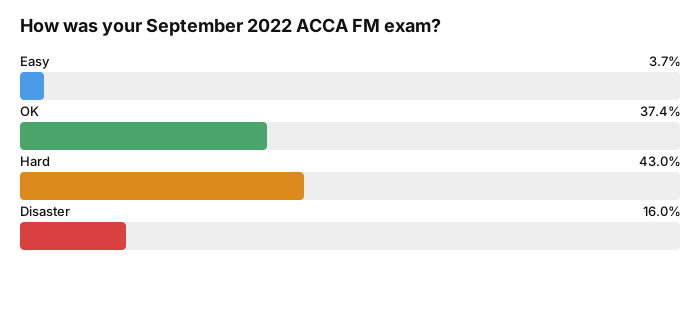
How was your September 2022 ACCA FM exam?
Vote in the Instant Poll
(Comments will be opened after 5PM UK)
ZZak4y ago#1
No NPV no WAVC no buy or lease...
Got equivalent annual cost question for 2 machines
Anddd a working capital question about short term and long term finances, with a couple theory questions
Nothing like any of the mocks (I've done like 5)
Definitely didn't get below 40% but was a hard exam
YYvonne4y ago#2
Yes I had this question. The question was about trade receivables not just receivables. I choose it retailer, this is because cinema, restaurant and supermarket won't have trade receivables as they often gets money paid upfront before providing service or immediately after so there is no waiting time for cash to be collected.
AAdelina4y ago#3
I had the same paper as Zak97...
Section C was:
1. (i) Work out if the company should take the bulk purchase discount and comment on its financial acceptability.
(This was a classic - Work out EOQ, Work out total working capital costs, work out the new number of orders and the purchase price at the discount provided, before working out new total working capital costs, + give a comment if its worth it - this was 6 marks)
(ii) Work out the net benefit of the company changing its working capital financing policy, as well as the risks involved.
(Here you got presented with basically what looked like details that the company was using a Conservative approach. Then, the company decided to change how it funds its permanent and fluctuating assets, so that they were moving onto what looked like a more aggressive policy, and I worked it out that the net benefit was that aggressive was cheaper.
This is to be expected because aggressive policies are good for profitability but quite risky. So then that tied me in into the last part of the question where I commented on the risks presented by overdrafts- this was 4 marks)
(iii) Advise on two reasons (other than the financial ones previously analysed) that the company needs to consider before deciding if to take the discount.
(Unsure if this was correct, but I commented on the storage facilities becoming a problem if part of the deal is to order more units at a time, and how this could lead to increased costs if they will have to outsource storage potentially.
Second reason was, to assess whether the demand is going to change because if it will, unfavourably, the company will be left with surplus units from their increased order quantities that the discount deal demands - this was 4 marks, presumably 2 per reason)
Question 2.
(i) Calculate the equivalent annual costs of two machines and comment on which one the company should go for.
This was 14 marks!!
And, it was everything to do with NPV. You had to inflate operating costs and maintenance costs per each year the machine was running and then at the end, once NPV is calculated, it needed dividing by the annuity factor to get EAC.
(ii) Discuss why discounted cash flows are more superior than non discounted cash flows. This was 6 marks.
(And I ran out of time - but I was happy with the rest I'd done until here)
I was hoping for something like this to come up as I had seen them before in the Section C exam Kit from Kaplan so that was so, so, so useful.
HOWEVER!
Section A and B were both brutal.
In these exams, I sit and I read these multiple choice questions, and I can't help but think: who on earth thinks up such Mad convoluted questions to make you question even the reason of your existence, NOT JUST question what they mean by the question. (?) Just crazy.
I absolutely despise how ACCA assess you in those sections. Full of traps and mind games, nothing else. Can't wait to get to the strategics, where it is all written, where no one can rob me of marks.
I'd be interested to hear what the other paper was like, if anyone can share? Thanks guys and best of luck!
MRMohammad Ryan4y ago#4
Section - A, Find out the equity beta of the Engineering company. What answer you'll get?
YYvonne4y ago#5
Yes I had npv but ended up with positive. Have you calculated inflated contribution and fixed costs? Have you deducted TAD and put balancing figure in year 4?
YYvonne4y ago#6
I'm sure in the text it says there was an inflation of x % so you should discounted your working capital to end up with relevant amount in year 4, as money in the future worth more than today I ended up with deducting 80000 and getting back in year 4 more than 80000 but im not sure if working capital is subject to inflation
Iibrahim4y ago#7
1) what about sales volume for year 2-3-4? (70 % of 10,000)+ (30 % of 5000) ?
2) Second Section C question. how did you find equity market price for right issuing?
YYvonne4y ago#8
Did just like you. I have ended up with reduced sales volume for year 2 and 3 and calculated as (10000*.7)+(5000*.3)=8500
I think I ended up with option one equity, there is no interest cost and is less risky to business, to be honest I didn't finished the last question fully as run out of time!!
RRachel4y ago#9
reaction to Section A & B: WTH!!!
Former user4y ago#10
DISASTER!
Former user4y ago#11
DISASTER!
CClaire4y ago#12
This exam was solid. I thought I was well prepared but I totally flunked mine.
Section a and b threw me.
Totally forgot how to calculate mv of a convertible. And I also had mv of a loan note to calculate. Can anyone explain how to do this, I didn’t have a clue?! Was it just the nominal value?
Also had a fx section b. Looked like data for a money market hedge but questions on foward exchange contract and forward rate agreement. Confused?!
I had section c questions on gearing I messed up as I did debt / debt + equity?
And the npv one which was difficult with the working capital and probabilities. I inflated the working capital by 3% each year, wrong?
I need a miracle!!
RRebecca4y ago#13
I had exactly the same section C.
Mine was a resit from Jun and I felt more comfortable with these Section Cs.
B was honestly disgusting. Be lucky if I get 10 marks altogether but the questions in A were just as awful. The way they word them. Just no need.
Did you get the Equity beta question too? It gave you equity and asked for equity? No matter which way I calculated it, I could not get one of the multiple choice answers.
I failed June with 45 so hopefully, my section C has been my saving grace this time because I will quit ACCA if I fail again.
AAtif4y ago#14
A hard exam! Section A had A LOT of questions where the examiner would like you to slip up.
I recall a question regarding conversion premium per share, luckily I had seen the other answers which were much smaller and made me rethink and realise it's the net amount which is the premium. There was a question on NFP's and TSR. The TSR question required careful reading as you needed to work out the initial share price. There was a question on equity beta. This was quick to do as the company was financed only through equity.
Section B was more difficult for me personally. The first section C question regarding the calculation of the interest cover and gearing ratio if one of the options is taken (Rights issue or Loan notes) - I struggled here and tried to get as many marks as possible along with the discussion afterwards. I made sure not to waffle but to show my knowledge and understanding. The NPV question was nice and the very last question was nice. I think I only made 3 valid points and accidentally mentioned sensitivity analysis which only measures uncertainty I believe.
A tough exam. I just hope I did enough!
AAtif4y ago#15
Don't quit, where there is a will there is a way. Once you become an ACCA member you will look back and say "it was worth it". Never stop trying.
LLucy4y ago#16
I had the same question about the 2 things to consider before making a final decision and also wrote about storage costs.
Lots of questions about futures and options too
Also had the question about the 2 machines
MRMohammad Ryan4y ago#17
What answers did you get for equity beta and the conversion premium ones?
CClaire4y ago#18
I’m sure the tsr two marker was probably the only one I got right. Haha.
My npv one was debatable, I inflated from t1 ?
And not sure on the working capital requirement movement.
Pecking order theory a nice q. But my gearing one was bad, I totally messed all of that up.
That cost of capital one in section b was solid?!
And I totally forgot how to calculate conversion premium.
Equity beta I had but could not get that at all.
I thought it was an equity beta proxy so needed de and then regearing? But I couldn’t remember the calc!
MMohamed4y ago#19
Beta I think I got 1.7. Conversion I think 24 something like that
MRMohammad Ryan4y ago#20
I still remember the main data from that equity beta question.
Engineering - 25% debt/equity ratio.
Industrial - 1.36 equity beta & 50% debt/equity ratio.
I couldn't get a proper answer, so went with 1.17 or 1.7 (whatever the one with seven was)
MMohamed4y ago#21
Yeah I just followed the lecture note.
I first ingress the project beta 100/50+50(1-T) x 1.36
100/140x 1.36 = 0.97
100/100+25(1-t)
100/120=0.833
0.97/0.833. 1.17
AAtif4y ago#22
I'm wondering if your paper was different from mine. I had a beta equity question in section A which said that one of the businesses was financed all by equity. Therefore no debt? I can't remember it well though.
CClara4y ago#23
The exam went horrible wrong and I have no hopes of passing at all.
Can anyone shed some light on Work out the net benefit of the company changing its working capital financing policy from fluctuating to permanent assets. It was given the average working capital and the minimum and they wanted to know the cost and short term finance needed. Had no idea what to do at all. Average capital 12.5 m and minimum 4.75 m I believe. Can anybody help? I think I didn't get one single mark on this question. I am so deflated right now!!!
SSyed4y ago#24
Did anyone get 2 questions from convertables?
1) it was about redemption yield 7% and calculate conversion premium
2) they gave floor value of around 112 and asked for minimum value
as far as i remember they dint give any cost of debt.
Does anyone know the answer or how its done?
MRMohammad Ryan4y ago#25
I just realized, I kept using the gearing ratio formula (debt/debt + equity), hence why I thought 50% debt/equity ratio (likewise for 25%) elaborated to 50 for debt and 50 for equity, still giving 50% ratio. Which is why I could not come to a conclusion.
I went with $4.5 for conversion premium, I got $124.5 for mv of loan note and $120 for share value. Info I recall; 9.5% convertible loan notes, 7% rate something (took this as discount factor), 20 shares for one loan note with market share price being $6 and redeemable after 5 years. Nominal value of loan note was not directly given so assumed it to be $100.
Conversion premium = mv of the convertible loan note - mv of the 20 shares (20x$6)
For the mv of convertible loan note part, the present value of loan note on redemption is $71.3 (100 x .713) since it was said to be redeemable at nominal value and present value of mv of the 20 shares conversion is $85.56 (120 x .713), choosing the higher return option which is $85.56 (conversion instead of redemption) and adding it with the present value of the interest payments for 5 years $38.95 (9.5 x 4.100).
The above gives mv of the convertible loan note as $124.5.
I may be wrong, what are your thoughts?
YYuliya4y ago#26
Had in C section 1) NPV calculation with inflations and probabilities; 2) Gearing + Interest cover ratio (with around 50% theory (discuss/explain) marks). Can't say C was too hard , however i did not manage to complete all theory questions.
Section A felt easy (but that might be a bad sign xD).
Section B took all energy from me. I had issues with:
1) FRA/ MMH (was not mine well-prepared topic), and
2) the most crazy for me was the question on Ordering and Holdings costs despite the fact I was confident in this topic. The wording in cases was very tricky. I am sure i correctly calculated Total Holding costs, but i was lost on Total ordering costs. If anyone remember and could explain the intended logic hidden in the text, please respond to me. Only i remember the ordering cost of $300 per order the size and the order size did not matter.
AAdelina4y ago#27
Hey Vicosta,
In my reply to this thread, (I think it might be the 5th one from the top on page 1) I wrote down all my impressions about that question and how I tackled it.
Hope it helps?
HBHoney Boo4y ago#28
Exam was not ideal, didn’t get a WACC Or NPV question in section C.
So from what I can remember for section C I put the following.
1. For the things the company needed to consider before taking the bulk discount I said
A) the financial risks of liquidity shortages from fronting more money for orders and holding costs and that the working capital cycle would be lengthened because of there being more inventory held.
B) Business risks taken from the day to day operations changing and what the impact of this would be, is there enough extra storage space available.
Not sure if these were right or not, was a hard question to answer and only 4 marks I believe!
2. There was a question about ST financing which was 5 marks, I winged it and tried to use the spread equation which I hadn’t practised at all! I don’t even know if this is the right approach.
3. Then there was a 6 mark question about why Discount Cash Flows are better than Non-discount cash flows, I put 3 points for this and tried to explain why they are beneficial:
1. Time Value of money
2. Compatibility
3. Sensitivity analysis
I have no idea how I’ve done, would be great if someone can let me know what they got for these questions because it seems like hardly anyone got them and they were unlike any section C’s I’ve come across after doing about 8 mock exams…
SMSayed Mahdi4y ago#29
Like most people here, in C section I got the bulk discount question which was pretty straight forward and then I got EAC for machine 1 three years and machine 2 five years, section C and got the question on why DCF methods are superior to non DCF method .. and in the middle there was question about how company should manage it cash balance and it was like I never seen this question before although I cover all the syllabus in BPP books
Section C was fine, but A and were just nasty man...
Section A was mostly theory I think the easiest questions were about money market and macroeconomics.
Section B .. fist question was about hedging the other two i cant even remember .. if someone can remind me i will be thankful .. the wording of the question was very confusing
this is my resit and i came prepared .. but with all the these section A and B question i don't know man .. it was too much really

 (Comments will be opened after 5PM UK)
 Former user4y ago#10