
Skip to content

ACCA Forums

SBR*** ACCA Paper SBR September 2019 Exam was.. Instant Poll and comments ***

Oopentuition_teamAdmin7y ago

How was your SBR exam? Please post your comments below, and vote in the Instant Poll
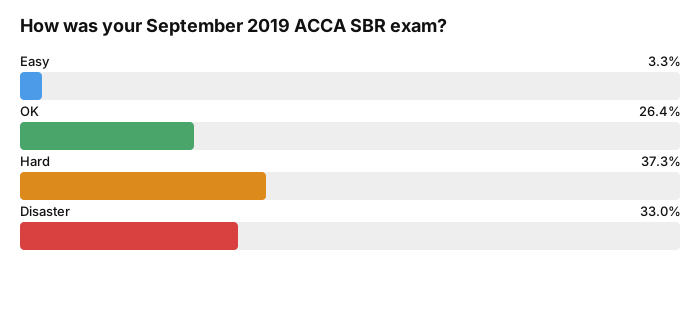
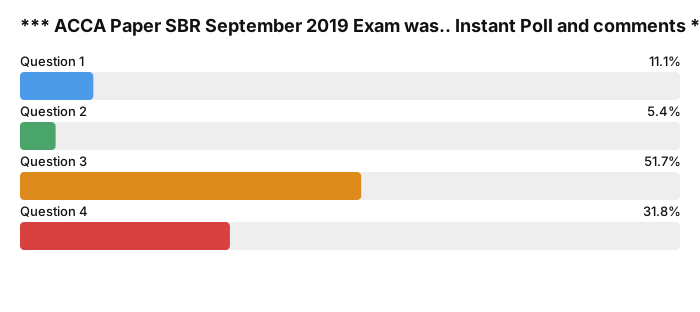
September 2019 ACCA SBR exam — historical results
*** ACCA Paper SBR September 2019 Exam was.. Instant Poll and comments *** poll results
EElle7y ago#1
Nightmare
FFrag7y ago#2
OMG!!!!
AAlan7y ago#3
One of me lectures stated need 30 out of 50 for part a but after looking at part b probably need 50 out of 50 I had no idea the framework changed for pensions
RRuhena7y ago#4
What the hell was that.
TTasbiha7y ago#5
One word for SBR, just one. Speechless ?
AAnton7y ago#6
Q1: remeasurement to FV (most effective use), Goodwill and impairment based on partial and full goodwill. More or less ok. Don’t remember other part) Q2: receivable to loan (?), preferred shares is FL, deferred tax - no evidence for the future profits. Ethical issues as usual :-) Q3: disaster with revenue recognition. Pension - no idea. Cryptocurrency is FA rather than int asset (?) Q4: question is more applicable for P4 paper. ROE - to calculate as it is and to add corrections. Very strange exam, untypical for SBR(P2). At least, 30 points are not covered in books (hardly achievable) imho.
Ccaroline7y ago#7
The first two were fair,cryptocurecy,is it an intangible or financial asset?I completely forgot the definition of a financial asset as per IFRS 9,so I used the regular definition. Last two were so hard,but I tried to write what I could.I did the simple return on equity and got 38% then 17% for 2016,after doing adjustments,i got 37.5% for 2016.anyone else found this? Q.1 share based payment threw me off,I just calculated the liabikiti for parents company only . Changes in conceptual framework for pensions,totally blank.
HHassan7y ago#8
Would anyone like to comment on the treatment of advance received from customer and preference shares in q2? And q3 JV or JO, treatment of derecogition of JV/ JO assets?
HHassan7y ago#9
Are impairments of 30.5 (partial) and 30 (full) correct?
KKevin7y ago#10
Nightmare exam. Section A was ok. Section B a disaster. I never came across the majority of section B.
KKevin7y ago#11
@arm2250 said: One of me lectures stated need 30 out of 50 for part a but after looking at part b probably need 50 out of 50 I had no idea the framework changed for pensions
I'm the exact same. However I might get away with getting 48 out of 50 for section A!
HHenrySupporter7y ago#12
Completely agree with this. Q3 was a nightmare although relevant to the SBR syllabus just made really difficult and pretty unreasonable. Q4 was more performance management which i haven’t studied since F5 around 18 months ago :s. Q1 and 2 i believe i must of gotten around 40 marks so would need 10 out of the section B but even that would be a big ask, I think i messed up pretty bad on this apart from applying IFRS 11 Joint arrangements. I really hope for a pass - glad it is not just me that thought section B was a disaster
@iftd said: Q1: remeasurement to FV (most effective use), Goodwill and impairment based on partial and full goodwill. More or less ok. Don’t remember other part) Q2: receivable to loan (?), preferred shares is FL, deferred tax - no evidence for the future profits. Ethical issues as usual :-) Q3: disaster with revenue recognition. Pension - no idea. Cryptocurrency is FA rather than int asset (?) Q4: question is more applicable for P4 paper. ROE - to calculate as it is and to add corrections. Very strange exam, untypical for SBR(P2). At least, 30 points are not covered in books (hardly achievable) imho.
Ccaroline7y ago#13
I had 49.5 for partial impairment,and 50 for fair value impairment.
Former userFormer user7y ago#14
Can anyone remember the exact questions?
TTwinkle7y ago#15
Q1) Fv of the non current asset, was it to do with highest and bestvalue use? should it Inc dismantling costs? The recoverable amount, was given but it didn't account for the 4 million worth of building that was destroyed. Did anyone take this in account to calculate the impairment? Share based payment is that contingent consideration? Q2) Pensions was in the current issues. It requires the net interest and service costs to be remeasured after curtailment but there nothing in the books on how the calculations should be done. So pretty much messed up there preference share, it should be debt and not equity? I said it should be debt as directors have option to redeem at par Q3) Revenue recognition was very hard. Did you guys say it should be recognised over time or point in time? There was some sort of conceptual framework related question here. How did u answer this? Regarding cryptocurrency- there was an article on acca website that detailed on how it should be recognised and measured. There was one more question on how entities have option to use different accounting policies. Again, this was generic but not sure what sort of points should he covered here. Not sure if I had enough to write here. Q4) was part a as simple as to take numbers and plugging into the formula? Seems too good to be true The entitity had purchased new entity and transferred asset. But entity didn't meet the definition of business. Nor did it meet criteria of sale. Should remain in the company's assets. Misc adjustments were also there. Didn't have enough time to address them properly. Let me know your thoughts
EEmily7y ago#16
Well I may aswell book in for a resit. Q1 and Q2 were ok. Definitely not enough there for me to get a pass. So frustrating as I’ve worked so so hard and it just seems Section B wasn’t at all logical.
FFaizan7y ago#17
God knows what was the examiner upto did he intentionaly want kids to fail or what half of the paper was something I never ever read about in any of the published and ACCA approved books . And if the amendment was done one night before would they still include it in the paper I never knew that net interest had to be calculated so big I never knew crypto currency was included I guess paper was set with the intension to kill the students and plz do update your books according to the standards and current issues ...
TTgl7y ago#18
@mhaa said: Are impairments of 30.5 (partial) and 30 (full) correct?
I got the same figures.
Kkch7y ago#19
i was only able to complete for 50 out of 100. so sad, will need to resit.
BBC7y ago#20
Ridiculous!!!
EEmmanuel7y ago#21
Same here, i want to book AAA and SBR. I will ensure this time i study everything.
EEmmanuel7y ago#22
It is an intangible asset, read the technical article on SBR
HHassan7y ago#23
Q1) I did same for NCA value. Did not deduct the RA by 4 I though 4 is already adjusted in it, but I restricted the allocation of goodwill for current assets because they were already at RA. Got 30 and 30.5 impairments and explained how goodwill allocation in full goodwill method will be distributed between parent and nci (nominal) and in partial method fully goes to parent. The CAs of other assets after impairment allocation was coming same in both methods. For the other part I included shares exchange at FV in consideration and the sbp replacement at incremental FV (that is 180m - 150m of old, so 30m). The sbp expense was adjusted for 4% employees change only GD fair value of options was locked and expense booked regardless of market condition being met or not. Q2) Advance to consumer = liability Pref shares as convertible instuemnets, i.e part liab part equity because it had fixed # of shares options.. I suppose this is correct Def tax asset not to be booked coz of future tax profits Q3) For revenue recognition I said over a period of time for license because needs to update it. Royalties also to be recorded in year of sales. Part b I said it is joint venture because of right on net assets and profit sharing, and treated cryptos as intangibles and not FA. Q4) Accounting policy question was subjective. For ROE I could only calculate it for both years and shortly explained its use. It was 17% and 38% at first. For adjusted ROE I made some corrections and ended up with around 21% for 20X6. Overall section B was exceptionally hard compared to the trend so far. I hope the checking would be lenient on that basis. Feel free to mention if anyone thinks I did something wrong.
@queen1234 said: Q1) Fv of the non current asset, was it to do with highest and bestvalue use? should it Inc dismantling costs? The recoverable amount, was given but it didn't account for the 4 million worth of building that was destroyed. Did anyone take this in account to calculate the impairment? Share based payment is that contingent consideration? Q2) Pensions was in the current issues. It requires the net interest and service costs to be remeasured after curtailment but there nothing in the books on how the calculations should be done. So pretty much messed up there preference share, it should be debt and not equity? I said it should be debt as directors have option to redeem at par Q3) Revenue recognition was very hard. Did you guys say it should be recognised over time or point in time? There was some sort of conceptual framework related question here. How did u answer this? Regarding cryptocurrency- there was an article on acca website that detailed on how it should be recognised and measured. There was one more question on how entities have option to use different accounting policies. Again, this was generic but not sure what sort of points should he covered here. Not sure if I had enough to write here. Q4) was part a as simple as to take numbers and plugging into the formula? Seems too good to be true The entitity had purchased new entity and transferred asset. But entity didn't meet the definition of business. Nor did it meet criteria of sale. Should remain in the company's assets. Misc adjustments were also there. Didn't have enough time to address them properly. Let me know your thoughts
SHSay HossZ7y ago#24
Examiner must be bored with this paper after so long service. ACCA should consider to replace him immediately as he is out of world now. BTW exam was disaster after so much hard working
Kkhan7y ago#25
Anyone remember the answer of goodwill and consideration of hammond co from Question 1
Kkhan7y ago#26
And anyone can describe what was happening in Q2 first paragraph where stent co receiving money ? in advance
Jjean7y ago#27
Question 1: 7pts, why is the replacement cost of 17 mil not a good fv for the building ? This is IFRS3 FV measurements, non-financial assets FV are based on highest and best use if the conditions, that it must be financially and legally feasable, are met, which it is. The market value of the building, for residential use, was 24 mil and also demolition plus permit costs of 1 mil. I did include this to come to a FV of 25 mil, but I was not fully sure if I had to include the 1 mil in the FV ?? I see several people have an impairment of 30 mil but I thought the RA and CV was for the whole company included the building, I might have misread the question. CV = 106 RA=100 so impairment of 6 from which 4 for an asset so goodwill impaired by 2. Does anyone also has these numbers ? FV- 1.6 goes to RE and 0.4 to NCI. Proport shares, 2 goes to RE. The SBP covered by IFRS 2, if there is an acquisition without obligation to pay the SBP, than is considered as SBP, if obligation to pay, than it is considered as a FV consideration for the acquisition. Problem here is that the old SBP, that the parent company is obliged to pay, is replaced by another one for the employees of the subsidiary. So here some part could be IFRS 2 and the other IFRS 3. FV of old SBP =15 mil. When making the calculation of the new SBP, I come to a total cost 19.2 mil without discounting. As the new one is bigger, the old SBP of 15 mil is dealt under IFRS2 and not FV consideration. Here it is also not clear cut, maybe the new SBP is considered obliged to pay and than 19.2 has to go in FV consideration, not sure. Question 2: - Advances to receivables: This is an advance for some future sales of goods. Under IFRS15 Revenues, the sale cannot be recognised and so the advance goes into liabilities -Pref shares to exchange for ordinary shares or cash. Pref shares are considered as debts so this is equivalent to a convertible loan. The loan fails the test of "fixed for fixed"payment as part is equity and the other part liability. -deferred tax- only to recognise if there is probable future profits. -ethical part ok Question 3: -3 years license + 5% royalties: to spread the revenue over 3 years. so by recognising the 7% shareholding we get this at Y/E: 1/3 FV 4-5 mil goes to P/L, 2/3 FV 4-5 mil goes in a liability account. -Cryptocurrencies cost 3mil and FV of 4 mil and Building cost of 6 and FV of 10 The cryptocurrency is an intangibles asset, see technical articles. The cryptos has been sold at cost so it means a loss of 1 mil for Guidance. There was no information about the selling price of the building so I assumed it was sold at FV and so Guidance had a gain of 4 mil. Total gain 3 mil for Guidance. Question 4: I missed the biggest part I have also 38% and 17%; the first part of the question about an evaluation of the ROE. There is a technical article Perf Measures dealing with it. The ROE is a good tool but has limitations, Perf measures are not covered by IFRS and so there is no standards on it so the calculation of it could be subject to interpretations, this lack of transparency is also a lack of comparability. I didn't answer to the rest of the question.
MMonika7y ago#28
Hi Do YOu know when exam results will be avaiable?
Jjean7y ago#29
@monikasiurnicka said: Hi Do YOu know when exam results will be avaiable?
14 October
KKevin7y ago#30
@geologist81 said: Question 1: 7pts, why is the replacement cost of 17 mil not a good fv for the building ? This is IFRS3 FV measurements, non-financial assets FV are based on highest and best use if the conditions, that it must be financially and legally feasable, are met, which it is. The market value of the building, for residential use, was 24 mil and also demolition plus permit costs of 1 mil. I did include this to come to a FV of 25 mil, but I was not fully sure if I had to include the 1 mil in the FV ?? I see several people have an impairment of 30 mil but I thought the RA and CV was for the whole company included the building, I might have misread the question. CV = 106 RA=100 so impairment of 6 from which 4 for an asset so goodwill impaired by 2. Does anyone also has these numbers ? FV- 1.6 goes to RE and 0.4 to NCI. Proport shares, 2 goes to RE. The SBP covered by IFRS 2, if there is an acquisition without obligation to pay the SBP, than is considered as SBP, if obligation to pay, than it is considered as a FV consideration for the acquisition. Problem here is that the old SBP, that the parent company is obliged to pay, is replaced by another one for the employees of the subsidiary. So here some part could be IFRS 2 and the other IFRS 3. FV of old SBP =15 mil. When making the calculation of the new SBP, I come to a total cost 19.2 mil without discounting. As the new one is bigger, the old SBP of 15 mil is dealt under IFRS2 and not FV consideration. Here it is also not clear cut, maybe the new SBP is considered obliged to pay and than 19.2 has to go in FV consideration, not sure. Question 2: - Advances to receivables: This is an advance for some future sales of goods. Under IFRS15 Revenues, the sale cannot be recognised and so the advance goes into liabilities -Pref shares to exchange for ordinary shares or cash. Pref shares are considered as debts so this is equivalent to a convertible loan. The loan fails the test of "fixed for fixed"payment as part is equity and the other part liability. -deferred tax- only to recognise if there is probable future profits. -ethical part ok Question 3: -3 years license + 5% royalties: to spread the revenue over 3 years. so by recognising the 7% shareholding we get this at Y/E: 1/3 FV 4-5 mil goes to P/L, 2/3 FV 4-5 mil goes in a liability account. -Cryptocurrencies cost 3mil and FV of 4 mil and Building cost of 6 and FV of 10 The cryptocurrency is an intangibles asset, see technical articles. The cryptos has been sold at cost so it means a loss of 1 mil for Guidance. There was no information about the selling price of the building so I assumed it was sold at FV and so Guidance had a gain of 4 mil. Total gain 3 mil for Guidance. Question 4: I missed the biggest part I have also 38% and 17%; the first part of the question about an evaluation of the ROE. There is a technical article Perf Measures dealing with it. The ROE is a good tool but has limitations, Perf measures are not covered by IFRS and so there is no standards on it so the calculation of it could be subject to interpretations, this lack of transparency is also a lack of comparability. I didn't answer to the rest of the question.
I calculated impairment in Q1 the same as you and split between P and NCI For the FV of the land do is it legally feasible if there was no planning permission granted?
Topic lockedNew replies are closed.