
Skip to content

ACCA Forums

SBR*** ACCA P2 June 2017 Exam was.. Instant Poll and comments ***

Oopentuition_teamAdmin9y ago

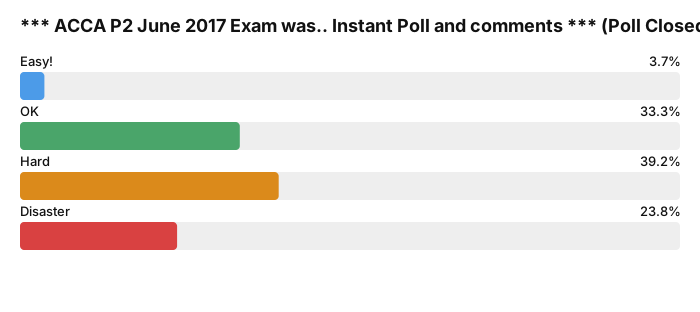
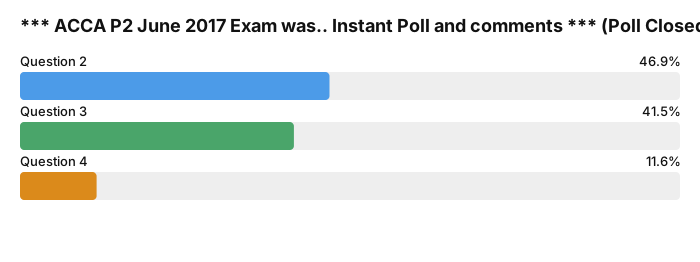
Please vote in our Instant Polls about the ACCA P2 June 2017 Exam

Post your comments about the ACCA P2 exam below *** ACCA P2 June 2017 Exam was.. Instant Poll and comments *** poll results *** ACCA P2 June 2017 Exam was.. Instant Poll and comments *** poll results
JJenYoong9y ago#1
Piecemeal acquisition (SFP) Disposal from associate to equity accounting Bond (sale and buyback option) Benefit plan PPE cost and dismantling cost for asset under finance lease Financing arrangement (recourse and non recourse) Ethics Share option (share based payment) Translation of loan and retail division Flood damaging warehouse and insurance (IAS 16/ias36/ias10/ias37) Manufacturing unit and listening of sales and marketing, contingent consideration recognised as a finance income Intangible asset (does legal cost of 600k constitute part of the asset cost) and changes in equity (want to purchase remaining 10% of the 90% owned subsi) Deffered tax asset and the unutilised tax losses They give some taxable temporary difference and expect future even more losses. Correct me if I'm wrong... I'm not sure
BBilal9y ago#2
Exam was ok. Attempted all. Hoping for the best results. If I fail it I won't regret it as only had 5 days off work to actually prepare for it. Best of luck to all students
JJenYoong9y ago#3
Piecemeal acquisition (SFP) Disposal from associate to equity accounting Bond (sale and buyback option) Benefit plan PPE cost and dismantling cost for asset under finance lease Financing arrangement (recourse and non recourse) Ethics Share option (share based payment) Translation of loan and retail division Flood damaging warehouse and insurance (IAS 16/ias36/ias10/ias37) Manufacturing unit and listening of sales and marketing, contingent consideration recognised as a finance income Intangible asset (does legal cost of 600k constitute part of the asset cost) and changes in equity (want to purchase remaining 10% of the 90% owned subsi) Deffered tax asset and the unutilised tax losses They give some taxable temporary difference and expect future even more losses. Q4 is something bout conceptual framework I might be wrong, I'm not sure
Former userFormer user9y ago#4
Can you share more about question 1?
AAGirl9y ago#5
A bit confused on Q1 about the second subs.. Another confusion came when Q gives amount of profit that accrued evenly for associate.. Not sure what to do with that.. After all I'm glad because SOFP came out.. Sad since cannot answer AT ALL factoring (recourse & non recourse) - 9 marks, Q3a manufacturing unit (which standards apply here?)- 9 marks, Q3b licensing agreement + legal costs (no idea when I read the requirement - "derecognition of licensing agreemet") :((((, Q3c deferred tax asset - 7 marks.. HOPING FOR GOD'S MIRACLE TO LET ME PASS!
A1aftaab 13909y ago#6
Contingent consideration and royalty isnt it ifrs 15?
SSatria9y ago#7
Yeah i think its IFRS 15 because its license agreement. Anyhow does anyone know when will the result will be released? Mid august?
AAmirul9y ago#8
Question 1a and 2 is quite straightforward, and not that hard. But question 3 is disaster. I know all about the standard and how to answer, but they make it so hard to answer. I seriously don't know what to answer. 3a is about discontiue product, even if it is discontinue, they still receive royalty from license. 3b they want to buy 10% of interest, the purchase is consideration is the license from 3a. 3c is about deferres tax. I also struggle with 1b and 1c, they ask about factoring. And i don't read a single thing about it. I hope i get high marks from questiom 1a and 2, and a little bit help from question 3.
CCraig9y ago#9
Factoring is a topic studied at a much lower level, i remember it from F3 or possibly F7, surprised when that came up. Factoring with recourse is not passing the risks of the debt going bad to the factor as you would have to refund the factor if this happens. Without recourse the factor bears the risks, but something in the question stated that the longer the debt remains uncollected the more the business would have had to pay in interest... or something along those lines? It really is basic receivables stuff. Basic double entry of when the cash is received the receivables is wiped out and a provision for bad debts is created, etc etc etc Hard to get 9 marks there though, not sure if others found it the same!
CCraig9y ago#10
The deferred tax asset they wanted to recognise, something along the lines of tax losses cannot be accumulated and held for future tax gains unless its likely the business will be profit making in the future... They were expecting to make losses for an additional 4 years, so this must mean its not allowed to be recognised... Something about a going concern status in there? Im sure tax assets cannot be held in a going concern scenario? That was a pretty tough and testing paper to work out the specific areas they want answers to focus on!
CCraig9y ago#11
@aries134 said: A bit confused on Q1 about the second subs.. Another confusion came when Q gives amount of profit that accrued evenly for associate.. Not sure what to do with that.. After all I'm glad because SOFP came out.. Sad since cannot answer AT ALL factoring (recourse & non recourse) - 9 marks, Q3a manufacturing unit (which standards apply here?)- 9 marks, Q3b licensing agreement + legal costs (no idea when I read the requirement - "derecognition of licensing agreemet") :((((, Q3c deferred tax asset - 7 marks.. HOPING FOR GOD'S MIRACLE TO LET ME PASS!
The profit accrued evenly for the associate is relevant because it was an associate for 6/12 months of the financial reporting period. Somewhere in there was the $20m profit for the year x 6/12 giving share of associates profit before disposal of $10m. Im guessing this is what needed to be included when working out the gain or loss on the sale of shares in that associate to lose control. Something along those lines anyway...
CCraig9y ago#12
Q1a was a bit of a lifesaver in this exam i felt? Anyone else? The basic workings for net assets, goodwill, nci, etc were very straightforward. FV adj for the land in the first sub, FV plant and depreciation on it for the second sub, no impairment for goodwill... the toughest bits on that question were the additional notes for me
AAnna9y ago#13
Hi, Instan pool is closed for comments. Maybe we can discuss here. Can you please tell me what were your treatments for the questions? I found it pretty difficult. In q1 -35 forgot to make investment revaluation to FV and to include it in RE for acquisition of control. How did you transfer associate? Did you transfer on CV and then revalued or did you revalue first? How did you treat bonds? Got completely confused there... Q1 (b) - factoring... (9p). Really? Not a single word about it in my book.... Q2 (c) - depends on q2(b), obviously not that good. Unless they will enjoy my general comments....
Vvashini9y ago#14
Results in 17 of july
Former userFormer user9y ago#15
On Q1 for the secondary subsidary it something about their FV based on market shared of £5 parent and £1.60 sub for the NCI and the 40% acq. We're we supposed to use this instead of consideration to work out goodwill?
AAnna9y ago#16
How did you dispose associate? And anyone knows what was there with bonds?
Llittlemiss19y ago#17
Okay - so I found question 1 a lot simpler than over papers , question 2 was reasonable Question 3 ... Well , I'm hoping for a pass .. It's my Last paper so would be nice to get 50 and say goodbye to all this pressure ... As for disposal of associate , it's my understanding it's similar to disposal of a subsidiary... Consideration received PLUS: FV of % maintained Less : carrying amount of the associate at the time of disposal The profit or loss goes to retained earnings. **The 6 months profits at 25% should be added to the carrying value - as this would give you the overall carrying value at disposal ( I think ) I'm keen to see if I pass . I studied every question in BPP AND Kaplan and still struggled .. Seriously hoping for the best :-/ Good luck all x
Ddanaradoi1986Supporter9y ago#18
Hi everyone, This is how I calculated the Disposal of associate. Might be wrong ..please let me know how you did it? Sales proceeds 42 Carrying value at disposal date: Profit for 6 mths (20mil x 6/12 x 25%) 2.5 Investment value at date of disposal 110 CV at disposal = 112.5 Value sold (112.5 ×10/25) 45 Loss on sale of associate (42-45) 3 Thanks !!
Former userFormer user9y ago#19
I got 22 and 25 for my goodwills. Did anyone get anything similar?
Ddanaradoi1986Supporter9y ago#20
I think I got 22 but for the second I think I got more ? Can't remember exactly how much..for the second subsidiary I used the FV of the shares(not the carrying value) , I think it was 700 ×40%×1.6$= 448...which also meant a gains should be recorded for the difference between the FV and CV for the 40% interest?
TThomas9y ago#21
Hi all, How should you treat the sale of inventory in Q1 with the option to buy back at a much lower price ? I guessed you should presume the company will certainly buy it back at some stage. I reversed the sale and adjusted the inventory to its FV at year end. Not sure if I should have kept it at Cost or FV ? Usually Inventory stays at Cost but in this case it has left the business ... Also not sure if I was meant to account for a Financing agreement i.e the difference between the sales price and the buy back price because this is the substance of the arrangement. Pretty sure what I did was either wrong or incomplete. Would be nice to know. Thanks
PPaulina009y ago#22
Hi guys! Anyone remembers Q2c? Initially I did not have a clue how to address this question... I ended up writing about the impairment of the warehouse as a result of the flood and concluded that Fs should be adjusted to reflect this. There was an insurance claim to be received but concluded that is not probable that they will be entitled to it and should not adjust Fs . Has anyone wrote anything similar??
BBilly9y ago#23
I got my Goodwill total of 59. I got 24 for Spade and 25 for Club.does anyone have the same answers as well.
AAnna9y ago#24
I wrote that flood is a non-adjusting event for the warehouse that was damaged by flood. But for other warehouses I wrote that it discovered conditions at the reporting date and hence FS should be adjusted. For insurance I was also not sure. I think I also wrote that it cannot be recognized as asset as it is not probable that benefits will flow. But not sure about it...
AAnna9y ago#25
Btw, translation of loan and retail. (Q2b) Charge to PL of fixed interest should be based on average exchange rate, right? Retail division I wrote that since it is valued at carrying value, should be at exchange rate at purchase date.
TThomas9y ago#26
The retail division was worth more by year end so the entity could elect to re-value should they wish. If they re-value you take the date of revaluation which was year end as the exchange rate. I don't think it was clear from the question whether they had re-valued or not so you were probably ok to say historical cost. so long as you explained all this. I think it was trying to get you to suggesting Hedging the asset and the loan since they were in the same currency but only touched on this saying it was possible and it would smooth the effects of any swings in currency
YYulia9y ago#27
Q2b was about monetary and non monetary assets. Which exchange rate we should use. I don't think that there were any hedging, because only loan should be recalculated. For asset we use historic exchange rate. So there is no forex on it.
AAnna9y ago#28
I took the question that its FV was recalculated due to some impairment indicators. So, assumed that it was cost model, not revaluation model. So it shouldn't be revalued. I slightly stated that in the question... I also was thinking about hedge, but in the end didn't write anything about it. Decided it's too much for 6 points :) So, interest on loan (charge for the year) should be calculated on average exchange rate? With interest to be paid recalculated at year end ex.rate and with difference to PL?
TThomas9y ago#29
Apologies I think Lemontrees & KPMG are correct. Hedging does not appear to be applicable here although it could be advised as a risk mitigator. I got that wrong ! Does this mean that you cannot re-value foreign currency non-monetary assets held at historical cost ? Ambiguous..
YYulia9y ago#30
Yes, av. Rate for interests. Also it was impairment for asset.
Sign into reply to this topic.