Changes in group structure – step acquisitions - ACCA (SBR) lectures
YouTube video
16 Comments
A
An·
Hi Mr Steve,
Thank you so much for the lectures!
I really enjoy your teaching style – you always explain things in such an easy-to-understand way and the way you connect the terminology to real-life examples makes it so much clearer. Your sense of humor also makes the class fun and engaging, which helps me stay focused. I really appreciate the effort you put into your lectures. Wishing you all the best and may you always be blessed!
S
Spongebob·
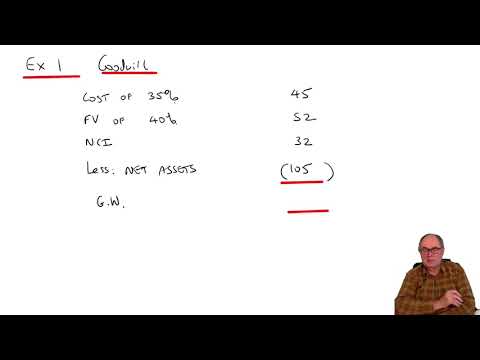
Template on video 10:50 is misleading. If you take notes for yourself, please be mindful:
cost of new investment 35% 45 value @step date
FV of existing stake 40% 52 value @step date
NCI 32 value @step date
Net Assets of S (105) value @step date
resulting G/W 24
CV (value @ acquisition) of old stake is only used calculating difference sent to PL and not in the above
K
Katlego·
Just to correct a mistake. At 10'37", it is in fact the FV that is put in the goodwill calculation, not the CA. The tutor made an error there.
S
Sameer·
Well found! Thanks!
T
Tuan Anh·
Good morning Sir,
In example 2, what should we calculate if A only purchase additional 15% of B with amount of for example 60?
R
Raymond·
Hi,
For the (W) Goodwill explanation, shouldn't it be "NCI at date of additional investment" instead?
Thanks.
D
dazzah666·
In Ex1 - in reality would the investment not have been revalued annually in the years preceding gaining control? So some of the 12m profit would have been realised in prior years and the book value therefore may not be the 40m initial investment?
W
wgk·
Then I suspect that the value of the original investment would be in the books at $52m and therefore nothing would need to be processed through profit or loss!!! Just an idea!!!
W
wgk·
Also take note of the comments in the video (Changes in group structure – step acquisition) between 16:13-16:30 ref. the difference between carrying amount and fair value. That's why it may be better to view this as "revaluation" rather than "disposal" - see video between 09:11-09:21 where he makes reference about some people prefer to view it as a revaluation rather than a disposal!!!
W
wgk·
10:33 - 10:40 on video
Should the arrow start at the FV and not the CA!?
A
andrerahming·
Just came to ask this same question. But yes I think so.
W
wgk·
Agree @andrerahming
J
Jonathan·
HI, thank you for the videos.
I have a simple question, but always gets me confused, especially if it comes to the exam.
What should we consider if the % of shares that we have is exactly 50% ; Is it treating as an associate because we dont have majority, or still it goes as subsidiary as we have equal control (unless this is treated as significant influence).
And same thing when we have 20% exactly. Associate or simply investment.
Thank you
F
Faeq Quadri·
Don't know how relevant this response will be since I am 6 months late, but if we have EXACTLY 50%, we consider it to be a subsidiary, and if it is 20%- 49%, we consider it to be an associate.
W
wgk·
Also I suggest a re-read chapter 3 of opentuition notes - especially section 1 and section 2, And listen to the accompanying video. Basically it is all about "power to direct" or "significant influence" - and that does not necessarily mean attaining 50% or > 50% as in the case of a subsidiary OR attaining between 20-49% as in the case of an associate. Example 1 (pp 12 of opentuition notes) is very simple but clearly demonstrates the issue of "significant influence".
W
wgk·
Also take note of the comments in the video (Changes in group structure - step acquisition) between 12:40-13:13 ref. associate vs normal investment!!


Thank you so much for the lectures!
I really enjoy your teaching style – you always explain things in such an easy-to-understand way and the way you connect the terminology to real-life examples makes it so much clearer. Your sense of humor also makes the class fun and engaging, which helps me stay focused. I really appreciate the effort you put into your lectures. Wishing you all the best and may you always be blessed!
cost of new investment 35% 45 value @step date
FV of existing stake 40% 52 value @step date
NCI 32 value @step date
Net Assets of S (105) value @step date
resulting G/W 24
CV (value @ acquisition) of old stake is only used calculating difference sent to PL and not in the above
In example 2, what should we calculate if A only purchase additional 15% of B with amount of for example 60?
For the (W) Goodwill explanation, shouldn't it be "NCI at date of additional investment" instead?
Thanks.
Should the arrow start at the FV and not the CA!?
I have a simple question, but always gets me confused, especially if it comes to the exam.
What should we consider if the % of shares that we have is exactly 50% ; Is it treating as an associate because we dont have majority, or still it goes as subsidiary as we have equal control (unless this is treated as significant influence).
And same thing when we have 20% exactly. Associate or simply investment.
Thank you