Quantitative analysis in budgeting - Learning curves part 1 - ACCA Performance Management (PM)
YouTube video
58 Comments
Z
zachary1982·
Just to be devil's advocate John, at the end of this video you say that it is labour who learns, machines don't learn. Well in this AI world that we are living in now, the machines are learning faster than the human labour.
J
John MoffatTutor·
Maybe computers, but not the machines used in manufacturing :-)
A
Aasif·
Sir..you are one of the best tutors I have come across who takes so much pain to make a concept understood on an online platform even when there is no one to ask you their doubts during the session and still you make it a point to dive into the basics of the concepts. God bless you Sir.
J
John MoffatTutor·
Thank you very much for your comment :-)
A
Abubukr·
Hi,
when multiplying 30x90.08 I got 2702.4 on both the calculator and phone how did you get 270.24 can you please explain?
A
Abubukr·
Hi, OK I just saw the correction I was a bit rashy!
D
Divij·
Hello Mr John,
I think there has been a slight error in example 3 on your part. You mistook 90.08 as 90.80 for calculating the total time for 29 units.
Kindly correct me if I am mistaken.
J
John MoffatTutor·
No, it is correct.
90.08 is the average time per unit when making 30 units. 90.80 is the time per unit when making 29 units.
D
Divij·
Got it, thanks a lot.
J
John MoffatTutor·
Great :-)
N
Nichola·
John, This is brilliant, you are brilliant!! Far better than the BPP text books. Thank you so much. I can't really donate now because I am currently without funds but I PROMISE, once I qualify I will send you a substantial donation. I'm not sure why you do this but you are helping me change my life! Thank you!! XX
J
John MoffatTutor·
Thank you for your comment :-)
F
Fez·
Me too! I've planned it all, once I qualify or land a job, I'm definitely gonna donate to them, They are Awesome!
K
Kamran·
Sir, while resolving part b of example 3, we calculated the avg. time for 29 units then we calculated avg. time for 30 units then subtracted avg. 30 minus avg. 29 to get the avg. time of 30th unit. However, the final answer derived was the avg. time of 30th unit not the exact time of 30th unit. So we we could not consider the avg. time of 30th unit from the earlier formula where we calculated the avg. time for 30 units.
J
John MoffatTutor·
That is not the case.
The formula gives us the average time per unit for any number of units. From that we can calculate the total time taken to make 29 units and the total time taken to make 30 units. The difference between the two must be the time taken to make the 30th unit - it is not an average time at all.
M
Mokshh·
I got calculator fx-83gt plus and there is no x with power y button.
J
John MoffatTutor·
Well either you need to buy a new calculator or you need to get used to using the calculator that is built-in to the exam software.
H
Hermela·
sir why we use the 8th unit product for all 8 units hours to get the seventh average hour
J
John MoffatTutor·
We don't. We use the average time per unit if we make 8 units to get the total time for 8 units. We subtract the total time for 7 units in other to get the time for the 8th unit.
J
JojoBeat·
Hey Sir,
I’ve seen in several answer schemes that used the cost of the first unit for a and even stated in the formula sheet that a=cost of first unit instead of time taken for first unit. Which one should I follow in the exam?
J
John MoffatTutor·
Either - using the time for the first unit gives you the time (and if you need the cost then multiply by the cost per hour).
J
JojoBeat·
It doesn’t make any sense, we are finding the average time per unit so why would we put the cost inside for a?
J
John MoffatTutor·
If you put in the cost for the first unit then the formula gives you the average cost.
If you put in the time for the first unit then the formula gives you the average time.
Which you do depends on what the question asks for.
Multiplying the average time by the cost per hour obviously also gives you the average cost.
It makes perfect sense!!
S
shakir7385·
Dear John,
- In example 2, why did we substracted the time taken by first unit to drive the time taken by 7 units? Since the first unit took maximum time because of no learning curve at this stage and the remaining 7 units were having learning curve. I may missed to capture this thing if covered in your lecture. Would appreciate if you can let me understand this.
J
John MoffatTutor·
It is covered in the lectures and is very important for the exam.
The learning curve does not tell the time for any unit directly. It gives the average time per unit for any number of units.
So we have to calculate the average time per unit if we make 8 units. For this we can calculate the total time to make 8 units. Since we know how long the first of the 8 units took, then the time for the next 7 units is the difference.
S
sleepybird·
Good day Mr John
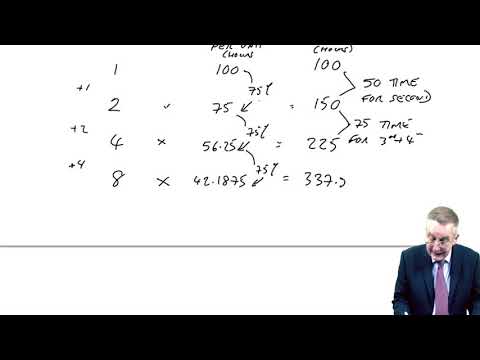
This may seem like a silly question but I don’t know how you got 150 hours for 2 units and 225 for 4 units.
S
sleepybird·
Ooh, you multiplied it.
J
John MoffatTutor·
Yes :-)
J
John MoffatTutor·
Yes - small rounding differences are not relevant :-)
V
Vidhi·
Thnakyou for quick response
J
John MoffatTutor·
You are welcome :-)
V
Vidhi·
Thank you John for this lecture, i have a question with regards to finding log in exams for CBE format exam. Is there a way how can we find log on excel (i believe they have limited excel formulas to an extent)
Are we also allowed scientific calculators in CBE exam? Please guide
J
John MoffatTutor·
The spreadsheet in the exam is not Excel. It is similar but does not have built in formulae. You are allowed to have a scientific calculator in the exam (and you need one).
I
Ibrahim·
Another question,
What is the difference between cumulative average hours per unit which equal to 90.08 hrs and average time for 30th 69.20 hrs.
Could you make it clear plz.
J
John MoffatTutor·
The first batch takes 200 hours. Each extra batch takes less and less time and the 30th batch only takes 69.20 hours.
90.08 hours is the average time per batch for all the batches made, which will therefore be somewhere between 200 and 69.20.
I
Ibrahim·
Thank you sir, thank you so much.
V
Victoria·
Hello!
My question regarding budgeting of time for a new product (Ex2 in this lecture).
We know about canceled of learning factor from 30th unit and calculated the number of hours which should be appear in the production plan for total number of unit.
However, we know that first 29th of unit will take more time.
Should I present it in my budget?
For example, I asked calculated the total production time for 1000 of unit in this example.
My calculation would be 1000*69.20 or (1000-29)*69.2+29*90.8?
Thanks in advance!
Best regards,
Victoria
I
Ibrahim·
Hello John sir,
How are you?
I hope you are doing well,
For the example 3 part (b) you got the average time per unit number 30 by getting the cumulative average total time for 30 units and subtract the cumulative average total time for 29 unit which equal to 69.20 hrs.
My question is I used the doubling method, I calculated the cumulative average total hours for 32 units and also I calculated the time spent for the most recent units I mean for the most recent 16 units (from 17 to 32) which equal 1169.294 and I divided on 16 unit to get the average time spent on unit number 30 but the result comes different I got 73.1 hrs.
So what is the mistake that I have already done?
J
John MoffatTutor·
Each batch they make takes less time. So the 17th will be faster than the 16th, the 18th will be faster than the 17th, and so on.
We need to know how long the 30th batch will take, which is bound to be less time than the average of the 16th to 30th times.
I
Ibrahim·
I got you,Thank you sir, thank you so much.
I
Ibrahim·
Hello John sir,
Thank you so much for your informative lecture.
J
John MoffatTutor·
Thank you for your comment :-)
S
SP·
Hi John,
As we'd be doing most of the workings on the spreadsheet provided, wouldn't it be easier to calculate x to the power y on the spreadsheet instead of using a calculator?
In this example, we'd simply type out "=30^-0.2345" on the spreadsheet and hit enter.
Thanks.
V
Vidhi·
But how do we find log on spreadsheet??
J
John MoffatTutor·
You don't with the spreadsheet in the exam. You need a scientific calculator.
A
adch111·
I just thought it would be useful to point out that when we use the doubling method we can multiply a by our rate to the power required. Using the example given we would get 200x0.85^4 = 104.40.
F
Felistus·
hi John
How do i know when i should apply the y=axb formula or the doubling formula
J
John MoffatTutor·
You can always use the formula, but if it does involve doubling then it is easier to use the doubling rule. The question will not tell you which approach to use - that is up to you to check (and it should be obvious always if it involved doubling).
The exception is when the question asks you to calculate the learning rate. That will always be using the doubling rule - you cannot be asked to use the formula 'backwards' :-)
F
Francisco·
Dear John!
Part A, example 3. Doubling Rule gives 1470.42 as the time for the next 15 batches. However, if i use the formula I get 15 X 105.99 = 1589.89. What am I missing / doing wrong here?
J
John MoffatTutor·
The formula just gives you the average time per batch. So you still have to calculate the average time per batch for 16 batches, then multiply by 16 to get the total time for 16 batches, and then subtract the time for the first batch (so as to end up with the time for 15 batches).
(The answer might still end up being slightly different, but that will then be simply due to rounding.)
F
Francisco·
Thank you, I got confused with part B of the example 3 where we use the formula for 30 and 29 batches and the subtract one result to the other. But I guess it has to do with the fact that the learning curve cease at the 30th. Am I right?
J
John MoffatTutor·
Yes (although only because we need the time for the 30th batch, because that is the time for all future batches).
Whether using the doubling rule or using the formula, that only gives us the total time for the total number of batches. For any others (whether it be like part (a) or like part (b)) we need the difference between the two total times.
D
Darcie·
Hello! I wasn't 100% sure if I should ask this in the forum or on the lecture notes so I apologise in advance!
In regards to the learning rate, can we just learn the doubling rule or would we be expected to learn the learning rate formula to calculate additional time for nth unit, which in the BPP text is shown as;
=(n x t2) - [n-1) x t1]
cumulative average time for first (n-1) units = t1
total time for first (n-1) units = (n-1) x t1
cumulative average time for first n units = t2
total time for first n units = n x t2
Hopefully this makes sense!
Thank you.
J
John MoffatTutor·
If you have watched all my lectures on this, then you will know that you need to know how to use both the doubling rule and the formula given on the formula sheet.
The formula you quote from BPP is not something to learn because if you understand what I explain in the lectures, then it is obvious - it is silly to learn formula for the sake of learning. Most of the exam is testing that you understand what is happening - not that you have learned formulae - which is why only 50% of the exam involves calculations.
A
alie2018·
Thanks John.
A
alie2018·
The most important thing to know is when to apply the formula and when not to, depending on the prevailing circumstances.
D
Duljan·
Very nice lecture and very helpful.
As time total per unit, we can rearrange formula y=ax^(b+1). When "y" is total time hours not average time per unit!
J
John MoffatTutor·
You can, but do not simply learn formula - the examiner is clever at testing your understanding :-)


when multiplying 30x90.08 I got 2702.4 on both the calculator and phone how did you get 270.24 can you please explain?
I think there has been a slight error in example 3 on your part. You mistook 90.08 as 90.80 for calculating the total time for 29 units.
Kindly correct me if I am mistaken.
90.08 is the average time per unit when making 30 units. 90.80 is the time per unit when making 29 units.
The formula gives us the average time per unit for any number of units. From that we can calculate the total time taken to make 29 units and the total time taken to make 30 units. The difference between the two must be the time taken to make the 30th unit - it is not an average time at all.
I’ve seen in several answer schemes that used the cost of the first unit for a and even stated in the formula sheet that a=cost of first unit instead of time taken for first unit. Which one should I follow in the exam?
If you put in the time for the first unit then the formula gives you the average time.
Which you do depends on what the question asks for.
Multiplying the average time by the cost per hour obviously also gives you the average cost.
It makes perfect sense!!
- In example 2, why did we substracted the time taken by first unit to drive the time taken by 7 units? Since the first unit took maximum time because of no learning curve at this stage and the remaining 7 units were having learning curve. I may missed to capture this thing if covered in your lecture. Would appreciate if you can let me understand this.
The learning curve does not tell the time for any unit directly. It gives the average time per unit for any number of units.
So we have to calculate the average time per unit if we make 8 units. For this we can calculate the total time to make 8 units. Since we know how long the first of the 8 units took, then the time for the next 7 units is the difference.
This may seem like a silly question but I don’t know how you got 150 hours for 2 units and 225 for 4 units.
Are we also allowed scientific calculators in CBE exam? Please guide
What is the difference between cumulative average hours per unit which equal to 90.08 hrs and average time for 30th 69.20 hrs.
Could you make it clear plz.
90.08 hours is the average time per batch for all the batches made, which will therefore be somewhere between 200 and 69.20.
My question regarding budgeting of time for a new product (Ex2 in this lecture).
We know about canceled of learning factor from 30th unit and calculated the number of hours which should be appear in the production plan for total number of unit.
However, we know that first 29th of unit will take more time.
Should I present it in my budget?
For example, I asked calculated the total production time for 1000 of unit in this example.
My calculation would be 1000*69.20 or (1000-29)*69.2+29*90.8?
Thanks in advance!
Best regards,
Victoria
How are you?
I hope you are doing well,
For the example 3 part (b) you got the average time per unit number 30 by getting the cumulative average total time for 30 units and subtract the cumulative average total time for 29 unit which equal to 69.20 hrs.
My question is I used the doubling method, I calculated the cumulative average total hours for 32 units and also I calculated the time spent for the most recent units I mean for the most recent 16 units (from 17 to 32) which equal 1169.294 and I divided on 16 unit to get the average time spent on unit number 30 but the result comes different I got 73.1 hrs.
So what is the mistake that I have already done?
We need to know how long the 30th batch will take, which is bound to be less time than the average of the 16th to 30th times.
Thank you so much for your informative lecture.
As we'd be doing most of the workings on the spreadsheet provided, wouldn't it be easier to calculate x to the power y on the spreadsheet instead of using a calculator?
In this example, we'd simply type out "=30^-0.2345" on the spreadsheet and hit enter.
Thanks.
How do i know when i should apply the y=axb formula or the doubling formula
The exception is when the question asks you to calculate the learning rate. That will always be using the doubling rule - you cannot be asked to use the formula 'backwards' :-)
Part A, example 3. Doubling Rule gives 1470.42 as the time for the next 15 batches. However, if i use the formula I get 15 X 105.99 = 1589.89. What am I missing / doing wrong here?
(The answer might still end up being slightly different, but that will then be simply due to rounding.)
Whether using the doubling rule or using the formula, that only gives us the total time for the total number of batches. For any others (whether it be like part (a) or like part (b)) we need the difference between the two total times.
In regards to the learning rate, can we just learn the doubling rule or would we be expected to learn the learning rate formula to calculate additional time for nth unit, which in the BPP text is shown as;
=(n x t2) - [n-1) x t1]
cumulative average time for first (n-1) units = t1
total time for first (n-1) units = (n-1) x t1
cumulative average time for first n units = t2
total time for first n units = n x t2
Hopefully this makes sense!
Thank you.
The formula you quote from BPP is not something to learn because if you understand what I explain in the lectures, then it is obvious - it is silly to learn formula for the sake of learning. Most of the exam is testing that you understand what is happening - not that you have learned formulae - which is why only 50% of the exam involves calculations.
As time total per unit, we can rearrange formula y=ax^(b+1). When "y" is total time hours not average time per unit!