Risk and uncertainty (part 1) - ACCA (AFM) lectures
YouTube video
21 Comments
J
Jatin·
Hello Sir!
I have a question related to Sensitivity Analysis regarding what needs to be done when the values change each year. Will the calculation increase in this case?
Thanks in Advance!
J
John MoffatTutor·
We can only deal with the situation when all of the relevant values change by the same % (even if the individual amounts are currently different from each other).
A
afnananesee·
Hi sir, may i ask why the contribution per unit is based on the total contribution, and not the current contribution per unit?
A
alastairk·
Hi,
Re Sensitivity Analysis for sales volume would it not be the %change in No of units we should use?
Taking the contribution p.u. and dividing by NPV gives no of units as 1937 which would give sensitivity of 1937/15000= -12,9%?
Thanks
J
John MoffatTutor·
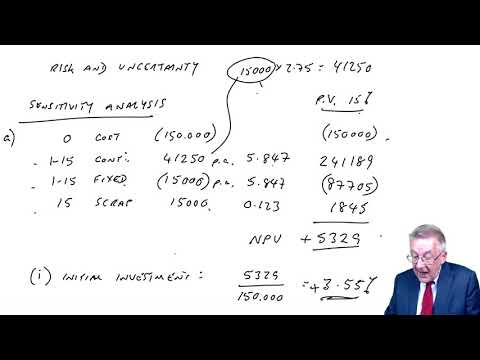
It certainly is the % change in the number of units. However what you want to do is not logical. If the number of units were to fall by 12.9% then the contribution each year would fall by 12.9% and therefore the PV of the contribution for 15 years would fall by 12.9% as well, which would be a fall of much more than the NPV.
D
Dean·
Speaking of sensitivity, are the sales volume p.a, and the contribution p.u. the same because of they are directly related with the sales?
J
John MoffatTutor·
No (because sales price itself is related but the sensitivity of sales price will be different).
It is because both sales volume and contribution effect the cash flows in the same way.
A
Ant.·
Hi Sir,
Great Lecture. Can you please help me understand how you define the sensitivity changing percentage as negative or positive? Thanks.
J
John MoffatTutor·
If the flow would need to increase in order to arrive at an NPV of zero then the sensitivity is positive.
If the flow would need to decrease in order to arrive at an NPV of zero then the sensitivity is negative.
A
Anon·
Hi Sir, so in continuation to this question-- am I correct to assume that if it's the sensitivity analysis of a cost or expense it's positive and it's vice versa for inflows?
Thank you for your efforts sir. Wonderful lecture!
J
John MoffatTutor·
If the NPV is positive at the moment (which it almost certainly will be in questions) then what you have written is correct :-)
D
Disha N·
Hello John,
I have a question in the BPP revision kit question 16 Arbore. The requirement is to calculate the sensitivity of the selling price. My first question is why was the PV of the investment has been divided by the annuity? Secondly, why has this figure been added to the cost if we are looking for the selling price sensitivity. Lastly, in the BPP kit there is a similar requirement for question 13, which is Fernhust, the calculation however was based on the usual NPV of Project/NPV of Sales Revenue. I am not sure why there is the difference in calculation. Thank you so much.
J
John MoffatTutor·
The sensitivity is the % change for the NPV to be equal to zero.
For the NPV is zero then the PV of the revenue must be equal to the PV of the costs, therefore the PV of the revenue must equal 4,717,000.
If the revenue for an NPV of zero was equal to X, then the PV of X per year for years 4-15 is equal to X (7.191 x (1/1.11)^3) and this is equal to 4,717,000.
M
mayjeng23·
Hi sir, I am not really sure about the fixed overheads per year. The question states that it increase by $140,000 per year, but what is the possible explanation of just taking the annuity value of $140,000 instead of increasing year by year?
J
John MoffatTutor·
You are misreading.
Suppose you are currently paid 10,000 per year. Suppose I tell you today that I will increase your pay by 2,000 a year. I think you would expect that you will now be paid 12,000 a year.
I do not think that you will expect me to pay you 12,000 next year and then 14,000 the year after and so on :-)
(Maybe I will increase your pay next year, but maybe I won't - from now on you will be paid 12,000 a year until I say differently :-) )
M
mayjeng23·
Thank you sir! I think I got it! there is a difference between increase per year and increasing every year. Thanks. :)
B
Belinda·
This explanation is Very helpful. I was confused by this part when I was going through the question, I tot the FOH would be
1st yr: $140k
2nd yr: $280k
3rd yr :$420k
4th yr: $560k
Thank you for clarification.
J
John MoffatTutor·
I hope it is now clear :-)
J
Jocelyn·
Dear John, thank you for the explanation!! I'm also wondering how would the wording be if it is the case that 1st year OH is 14k, 2nd's is 28k and 3rd year is 42k..?
G
gumeden·
Thank you very much for the lecture. Just a question pls. The question asks us on the sensitivity p.a . Why are we using the figures based on the fifteen years and not annual figure
J
John MoffatTutor·
If the annual figure changes then it will change for every year and therefore the present value of all 15 years will change.


I have a question related to Sensitivity Analysis regarding what needs to be done when the values change each year. Will the calculation increase in this case?
Thanks in Advance!
Re Sensitivity Analysis for sales volume would it not be the %change in No of units we should use?
Taking the contribution p.u. and dividing by NPV gives no of units as 1937 which would give sensitivity of 1937/15000= -12,9%?
Thanks
It is because both sales volume and contribution effect the cash flows in the same way.
Great Lecture. Can you please help me understand how you define the sensitivity changing percentage as negative or positive? Thanks.
If the flow would need to decrease in order to arrive at an NPV of zero then the sensitivity is negative.
Thank you for your efforts sir. Wonderful lecture!
I have a question in the BPP revision kit question 16 Arbore. The requirement is to calculate the sensitivity of the selling price. My first question is why was the PV of the investment has been divided by the annuity? Secondly, why has this figure been added to the cost if we are looking for the selling price sensitivity. Lastly, in the BPP kit there is a similar requirement for question 13, which is Fernhust, the calculation however was based on the usual NPV of Project/NPV of Sales Revenue. I am not sure why there is the difference in calculation. Thank you so much.
For the NPV is zero then the PV of the revenue must be equal to the PV of the costs, therefore the PV of the revenue must equal 4,717,000.
If the revenue for an NPV of zero was equal to X, then the PV of X per year for years 4-15 is equal to X (7.191 x (1/1.11)^3) and this is equal to 4,717,000.
Suppose you are currently paid 10,000 per year. Suppose I tell you today that I will increase your pay by 2,000 a year. I think you would expect that you will now be paid 12,000 a year.
I do not think that you will expect me to pay you 12,000 next year and then 14,000 the year after and so on :-)
(Maybe I will increase your pay next year, but maybe I won't - from now on you will be paid 12,000 a year until I say differently :-) )
1st yr: $140k
2nd yr: $280k
3rd yr :$420k
4th yr: $560k
Thank you for clarification.