I'm not sure why we took the pains to make an assumption about what the contribution could be at the beginning and went on to discuss how the gradient of the line is affected by the 2 variables because while it's true that the angle depends on those two variables, their sum total also has a bearing on the gradient of the line. That's to say, s+2e =3, isn't the same as s+2e=4, that their gradients cannot be the same. Can you help me understand why we made that assumption please. Thanks
K
Keaobaka Martha Thebe·
Not to worry. I went back to the lecture and reflected back on my high school Math and realized how wrong I was! It helps to review these lessons
J
John MoffatTutor·
No - the total has no bearing at all on the gradient/angle of the line. It is not an assumption at all but is a fact.
The only difference is that if the total is 4 then the line will be further away from the origin than if the total is 3.
Get some graph paper and draw the lines yourself. You will see that they are parallel to each other, and will be parallel whatever the total is.
J
Jenishca·
This was really interesting and it is how the math works out that's such a wow. Thank you...
J
John MoffatTutor·
You are welcome :-)
Z
Zolzaya·
Thanks very much for a very clear explanation! :)
B
bineeshaleyas·
Hi, we had the equation of 5S+6E= 180 and 2S+4E=80 right at the beginning itself so we could have used this to solve via the simultaneous equation route. So I am bit confused that why did we draw the graph when we had this equation right at the beginning please ? Thanks
J
jasminetomz·
Thank you so very much i now have a clearer view of linear programming.


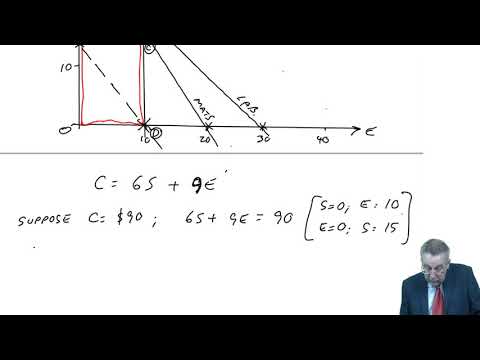
The only difference is that if the total is 4 then the line will be further away from the origin than if the total is 3.
Get some graph paper and draw the lines yourself. You will see that they are parallel to each other, and will be parallel whatever the total is.