
APM
Discounted Cash Flow Techniques - ACCA Advanced Performance Management (APM)

You have studied investment appraisal previously so most of this chapter will be revision for you. Of the few new items in this chapter, the most important is Modified Internal Rate of Return and you should make sure that you learn the technique involved.
YouTube video
Net present value calculations
Here is a list of the main points to remember when performing a net present value calculation. After we will look at a full example containing all the points.
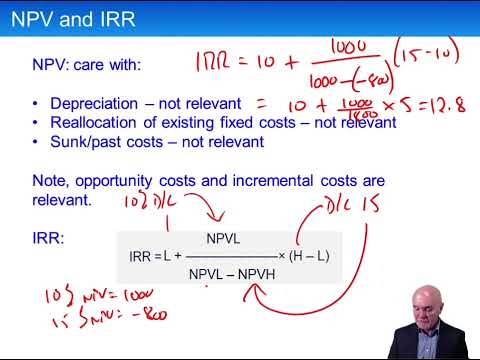
- Remember it is cash flows that you are considering, and only cash flows. Non-cash items (such as depreciation) are irrelevant.
It is only future cash flows that you are interested in. Any amounts already spent (such as market research already done) are sunk costs and are irrelevant. - There is very likely to be inflation in the question, in which case the cash flows should be adjusted in your schedule in order to calculate the actual expected cash flows. The actual cash flows should be discounted at the actual cost of capital (the money, or nominal rate). (Note: alternatively, it is possible to discount the cash flows ignoring inflation at the cost of capital ignoring inflation (the real rate). We will remind you of this later in this chapter, but it is much less likely to be relevant in the examination.)
- There is also very likely to be taxation in the question. Tax is a cash flow and needs bringing into your schedule. It is usually easier to deal with tax in two stages – to calculate the tax payable on the operating cash flows (ignoring capital allowances) and then to calculate separately the tax saving on the capital allowances.
- You are often told that cash is needed to finance additional working capital necessary for the project. These are cash flows in your schedule, but they have no tax effects and, unless told otherwise, you assume that the total cash paid out is received back at the end of the project.
Thank you
1. How is 200k fixed costs accounted for? I cannot see them included, so this would reduce the NPV ?
2. How is 3 square root 1.3 calculated to 0.09. I tried using ACCA calculators and mine to no avail...
Thanks again!
Is this still relevant for March 2020 sitting?
You are often told that cash is needed to finance additional working capital necessary
for the project. These are cash flows in your schedule, but they have no tax effects and,
unless told otherwise, you assume that the total cash paid out is received back at the
end of the project.
Thank you
Balancing chrge is 1000 -570 = 430
Tax on this = 0.25 x 430 = 107
Please can you advise on how you reached the "tax on saving on capital allowance" in example 1?
When I calculate it I get the following (y1 and y2 only for illustrative purposes):
y1: 200,000 x 25% (allowance) = 50,000 x 25% (tax rate) = 12,500
y2: 150,000 x 25% (allowance) = 37,500 x 25% (tax rate) = 9,375
Please assist.
Thanks!
y1: 1,800,000 x 25% = 450,000 x 25% = 112,500 allowance
y2: 1,350,000 x 25% = 337,500 x 25% = 84,375 allowance
Hope it helps anyone else.