
APM
Learning Curves - ACCA Advanced Performance Management (APM)

You have been examined on learning curves previously. Although they are a little less likely in this examination, they are still relevant and this chapter is included as revision – there is nothing new to learn.
Learning
In most budgeting techniques we assume that the total variable cost is reasonably linear – that the variable cost per unit is fixed.
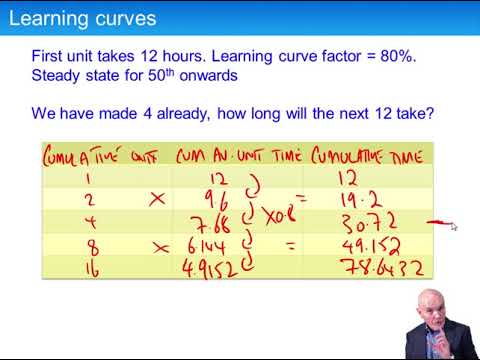
In the case of labour, this is very often not the case in the early stages of a new product. If we were intending to start production of a new product, then the obvious thing to do would be to produce a prototype in order to assess how long it would take to produce each unit. However, this would be dangerous because as we were to produce more and more units it is likely that the time taken for each unit would reduce as the workers gained experience. This reduction in time per unit is known as the learning effect.
However, I have wondered for some time if we should take the plunge and drop it from our material as it is a long time since it was examined. I think it would be safe simply to know the concept (ie budgets and planning will not be accurate if learning is ignored) without being able to perform the tricky calculations.
Tutors tend to monitor the Ask the Tutor Forums and they are more reliable places to post any questions you have.
I know the OT team update notes and lectures with syllabus changes, but is this topic still valid. Last examined in June 2006 (I think) and couldn't see it in the latest APM syllabus (have to admit did skim through and used the key words search on the pdf document).
It is a brief topic but would rather ignore if something that is no longer part of the APM.
Stay safe!
Thanks,
Zakariya
50 x^y ( 0.8 log / 2 log ) * 12
x^y = that funny x to the power y button
hope that helps
you have to use both (numerator and denominator ) base as same number if you use ES series calculator.
fx- 991Ms calculator just use Log (base 10 ) or Ln (base e ) .please refer below.
log 2 base 10=0.3010
don't enter 2 as base.
Conditions:
There must be consistency in the workforce.
Cessation Of Learning Effect
When machine efficiency restricts any further improvement
Physical processes (e.g. drying).
Kind Regards
Cessation of learning effect means you cant get any better because of a factor in your process. Examples given are machine efficiency. if the machine is running flat out you cant make any further improvements.
hope that helps
But! "log" means 10-base logarithm, while the numbers (and the logic) shows 2 base logarithm, what should be indicated with "ln" am i not right?
I have seen the same error in the Kaplan textbook too by the way. It can be a bit confusing, if somebody start to use "log" function instead of "ln" on the calculator when tries to solve a question.